The Babylonian Empire 606-536 BC

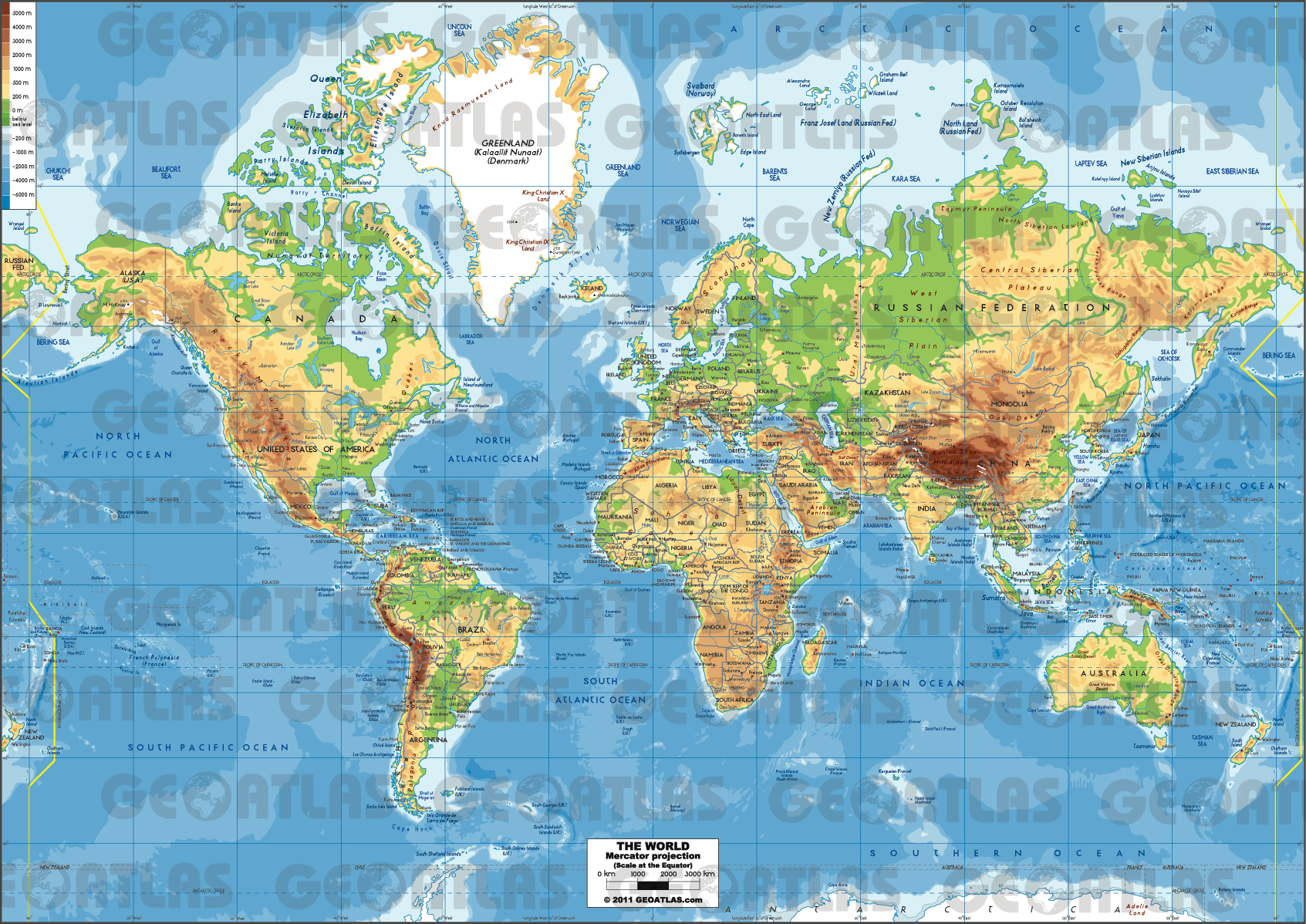
Located in The Tigris-Euphrates Valley, Babylon has been referred to as “the cradle of the human race” for a good reason – the Garden of Eden was located somewhere in it.

The Old Babylonian Kingdom was at its peak at about the time of God’s calling of Abraham, who was from Ur of the Chaldees.

However, after many centuries of conflict, the old Babylon Empire eventually became subject to the Assyrians, from about 885 to 607 B.C. It was during that period that the Assyrians conquered and took into captivity the northern kingdom of Israel, from which the “Lost Ten Tribes” never returned.

Babylon was divided into Accad to the north, and Summer (“Shinar” of the Old Testament) to the south. Along with Ur and the city of Babylon itself, other major cities were Uruk, or Erech (Genesis 10:10), Larsa, or Ellasar (Genesis 14:1), Sepharvaim (2 Kings 17:24), Eridu, and Calneh (Genesis 10:10).

The New Babylonian Empire, which existed from 606 to 536 B.C., fully conquered the southern kingdom of Judah in 586 B.C. It was then that the Babylonians under the rule of King Nebuchadnezzar completely devastated the city of Jerusalem, looted and burned the original Temple of God, built by Solomon and carried the people of Judah, including the prophets Daniel and Ezekiel, off into captivity.

In 536 B.C., after 70 years of supremacy, the Babylonian empire, the “head of gold” in Daniel’s Statue, came to an end when it fell to the Persians. A future Babylon is referred to in the Book of Revelation and has many prophetic applications that have yet to be completed (Revelation 18:1-24).

The Babylonian Empire


The Babylonian Empire was a civilization of Babylonians in Lower Mesopotamia (central and southern Iraq), with Babylon as its capital. The Persian Empire later grew near the Babylonians region.

Babylonia emerged when Hammurabi (1696 – 1654 BC) created an empire out of the territories of the former kingdoms of Sumer and Akkad.

The Amorites being a Semitic people, Babylonia adopted the written Semitic Akkadian language for official use, and retained the Sumerian language for religious use, which by that time was no longer a spoken language. The Akkadian and Sumerian cultures played a major role in later Babylonians culture, and the region would remain an important cultural center, even under outside rule.

The earliest mention of Babylonians in the city of Babylon can be found in a tablet from the reign of Sargon of Akkad, dating back to the 20th century BC. Following the collapse of the last Sumerian “Ur-III” dynasty at the hands of the Elamites (2002 BC traditional, 1940 BC), the Amorites gained control over most of Mesopotamia, where they formed a series of small kingdoms.

During the first centuries of what is called the “Amorite period”, the most powerful city states were Isin and Larsa, although Shamshi-Adad I came close to uniting the more northern regions around Assur and Mari. One of these Amorite dynasties was established in the city-state of Babylon, which would ultimately take over the others and form the first Babylonian empire, during what is also called the Old Babylonian Period.

Finishing the Race

The Lord said to me, “My grace is sufficient for you, for my power is made perfect in weakness.”

Therefore I will boast all the more gladly about my weaknesses, so that Christ’s power may rest on me. 

2 Corinthians 12:9

Derek Redmond was favored to win the 400 meter race in the 1992 Barcelona Olympics.  Halfway into his semi-final heat, he suffered a torn hamstring.  Even as the medical team was approaching, he pushed away to finish the race.  A big man pushed through the crowd.

“You don’t have to do this,” he told his weeping son.
“Yes, I do.”  Derek declared.
“Well, then,” he said, “we’re going to finish this together.”

And they did!  His dad wrapped Derek’s arm around his shoulder and helped him hobble to the finish line.

What made him do it?  His son was hurt so the father came to help him finish.

God does the same.

Our attempts may be feeble.

Our prayers may seem awkward.

But He comes to help us finish the race!

~ Max Lucado

‘Passion of the Christ’ star Jim Caviezel says playing Jesus sunk his career

Despite a long list of woes that include being labeled an anti-Semite, having a violent temper and allegedly breaking the teeth of the mother of his youngest child—Mel Gibson has a friend in Jesus—or, at least the actor who played him in 2004’s “Passion of the Christ.”

“Mel Gibson, he’s a horrible sinner, isn’t he?” Jim Caviezel asked members of the First Baptist Church of Orlando, FL during an appearance Saturday night. “Mel Gibson doesn’t need your judgment, he needs your prayers.”

Caviezel, 42, spoke at the 14,000-member church in a speech the local paper described as “giv(ing) witness to his faith, (urging) others to share it and to sell a new all-star audio production of the Bible that he has produced.”

The staunch Roman Catholic recalled when Gibson first offered him the role of Jesus, he warned that it could end his career.

“(Gibson) said, ‘You’ll never work in this town again,’” Caviezel explained. “I told him, ‘We all have to embrace our crosses.’”

During the 20-minute talk, Caviezel said he was “called” to be an actor, noting that it was no coincidence that “in my 33rd year, I was called to play Jesus.”

He even joked about his initials– J.C. –with Gibson during casting, which “freaked [the director] out a little.”

Caviezel said taking on the role of the Son of God limited his career, saying that he was “rejected in (his) own industry.”

“Jesus is as controversial now as he has ever been,” Caviezel said. “Not much has changed in 2,000 years.”

But Caviezel has no regrets, saying “We have to give up our names, our reputations, our lives to speak the truth,” and adding that he’ll get his reward in heaven.


Remembering the Holocaust: Never Again!

By Joel C. Rosenberg

Today in Israel, and around the world, we stop to remember the evil that was perpetrated during the Holocaust, pray for the survivors and their families, and recommit ourselves to the principle: Never Again.

“A two-minute siren sounded across the country at 10 am Thursday in memory of the six million Jews who perished in the Holocaust,” reports Ynet News. Israeli Prime Minister Benjamin Netanyahu delivered a moving address honoring Holocaust Remembrance Day, and applied its lessons to the current showdown with Iran. Israeli President Shimon Peres also discussed Iran today in light of the Holocaust. I commend these to your attention.

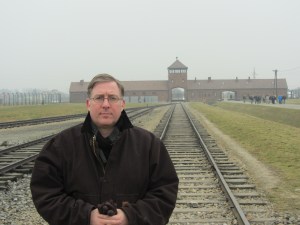
Last November, I had the opportunity to travel to Poland with two pastors and their wives to visit the Auschwitz-Birkenau death camps for the first time. My son, Caleb, and I produced a short video of that trip which might help you and your family and friends get a brief glimpse inside the tragedy and what it means.

Most of all, please pray for these survivors, that the Lord would draw them close to His heart and heal their memories and show them His amazing grace and mercy. As the Hebrew prophet Isaiah wrote, “How lovely on the mountains are the feet of him who brings good news, who announces peace and brings good news of happiness, who announces salvation, and says to Zion, ‘Your God reigns!’” (Isaiah 52:7)

Why we’re less likely to try great things for God

By Jon Walker

I can do everything through him who gives me strength.

Philippians 4:13 (NIV)

God pours his power into your life, giving you his strength to do what he’s called to do.

Faith is acting in confidence that God’s power is active in and through your life; faith is trusting God’s power will be your strength to do everything through him.

He’s not asking you to live life under your own power or through your own strength. That would limit what you can do while God’s power and strength are unlimited.

When you say, “There’s something I’d really like to do for God, but I don’t think that I can do it,” God may reply, “Great! I’m glad you’ve figured it out. You can’t do it by yourself, but with my power working through you, you can do anything I ask you to do.”

If you stay at “I can’t” and never move power to “God can,” then you’re less likely to even try great things for God. It’s like having a car with the most powerful engine ever built, but saying, “I don’t think it can get me past the first intersection.” So you leave it in your garage, never taking it onto the road.

God’s power is available to you: “For God is working in you, giving you the desire to obey him and the power to do what pleases him” (Philippians 2:13 NLT).

How do you explain God to an atheist?

We are needing guidance on this subject. We have a friend who is an atheist. We’ve explained what we know from the Bible, and from our own personal experience with our Lord and Savior, Jesus Christ. Because he has done much research and study on the subject of God, creation, the Bible, etc., he doesn’t feel God is real.

The oddity is that he is one of the most loving people we know. That seems to conflict with our thoughts, since we know that God is love, and all love comes from him.

Rather than go into all of the research we’ve done, we’re reaching out to you to give us insight and guidance. Any website addresses, Bible passages, or resources that you feel would be helpful would be greatly appreciated. Your prayers are needed as well as your personal support.

He is 87 years old, has been a professor in college, and is an avid reader.

Thanks so much.

THE FUTURE OF BABYLON | World Monuments Fund

THE FUTURE OF BABYLON | World Monuments Fund.

Another interesting website regarding the rebuilding of Babylon. Important information in relation to Prophecy.

Also read the following by Joel C. Rosenberg.

IRAQ REBUILDING ITS MILITARY, EVEN AS THEY REBUILD BABYLON: Prophetic significance?

Posted: April 13, 2012 in Uncategorized

Bible prophecy indicates that in the End Times, the nation we know today as the Republic of Iraq — known variously in Scripture as Babel, Babylon, Babylonia, Mesopotamia and Shinar — will emerge as the global center of wealth, power and terrible evil. Eventually Iraq will pose a direct and existential threat to the State of Israel, particularly during the Tribulation.

Since the fall of Saddam Hussein and his regime in 2003, Iraq has not been a regional threat, much less a danger to Israel. Some have assumed, therefore, that Iraq would no longer play a major role in Middle Eastern or global affairs in the future. But such a conclusion would be a mistake. As I wrote about in my first non-fiction book, Epicenter, those who read, understand and believe Bible prophecy have been watching for Iraq to: 1) begin rebuilding its offensive military capability; 2) begin rebuilding its economy; 3) continue rebuilding the ancient city of Babylon into a major center of commerce and tourism.

Interestingly, all three developments are currently underway.

IRAQ IS REBUILDING ITS MILITARY

Now that the Iraqi government has forced the American military out of their country, they have embarked on a dramatic arms build-up, including the purchase of American weapons systems that could be used for offensive purposes in the future. Examples:

  • The Iraqis are buying 140 state-of-the-art American M1A1 combat tanks. “The Government of Iraq has purchased 140 tanks from the United States, all of which have arrived in Iraq,” reports an Iraqi business website. “131 of those tanks are already in the possession of the Iraqi Army. The nine remaining tanks are in Iraq, but in U.S. possession.”
  • The Iraqis are buying 36 advanced American F-16 fighter jets. “Israel is monitoring Iraq’s rearmament program, particularly Bahgdad’s acquisition of 36 Lockheed Martin F-16s, with some disquiet amid intelligence reports Iran is consolidating its influence in Iraq following the U.S. military withdrawal,” reports UPI. “Baghdad ordered the F-16 Block 52 multi-role Fighting Falcon jets — enough to equip the Iraqi air force’s first two fighter squadrons — in two 18-plane batches in 2011 at an estimated total cost of $7 billion.”
  • In 2010, the Iraqis embarked on a $13 billion weapons spending spree. “Iraq is preparing to buy as much as $13 billion in American arms and military equipment, a huge order of tanks, ships and hardware that U.S. officials say shows Iraqi-U.S. military ties will be tight for years to come,” reported USA Today. “‘It helps to build their capabilities, first and foremost; and second, it builds our strategic relationship for the future,’ said Army Lt. Gen. Michael Barbero, the ranking U.S. officer responsible for training and advising Iraq forces.”

IRAQ IS REBUILDING ITS ECONOMY

Now that the war of liberation is over and most of Iraq has been pacified and stabilized from the terrorist insurgency, Iraq’s economy is not only growing but is poised for hyper-growth. Analysts expect Iraq’s GDP to grow by more than 9% annually for the next few years, and expect Iraq’s oil production to nearly triple by 2017.

  • “Iraq’s gross domestic product is expected to grow by an average rate of at least 9.4 percent annually between 2012 and 2016 as the oil-producing country benefits from larger windfalls in oil revenues, a senior central bank official said [in February],” reports Reuters. ”Iraq, which has the fourth-biggest oil reserves in the world, is currently producing around 2.9 million barrels per day (bpd). Iraq’s oil minister said last year he expected production to reach between 8-8.5 million bpd by 2017.”
  • Some analysts within the Iraqi Planning Ministry believe Iraq could reach a 47% growth rate by 2017, once the oil starts flowing fast and furious.
  • More and more major international companies are signing deals to do business in Iraq — see this intriguing list published by Reuters, published in December 2011.
  • In 2011, ExxonMobil — the world’s largest oil company — signed a major deal to help develop the oil industry in Iraq’s northern region of Kurdistan. Despite the fact being mired in some political controversy, the deal is likely to be fully ratified in the not-too-distant future.
  • Also in 2011, Royal Dutch Shell signed a $17 billion deal to help Iraq develop its enormous lucrative oil industry in its southern regions.
  • In 2010, the Iraqi government ratified four other major oil deals.

IRAQ IS REBUILDING THE CITY OF BABYLON

Largely overlooked by Westerners is the fact that the government of Iraq is moving forward with plans to protect the archaeological remains of the ancient City of Babylon, in preparation for building a modern city of Babylon. As I wrote in 2009, the project — originally started by the late Saddam Hussein — is aimed eventually at attracting scores of “cultural tourists” from all over the world to see the glories of Mesopotamia’s most famous city. What’s more, the Obama Administration has actually helped contribute U.S. taxpayer dollars to “The Future of Babylon Project” through the State Department’s budget. Read more at the World Monuments Fund website for the rebuilding Babylong project.

In 2011, I noted that the New York Times had published an intriguing article on Iraqi efforts to preserve, protect, restore and then rebuild the ancient city of Babylon and make it a draw for tourists, with U.S. taxpayer assistance. The Times reports that a modern Babylon museum will open later this month. Times’ reporter Steven Lee Myers also posted a fascinating four minute video walking through some of the rebuilt ruins of Babylon, and explaining Iraqi efforts to protect and restore numerous Biblical sites.

“The Babylon project is Iraq’s biggest and most ambitious by far, a reflection of the ancient city’s fame and its resonance in Iraq’s modern political and cultural heritage,” the Times reported, noting that “in November, the State Department announced a new $2 million grant to begin work to preserve the site’s most impressive surviving ruins. They include the foundation of the Ishtar Gate, built in the sixth century B.C. by Nebuchadnezzar’s father, Nabopolassar, and adorned with brick reliefs of the Babylonian gods Marduk and Adad.”

“The American reconstruction team has refurbished a modern museum on the site, as well as a model of the Ishtar Gate that for decades served as a visitors’ entrance. Inside the museum is one of the site’s most valuable relics: a glazed brick relief of a lion, one of 120 that once lined the processional way into the city. The museum, with three galleries, is scheduled to open this month, receiving its first visitors since 2003. And with new security installed, talks are under way to return ancient Babylonian artifacts from the National Museum in Baghdad. The fate of Babylon is already being disputed by Iraqi leaders, with antiquities officials clashing with local authorities over when to open it to visitors and how to exploit the site for tourism that, for the most part, remains a goal more than a reality. Even now they are clashing over whether the admission fee should go to the antiquities board or the provincial government.”

(Photo by New York Times: Iraqi women walking through the city of Babylon that is currently being rebuilt.)

Transformed By Grace

He hath made him to be sin for us . . .

that we might be made the righteousness of God . . .
–2 Corinthians 5:21

Augustine was one of the greatest theologians of all time. He was a wild, intemperate, immoral youth. In spite of his mother’s pleadings and prayers, he grew worse instead of better. But one day he had a personal encounter with Jesus Christ that transformed his life. His restlessness and the practice of sin disappeared. He became one of the great saints of all time.

John Newton was a slave trader on the west coast of Africa. One day in a storm at sea he met Jesus Christ. He went back to England and became an Anglican clergyman. He wrote scores of hymns, one of which has become the modern
popular song, “Amazing Grace.”

This is what Christ can do for anyone who puts his trust in Him.

Prayer for the day

Your amazing grace transformed even my unworthy life—I love You, Lord Jesus!

~ Billy Graham’s Daily Devotional


This is Love

“This is love; not that we loved God, but that he loved us.

John 4:10”

Love never fails!

Wait a minute, no one has unfailing love! 

No person can love with perfection. 

That’s right. 

But God is not a person. 

Unlike our love, his love never fails! 

God’s love is immensely different from ours. 

Ours depends on the receiver of the love. 

Our love will be regulated by appearance or by personality. 

Even when we find a few people we like,

our feelings will still fluctuate.

Does God love us because of our goodness? 

Because of our kindness? 

Because of our great faith?

No.

He loves us because of HIS goodness,

kindness,

and great faith. 

The love of God is born from within him,

not from what he finds in us. 

His love is uncaused, spontaneous. 

God loves you simply because he has chosen to do so!

~ Max Lucado

The Secret of Forgiveness

“Blessed is he whose transgression is forgiven,
Whose sin is covered. 

Psalm 32:1”

Is it still hard to consider the thought of forgiving the one who hurt you?

We’ll never be able to wash the feet of those who’ve hurt us until we allow Jesus,

the one we’ve hurt, to wash ours. 

That’s the secret of forgiveness. 

You’ll never forgive anyone more than God has already forgiven you.

Watch Jesus as he goes from disciple to disciple. 

Can you hear the water splash?  Keep that image. 

John 13:12 says, “When he had finished washing their feet…” 

Note, he finished washing their feet. 

He left no one out. 

That’s important! 

It means he also washed the feet of Judas. 

Jesus washed the feet of his betrayer.

That’s not to say it was easy for Jesus. 

That’s not to say it’s easy for you. 

That IS to say—

God will never call you to do what he hasn’t already done!

~ Max Lucado

I Know My Redeemer Lives


But as for me, I know that my Redeemer lives, and that he will stand upon the earth at last. And after my body has decayed, yet in my body I will see God. I will see him for myself. Yes, I will see him with my own eyes. I am overwhelmed at the thought!

Job 19:25-27 NLT

I know that my Redeemer lives; what joy the blest assurance gives! He lives, He lives, who once was dead; He lives, my everlasting Head!

He lives, all glory to His name; He lives, my Savior, still the same; what joy the blest assurance gives: I know that my Redeemer lives!

I Know That My Redeemer Lives
Samuel Medley (1738-1799)

One of those verses

Every once in a while, a verse jumps out of the Old Testament and takes on a new meaning. Job lost his fortune, family, and much of his health. In a stunning display of faith, he expresses his only remaining hope: “I know that my Redeemer lives, and that in the end he will stand upon the earth” (Job 19:25). The words find an uncanny fulfillment in Jesus.

Jesus gave His life to redeem us, to buy us back from our slavery to sin. His death was the price of our freedom. But that’s not the bottom line, thank God. As the sun rises on Easter morning, we can say with Job, “I know that my Redeemer lives.” He lives! Death could not hold Him. He lives, to finish salvation’s work in me.

Hymn writer Samuel Medley often repeated words and phrases in his songs. Here, what’s repeated is the most important concept: “He lives…He lives…He lives.”

Our “Resurrection Week” readings are adapted from The One Year® Book of Hymns by Mark Norton and Robert Brown, Tyndale House Publishers (1995). Today’s is taken from the entry for April 2.

Content is derived from the Holy Bible, New Living Translation and other publications of Tyndale Publishing House

Stepping into a new life

By Jon Walker

“Come” he said. Then Peter got down out of the boat, walked on the water and came toward Jesus. Matthew 14:29

“The disciple may think he is being dragged out of his secure life into a life of absolute insecurity, but in truth he is stepping into the absolute security and safety of Jesus’ fellowship.” —Dietrich Bonhoeffer

When Peter stepped out of the storm-tossed boat and onto the water, where was the safest place to be? In the boat or in the arms of Jesus?

The answer, of course, is with Jesus, and for a brief time, Peter saw that. Right then he got a glimpse of what it is like to TRUST in Jesus and what it is like to operate within the realm of costly grace as a citizen of the kingdom of heaven.

And we get a glimpse of that, too. We see that following Jesus requires us to step into apparent insecurity in order to find true security. In the alleged insecurity of discipleship, we experience the gift of Christ and are enveloped in the grace of God.

It’s a paradox of faith: Our first step of faith places us in a position where faith becomes possible. By our obedience, we learn to be faithful. If we refuse to follow, we never learn how to believe. We stay stuck in the shallow end of faith, trusting in ourselves, living by sight and not by faith.

Discipleship is Jesus constantly pushing us into new situations where it is possible for us to trust him even more. He pushes us into impossible situations where we must stake everything solely on his Word. Ask Jesus to push you to the place where you will know with certainty that he is good for his Word, that he is the Word of God.

Six Hours, One Friday

“For He made Him who knew no sin to be sin for us,

that we might become the righteousness of God in Him.

2 Corinthians 5:21”

Six hours, one Friday. 

Mundane to the casual observer. 

A shepherd with his sheep,

a housewife with her thoughts,

a doctor with his patients. 

But to a handful of awestruck witnesses,

the most maddening of miracles is occurring.

God is on a cross. 

The creator of the universe is being executed. 

It is no normal six hours. 

It is no normal Friday. 

Far worse than the breaking of his body is the shredding of his heart. 

And now his own father is beginning to turn his back on him,

leaving him alone.

What do you do with that day in history? 

What do you do with its claims? 

They were the most critical hours in history. 

Nails didn’t hold God to a cross. 

Love did.

The sinless One took on the face of a sinner

so that we sinners could take on the face of a saint!

~ Max Lucado

The Cross

“And They Crucified Him” – Mark 15:24

So often the sacrifice that Christ made for us is presented in a sanitized, bloodless manner. It’s easier to take, less traumatizing. But the reality of the suffering he bore for you and I was profound. He gave everything so that you could be saved. Let’s not forget what he endured for us on that first Good Friday!

This description of a crucifixion is graphic. Reader discretion is advised.

The cross is placed on the ground and the exhausted man is quickly thrown backwards with his shoulders against the wood. The legionnaire feels for the depression at the front of the wrist. He drives a heavy, square wrought-iron nail through the wrist deep into the wood. Quickly he moves to the other side and repeats the action, being careful not to pull the arms too tightly, but to allow some flex and movement. The cross is then lifted into place. The left foot is pressed backward against the right foot, and with both feet extended, toes down, a nail is driven through the arch of each, leaving the knees flexed. The victim is now crucified.

As he slowly sags down with more weight on the nails in the wrists, excruciating fiery pain shoots along the fingers and up the arms to explode in the brain — the nails in the wrists are putting pressure on the median nerves. As he pushes himself upward to avoid this stretching torment, he places the full weight on the nail through his feet. Again he feels the searing agony of the nail tearing through the nerves between the bones of his feet.

As the arms fatigue, cramps sweep through his muscles, knotting them deep relentless, and throbbing pain. With these cramps comes the inability to push himself upward to breathe. Air can be drawn into the lungs but not exhaled. He fights to raise himself in order to get even one small breath.

Finally, carbon dioxide builds up in the lungs and in the blood stream, and the cramps partially subsided. Spasmodically, he is able to push himself upward to exhale and bring in life-giving oxygen.

Hours of limitless pain, cycles of twisting, joint-renting cramps, intermittent partial asphyxiation, searing pain as tissue is torn from his lacerated back as he moves up and down against rough timber. Then another agony begins: a deep, crushing pain deep in the chest as the pericardium slowly fills with serum and begins to compress the heart.

It is now almost over. The loss of tissue fluids has reached a critical level. The compressed heart is struggling to pump heavy, thick, sluggish blood into the tissues. The tortured lungs are making frantic effort to gasp in small gulps of air. He can feel the chill of death creeping through his tissues.

Finally, he allows his body to die.

All this the Bible records with the simple words, “and they crucified Him” — Mark 15:24

Jesus’ Burial

~ by Max Lucado

When Pilate learned that Jesus was dead, he asked the soldiers if they were certain. They were. Had they seen the Nazarene twitch, had they heard even one moan, they would have broken his legs to speed his end. But there was no need. The thrust of a spear removed all doubt. The Romans knew their job. And their job was finished. They pried loose the nails, lowered his body, and gave it to Joseph and Nicodemus.

Joseph of Arimathea. Nicodemus the Pharisee. They sat in seats of power and bore positions of influence. Men of means and men of clout. But they would’ve traded it all for one breath out of the body of Jesus. He had answered the prayer of their hearts, the prayer for the Messiah. As much as the soldiers wanted him dead, even more these men wanted him alive.

As they sponged the blood from his beard, don’t you know they listened for his breath? As they wrapped the cloth around his hands, don’t you know they hoped for a pulse? Don’t you know they searched for life?

But they didn’t find it.

So they do with him what they were expected to do with a dead man. They wrap his body in clean linen and place it in a tomb. Joseph’s tomb. Roman guards are stationed to guard the corpse. And a Roman seal is set on the rock of the tomb. For three days, no one gets close to the grave.

But then, Sunday arrives. And with Sunday comes light—a light within the tomb. A bright light? A soft light? Flashing? Hovering? We don’t know. But there was a light. For he is the light. And with the light came life. Just as the darkness was banished, now the decay is reversed. Heaven blows and Jesus breathes. His chest expands. Waxy lips open. Wooden fingers lift. Heart valves swish and hinged joints bend.

From When Christ ComesAnd, as we envision the moment, we stand in awe.

We stand in awe not just because of what we see, but because of what we know… We know that when Jesus was raised from the dead it was a signal of the end of death-as-the-end. Never again will death have the last word. When Jesus died, he took sin down with him, but alive he brings God down to us” (Rom. 6:5–9 MSG).

From From When Christ Comes: The Beginning of the Very Best
Copyright (Thomas Nelson, 1999) Max Lucado

Trust the Cross

“Let us draw near to God with a sincere heart and with the full assurance that faith brings, having our hearts sprinkled to cleanse us from a guilty conscience and having our bodies washed with pure water. Hebrews 10:22”

My dog Salty knows he isn’t supposed to get into the trash.  But let the house be human free, and the dark side of Salty takes over.  If there’s food in a trash can, the temptation is too great!

That’s what happened the other day.  I got made, but I got over it.  I cleaned up the mess and forgot about it. 

Salty didn’t!  He kept his distance.  When I finally saw him, his tail was between his legs, his ears dropping.  He thinks I’m mad at him.  He doesn’t know I’ve already dealt with his mistake.

Somewhere, sometime, you got tangled in garbage…and you’ve been avoiding God.  You wonder if you could ever feel close to God again.  The message of his torn flesh on the cross is—you can

The door is open.  Don’t trust your conscience.  Trust the cross.  You’re welcome in God’s presence!

~ Max Lucado

Eternal Choices

Then (the thief) said, “Jesus, remember me when you come into your kingdom. Jesus answered him, “Truly I tell you, today you will be with me in paradise.”  Luke 23:42-44

Isn’t this the reminder of Calvary’s trio?  Ever wonder why there were two crosses next to Christ?  Why not six or ten?  Ever wonder why Jesus was in the center?  Could it be the two crosses on the hill symbolize one of God’s greatest gifts?  The gift of choice.

The two criminals were convicted by the same system.  Condemned to the same death.  Equally close to the same Jesus.  But one changed!

You’ve made some bad choices in life, haven’t you?  You look back and you say, “If only I could make up for those bad choices.  You can! 

When one thief on the cross prayed, Jesus loved him enough to save him.  When the other mocked, Jesus loved him enough to let him.  He allowed him the choice.

He does the same for you!

~ Max Lucado

Tree of Mystery

April 10, 2010 By Smith
Just before Easter I was driving the kids over to see my parents (they live about 2 minutes from me) and we were talking about all the beautiful trees that had blossomed overnight. The whole neighborhood was transformed by bursts of lavender, pink, and pure white and it looked like something out of a movie. They even blew across the road as we drove and we all oohed and aahed at the Lord’s handiwork.“Which one is your favorite, Kate?”

She pointed out at a tall white tree that looked like it was covered with snowballs, keeping her finger pressed to the window as it faded out of sight.

“That one is my favorite, mommy.” Abby chose what looked like hydrangeas. It might not have been. I know nothing of plants with the exception of the fact that the mere sight of my face makes them wither and die. I’m pretty sure a rosebush I planted a few years ago picked up its roots and replanted itself in our neighbor’s yard. She has a belt with gardening tools and a hat that’s roughly the size of New Mexico. She also has a little pad to kneel on. I don’t blame the roses.

“How about you, Ellie? Got a favorite?”

She watched as the houses passed us and then a few seconds later I heard her say quietly, “That one, mommy. That one is my favorite. It’s the prettiest one on the whoooole street. That’s what I think.”

“Oh, I see it! Those pink leaves are such a cool color, aren’t they? I would wear one of those behind my ear for a date with daddy!”

“No, momma. Not that one. The one next to it.”

I slowed down the car because I hadn’t really seen one next to it. I asked her where she was looking.

“There. Right there.”

I made a confused face and looked at her in the rearview mirror.

“I think it’s dead mommy. It doesn’t have anything on it. But it’s the prettiest one.”

I just sat and waited, fascinated by the fact that out of everything we were looking at, that was the one she chose.

“Tell me more, hon.”

“Well…it looks dead, but I love it because everyone picks the fancy ones and that one might be keeping a secret. Maybe it’s flowers haven’t come out yet, or maybe it’s just pretending to be dead. Nobody knows what that one is going to do. So I think it’s the most beautiful.”

I sat stunned with my hand on the gearshift, unable to even put it into drive because I so felt the presence of the Lord. He uses my girls so many times when He is speaking to me and I know from experience that it’s best to just be still and soak it in.  I smiled at her and after a few minutes we headed on to see my family. It wasn’t until later that night that I settled in for some quiet time and opened the Scripture to the story of Christ’s resurrection. If I absolutely had to pick, I think John is my favorite Gospel account. I do love to compare and contrast them all because the different perspectives are amazing, but I always seem to end up in John.

While I asked the Lord to prepare my heart for Easter and speak to me through His Word (try it sometime if you haven’t…He won’t fail to show you something you need to read. But don’t do the whole “I’m going to open to anywhere and that’s what you want to tell me” thing, because you will usually end up in some kind of confusing lineage chapter. Seriously. And if you have done this, back me up here, people).

I began with the crucifixion. Slowly, deliberately, ever mindful that the Lord was stirring in me a new understanding. I have read it at least 45 million times (give or take 44 million or so) and it is so easy for it to feel rote. I know what happens next, and then this, and then this…okay, done. But as I moved into the part about His resurrection, I started thinking about what Ellie had said and I felt like part of the story took on new meaning to me.

Jesus died on a cross.

He was prepared for His burial and placed in a tomb that was blocked by a stone.

Early the next day, some of His followers went to visit the tomb and He was gone. His linens were there, but He Himself was not.

Eventually, everyone realizes it’s a miracle, but at first they think He has been stolen and they are heartbroken over the fact that someone has taken the body of their Lord.

The women see the risen Christ and they believe. Shortly after, He appears to another group and after walking through a wall, asking for a little something to eat, and letting Thomas touch His wounds, there is a consensus that He had actually done what He said He would.

So that’s the (very brief and detail-lacking) synopsis of the miracle of the resurrection.

But here’s the thing I think is interesting.

We don’t know when He actually rose from the dead.

We don’t know what happened in that dark tomb between He and His Father. We have no visual for that exact moment, other than that He had arranged his linens neatly before He left, which, I think is very polite for a man who just woke up from death.

Sometime in the dark of night, in a sealed tomb, a miracle happened. And nobody knew it at that time.

It wasn’t until the next day that they were privy to the beautiful truth.

It struck me that in a sense, we are living in that moment. We are weeping in our homes, crying out by an empty tomb, begging to see that we haven’t been duped. That He isn’t going to let us down and leave us to face the fact that it might have all been a hoax.

We walk side by side on the dusty road to Emmaus, never knowing that He walks alongside us. We are already weeping with discouragement, unaware of the footsteps of the Holy being imprinted next to ours.

You see, friends, we don’t get to be in the tomb. There is a gap of time between the miracle itself and when we get to see the evidence of it.

We walk in that gap everyday.

I think that many of His loyal followers probably thought He was dead and gone, and that they had been deceived. As far as I can tell, there weren’t groups of people huddled around His tomb crying out and awaiting His exit. They were bundled up with their children, miles away, left with only their imaginations, and during those very moments, guess what?

He rose.

The beautiful, resilient flower that we call our Christ was dead. Or so it seemed.

I am shattered by the humble recognition that somewhere in the night, there is a divine plan that I am unaware of. While I tuck my children into bed and pray for Him to have His way and live within my every thought, I will remember the tomb. I will remember the long, winding roads that I must walk to see His face. I will anticipate the moment where the bread is broken and I fall face first before Him in worship.

I will continue to choose the tree that has secrets.

I will not be enticed by the blooms that fade quickly, but rather allow myself to live in the mind of a seven year old who realizes that the most amazing thing we can look to in this life is the part that is hidden, waiting for rebirth.

I believe with all my heart that one day I will be in the presence of the One Who watches my Audrey, and I will thank Him for the moments He gave me here on this earth in the presence of a crooked, weathered tree that I could have given up on long ago.

And in that place, I will know the secrets. I will understand the mystery. I will cling to it’s truth and bow my head in reverence.

Beautiful Savior, may all the world see you in the midst of the blooming and choose to believe that Your splendor is waiting, somewhere beyond the brittle branches, and may we live lives that glorify the Man Who made light in the darkness of a tomb…

Soli Deo Gloria.

Such Passion

Posted: 16 Mar 2012 11:01 PM PDT

“I pray that you and all God’s holy people will have the power to understand

the greatness of Christ’s love.” 

Ephesians 3:18


From the cradle in Bethlehem to the cross in Jerusalem

we’ve pondered the love of our Father.

What can you say to that kind of emotion?

Upon learning that God would rather die than live without you,

how do you react?

How can you begin to explain such passion?

~Max Lucado

Caesarea

Caesarea is a magnificent site, a national park where amazing amazing ancient harbor ruins, beautiful beaches, and impressive modern residences sit side by side. Caesarea is originally an ancient Herodian port city located on Israel’s Mediterranean Coast about half way between Tel Aviv and Haifa. The site recently been restored to create one of Israel’s most attractive and fascinating archaeological sites. The restored Caesarea amphitheater hosts modern-day concerts during the summer months, whilst the Old City has a range of boutiques and restaurants. The new town of Caesarea is a luxurious neighborhood of villas, whose beach, the Caesarea Aquaduct Beach is one of the best beaches in Israel.

Citadel at Caesarea by Adam Reeder, on FlickrCitadel at Caesarea by Adam Reeder, on Flickr

Caesarea National Park is one of, if not Israel’s, most impressive archaeological site. The beautifully restored harbor here was built by King Herod and is a work of engineering marvel. The site is a fascinating place to explore and the museum includes a great multimedia explanation of the history of the port.

Within the park is the Caesarea Amphitheater, also restored, which  during the summer regularly hosts concerts of both local, and international acts. The Harbor Beach is located within the Park although you can enter seperately, and is totally unique in its setting, with superb facilities.

The Park is also home to a unique museum, the world’s only underwater museum where you are able to dive through the underwater ruins of this ancient city. Wow! For more call the Caesarea Dive Club (04-6265898).

Caesarea Aqueduct by luzer, on FlickrCaesarea Aqueduct by luzer, on Flickr

Outside the national park, in the modern day neighborhood of Caesarea is the Aquaduct Beach one of the most breathtaking beaches imaginable. With an ancient aquaduct marking the edge of the beach the breathtaking approach is even more stunning up close. There is no life guard here so bathing is not strictly allowed although it does get busy on summer weekends, but the is worlds away from the beaches further south with a more rural surrounding and breathtaking archaeological feature

Caesarea Amphitheater where concerts are held in the summer by Flickr user heatkernel

Caesarea Amphitheater where concerts are held in the summer by Flickr user heatkernel

Caesarea also hosts the Ralli Museum, one of four museums around the world funded by philanthropist Harry Recanti. The two galleries at Caesarea focus on Latin American and Sephardic Jewish artwork. The museum is free to enter and has some fantastic pieces so if you’re in the area, and cant resist the urge to see some art, this is the place to go. Nearby is Caesarea Golf Club which is Israel’s only full size golf course. Recently reconstructed by renowned designer Pete Dye, this course plays host, every four years to the Maccabi Games, the Jewish Olympics.

All this is exploring is likely to get your appetite going, and there are some brilliant restaurants in Caesarea at the Harbor. They vary in price although most are pretty good and serve seafood with an awesome location overlooking the Mediterranean.

Visiting Caesarea

Caesarea National Park is a half-day attraction which is great all-year round. It is easily accesisble by road, although getting to Caesarea by public transport can be tricky. Many tourists therefore decide to visit the site on a tour of Caesarea, many of which incorporate other sites along the coast and can start from either Tel Aviv or Jerusalem.

Caesarea is a great place to enjoy a sunset and meal so go late afternoon in the summer and enjoy the sunset in one of the many restaurants in Caeasarea harbor. The museum is open in summer months (April-September) from 8am to 6pm and winter months until 4pm, with the site itself and restaurants remaining open later into the evening.

Enquiries: 04-626-7080

Fees: Adult: NIS 38; child: NIS 23Israeli senior citizen: 50% discount. Group (over 30 people): Adult: NIS 34: child NIS 21

Caesarea is located just off of Road 2, the main coastal highway about mid-way between Haifa and Tel Aviv. It is about a 1 hour drive from downtown Tel Aviv.

Public transport to Caesarea is slightly difficult. There is a train link between Tel Aviv and Haifa, and Kesarya, however from the station you will need to take a taxi to the site about a five minute ride away (it is too far to walk). There are no inter-city buses to the town although local buses do come from Hadera irregularly during the day.

Jesus is watching you

A burglar broke into a house one night. He shined his flashlight around, looking for valuables when a voice in the dark said, ‘Jesus knows you’re here.’

He nearly jumped out of his skin, clicked his flashlight off, and froze. When he heard nothing more, he shook his head and continued.

Just as he pulled the stereo out so he could disconnect the wires, clear as a bell he heard ‘Jesus is watching you.’

Startled, he shined his light around frantically, looking for the source of the voice. Finally, in the corner of the room, his flashlight beam came to rest on a parrot.

‘Did you say that?’ he hissed at the parrot.

‘Yes’, the parrot confessed, then squawked, ‘I’m just trying to warn you that he’s watching you.’

The burglar relaxed. ‘Warn me, huh? Who in the world are you?’

‘Moses,’ replied the bird.

‘Moses?’ the burglar laughed. ‘What kind of people would name a bird Moses?’

‘The kind of people who would name a Rottweiler Jesus.’

The 100/0 Principle

An excerpt from
The 100/0 Principle
by Al Ritter

What is the most effective way to create and sustain great relationships with others? It’s The 100/0 Principle: You take full responsibility (the 100) for the relationship, expecting nothing (the 0) in return.

Implementing The 100/0 Principle is not natural for most of us. It takes real commitment to the relationship and a good dose of self-discipline to think, act and give 100 percent.

The 100/0 Principle applies to those people in your life where the relationships are too important to react automatically or judgmentally. Each of us must determine the relationships to which this principle should apply. For most of us, it applies to work associates, customers, suppliers, family and friends.

STEP 1 – Determine what you can do to make the relationship work…then do it. Demonstrate respect and kindness to the other person, whether he/she deserves it or not.

STEP 2 – Do not expect anything in return. Zero, zip, nada.

STEP 3 – Do not allow anything the other person says or does (no matter how annoying!) to affect you. In other words, don’t take the bait.

STEP 4 – Be persistent with your graciousness and kindness. Often we give up too soon, especially when others don’t respond in kind. Remember to expect nothing in return.

At times (usually few), the relationship can remain challenging, even toxic, despite your 100 percent commitment and self-discipline. When this occurs, you need to avoid being the “Knower” and shift to being the “Learner.” Avoid Knower statements/thoughts like “that won’t work,” “I’m right, you are wrong,” “I know it and you don’t,” “I’ll teach you,” “that’s just the way it is,” “I need to tell you what I know,” etc.

Instead use Learner statements/thoughts like “Let me find out what is going on and try to understand the situation,” “I could be wrong,” “I wonder if there is anything of value here,” “I wonder if…” etc. In other words, as a Learner, be curious!

Principle Paradox

This may strike you as strange, but here’s the paradox: When you take authentic responsibility for a relationship, more often than not the other person quickly chooses to take responsibility as well. Consequently, the 100/0 relationship quickly transforms into something approaching 100/100. When that occurs, true breakthroughs happen for the individuals involved, their teams, their organizations and their families.

The Forgetful Servant

Posted: 12 Mar 2012 01:00 AM PDT

By Jon Walker

I have set you an example that you should do as I have done for you. John 13:15 (NIV)

It’s near impossible to remain self-centered while serving the deep needs of another person. “Do nothing out of selfish ambition . . .” Paul says, “But in humility consider others better than yourselves” (Philippians 2:3 NIV).

Jesus set an example for us when he got up from the meal and then got down on his knees to wash his students’ feet (John 13:4–5).

Since people wore sandals or walked barefoot on dusty roads, they needed to clean their feet when they entered a house. Usually, the host would have a servant do the dirty chore, but Jesus assigned the service to himself, “taking the very nature of a servant . . .” (Philippians 2:7 NIV).

Menial was not beneath Jesus. He placed the needs of his students above his own, even as he approached his darkest hour.

Serving others requires forgetfulness on your part; you start by forgetting yourself (Matthew 10:39). “Now that I, your Lord and Teacher, have washed your feet, you also should wash one another’s feet” (John 13:14 NIV).

Ask God to show you one relationship that would be transformed if you emphasized the other person’s needs over your own. Like Peter walking on water, God will support you one step at a time.

My new book, In Visible Fellowship: A Contemporary View of Bonhoeffer’s Classic Work ‘Life Together’, will help you understand why you must be in Christian community in order to mature spiritually..

This devotional © Copyright 2012 Jon Walker. All rights reserved. Used by permission.

From my heart

Please bear with me as I am still recuperating from surgery. I have such great intentions–to read your messages, comment, or at least “like” them. But I am falling further and further behind.

I’ve even worked on the “Sunshine Award”, and posted it; however, I haven’t sent you the congratulations letter. I also want to do another “Sunshine Award” post and add all of the others of you that I follow, to the award nominations. I’m frustrated because I have so little energy. As I sit here today, contemplating all that I want to do here on the site, I am in major physical pain. Because I can’t take pain meds because of the effect they have on me, I am going through this recuperation on my own with the help of  God and my husband.

Just sharing my heart with you, with the sincere hope you’ll just understand.

Much love and blessings,

Sharon


Why do we pray? « Actions, not just words…

We pray to change our attitude towards our own ability to effect change on the things that have eternal consequences. I think prayer reorients our mind to things that really matter and do focus our attention on the things that God is already working on. He will do the work with or without us, but He wants us to join in the effort and God knows, that this effort is the only thing that will bring us real joy through his eternal grace.

via Why do we pray? « Actions, not just words….


Very good message! I know you will be blessed by it, as much as I am.

Spiritual maturity means following the truth

By Jon Walker

He replied, “The man they call Jesus made some mud and put it on my eyes. He told me to go to Siloam and wash. So I went and washed, and then I could see.” John 9:11 (NIV)

A sign of our spiritual maturity is when we follow truth wherever it leads; we face the truth no matter how much it hurts; we stand on truth no matter how much it costs.

We’re called to come out of the darkness into the obedience to the truth, who is Jesus Christ, our Lord: “I am the way and the truth and the life. No one comes to the Father except through me” (John 14:6 NIV).

When the now-seeing man saw the truth, his whole perspective changed.

We see truth with Jesus-eyes. The blind man now had eyes that could see, and he saw with Jesus-eyes. Yet, when his neighbors realized the man was no longer blind, they couldn’t believe their eyes; they were blind to the ways of Jesus: “The man without the Spirit does not accept the things that come from the Spirit of God, for they are foolishness to him, and he cannot understand them, because they are spiritually discerned” (1 Corinthians 2:14 NIV).

We testify oneness-with-God. As the now-seeing man walked back from Siloam, those who’d ridiculed him saw a man transformed. His abandonment to God transformed him into a new man; Jesus re-created him from a man born blind to a man who could see to eternity.

Sunshine Award

Thank you, Canadian Mommy Time (http://canadianmommytime.wordpress.com) for nominating sharin’ His love for the Sunshine Award.  “Sunshine” was a nickname that was given to me when I was a young lady working at St. Regis Paper Company near Pensacola, Florida.  Japanese visitors to our company gave me this nickname, so this nomination stirred up a fond memory.

Being nominated by Canadian Mommy Time is such an honor, I enjoy her blog and all of the wisdom she shares.  She also encourages me every time she presses the “like” button on my posts.

Please go and see her blog for plenty of thought-provoking articles, life tools and guidance for everyone.  She’ll leave you feeling inspired and encouraged.

The Sunshine Award has some rules:

 Include the award’s logo on your blog.
 Answer some questions about yourself.
 Nominate 10-12 other fabulous bloggers for this award.
 Link your nominees to the post and comment on their blogs letting them know they have been nominated.
 Share the love and link to the person who nominated you.

Questions:

1. What is your favorite color? Red; that color makes me feel passionate, which is so typical of my personality.
2. What is your favorite animal? Lions; they seem so majestic and powerful. No, I don’t own a lion!
3. What is your favorite number? 7
4. What is your favorite non-alcoholic drink? Diet Pepsi, but I have given it up so that I don’t have caffeine or artificial sweeteners. So, I’d have to say water, apple juice, and milk.
5. Do you prefer Facebook or Twitter? Facebook.
6. What is your passion? My awesome husband, who, by the way is 32 years younger than me.
7. Do you prefer getting or giving presents? Giving.
8. What is your favorite pattern?  Circles and arcs.
9. What is your favorite day of the week? Every day, for each day I am just humbled to be living a wonderful, peaceful life.
10. What is your favorite flower? Roses, pansies.

My nominees (in no particular order) –

You’ve each inspired me enough to nominate you for the Sunshine Award. If you’ve already received this reward, just know that I wanted to share with other readers your importance to me so they have a chance to know you like I do. There are so many more blogs that are important to me, so if you’re not on this list, I’m sorry. I’ve already gone way past the normal number of nominees. I’ll include my other favorites in other blogs.

Please take some time to read these blogs, they all have a little sunshine to offer to their readers – PLEASE ENJOY!

1)   Canadian Mommy Time (http://canadianmommytime.wordpress.com)

2)  Women’s Window  (http://womenswindow.com)

3)  Breathe Deeply (http://breathedeeply.org)

4)  Two Minutes of Grace (http://twominutesofgrace.wordpress.com)

5)  Faith is the Reason (http://faithisthereason.com)

6)  Wordsmith’s Desk (http://butchdean.wordpress.com)

7)  Story of the Day (http://kaarre.wordpress.com)

8)  So Beloved (http://sobeloved.wordpress.com)

9) Loving Ministry (http://trusting.wordpress.com)

10) Mental Health Food (http://living4bliss.wordpress.com)

11)  In Love with the Lord (http://inlovewiththelord.wordpress.com)

12) Memory Bears by Bonnie (http://memorybearsbybonnie.wordpress.com)

13) Found it on a posted Note (http://founditonapostednote.wordpress.com)

14) Lilies, sparrows, and Grass (http://liliessparrowsandgrass.com)

15) Jesus is my Joy (http://jesusmyjoy.wordpress.com)

16)  Aspire Motivate Succeed (http://amsdaily.net)

17) Samuel at Gilgal (http://samuelatgilgal.wordpress.com)

18) Broken Believers (http://brokenbelievers.com)

19) Actions, not just words (http://catholicjournaling.wordpress.com)

20) Dicky To’s Inspirational Writings (dickyto.com)

21) Hodgepodge 4 the Soul (http://hodgepodge4thesoul.wordpress.com)

Don’t Be Afraid

“Overhearing what they said, Jesus told him,

‘Don’t be afraid; just believe.’

Mark 5:36”

Sometimes what we need is just a word of encouragement,

isn’t it?

And God gives a word—

to the overwhelmed. 

To the downcast. 

To us. 

He urges, “Don’t’ be afraid; just believe.”

Believe that He can. 

Believe that He cares. 

Believe that He comes.

Mark it down. 

You will never go where God is not. 

You may be transferred, enlisted, commissioned, re-assigned, or hospitalized….

But brand this truth on your heart—

Jesus promised, “I am with you always.” 

Don’t be afraid, just believe!

Make your fear a visitor and not a resident. 

Hasn’t fear taken enough? 

Enough smiles? 

Enough restful nights? 

Enough exuberant days?

Make it a day changer to meet your fears with faith. 

Choose to make every day—a great day!

~ Max Lucado

What’s your problem?

If your father were Bill Gates and your computer crashed,

where would you turn? 

If Stradivari were your dad and your violin string snapped,

to whom would you go?

If your father is God and you have a problem on your hands,

what do you do?

Is your problem too large? 

Ephesians 3:29 says, “God is able to accomplish infinitely more than we might ask or think.” 

Is your need too great? 

2 Corinthians 9:8 says, “God is able to provide you with every blessing in abundance.”

Is your enemy too strong? 

Philippians 3:21 says, “God is able even to subdue all things to Himself.”

God is able to do what you cannot. 

When you have a problem—

make this your first thought—

“How can I get this problem to Jesus!”

It’s a day changer. 

Choose to make every day a great day!

~ Max Lucado

Prayer changes things!

A banner on the wall in my home church when I was growing up

kept us reminded of that wonderful personal relationship

we can have with our Lord by just talking to Him.

Prayer Changes Things!

He knows what’s going on.

He just wants us to talk to Him about it.

He wants to talk to us, too.

He wants to know we care enough to stop what we’re doing

and offer up our concern to Him.

YSIC,

Sharon

Likelihood of Israel-Iran War Growing

Some analysts say spring, others see Sept-Oct as “sweet spot”

Posted: February 18, 2012 in Uncategorized

The debate seems increasingly to be over “when,” not “if” Israel will launch preemptive strikes against Iran. A story in a major British newspaper today reports the Obama administration realizes that economic sanctions aren’t working well enough to stop Iran from vigorously pursuing nuclear weapons, and thus makes an Israeli war with Iran all the more likely. According to the story, some experts believe that the Israelis won’t strike in the April to June window suggested by Defense Secretary Leon Panetta, but might wait until the fall during the height of the U.S. presidential elections. “Earlier this month, the US defence secretary, Leon Panetta, told the Washington Post that he thought the window for an Israeli attack on Iran is between April and June,” the story noted. “But other official analysts working on Iran have identified what one described as a ‘sweet spot,’ where the mix of diplomacy, political timetables and practical issues come together to suggest that if Israel launches a unilateral assault it is more likely in September or October, although they describe that as a ‘best guess.’” Expect more speculation — and even disinformation — to keep the “experts” guessing. Should Israel strike, it will be hard, fast and without notice.

Time is running out, according to Bible prophecy

THE EVIL ASSAD REGIME MUST BE BROUGHT DOWN AND BROUGHT TO JUSTICE, OR FACE JUDGMENT: Time is running out according to Bible prophecy

By Joel Rosenberg

Posted: February 18, 2012 in Uncategorized

The butchery of the Assad regime is horrifying to behold. More than 6,000 Syrians have been brutally murdered by the thugs in Damascus. The evil Assad government must be brought down and brought to justice, or face judgment.

Bible prophecy tells us in Isaiah 17:1-3 and Jeremiah 49:23-27 that Damascus will be destroyed as a city in the last days. Scripture doesn’t tell us exactly when or how this will happen, but I believe that day is steadily approaching. Indeed, it may not be far off. I’m currently writing a political thriller called The Damascus Countdown about how this could play out.

In the meantime, followers of Jesus Christ around the world must be praying and working for the spiritual and political liberation of the Syrian people. We need to be praying and working to strengthen the persecuted Church in Syria, and to help believers there spread of the Gospel to every person in that precious country. Make no mistake: God loves the people of Syria. The Apostle Paul came to faith in Jesus Christ on the road to Damascus. Believers were first called “Christians” in Antioch, Syria. And our God and Father wants every Syrian to receive Jesus as Savior and Lord. We need to act now and share the good news with Syria before judgment comes. For God is not going to allow this current evil to go unchecked much longer. In Genesis 12:1-3, the Lord told us that those who bless the children of Israel will be blessed, and those who cursed them will be cursed. The Syrian government faces judgment for killing its own citizens, but also for killing so many Jews and Israelis over the years, and cursing the State of Israel on a daily basis.

Meanwhile, since we don’t know when the judgment of Syria’s government will happen, the U.S. government — and our allies — can and must take decisive steps to stand with and for the people of Syria against the Assad regime. This past week, 58 foreign policy experts urged President Obama to take strong, specific action. Among their recommendations:

  • Immediately establish safe zones within Syrian territory, as well as no-go zones for the Assad regime’s military and security forces, around Homs, Idlib, and other threatened areas, in order to protect Syrian civilians.  To the extent possible, the United States should work with like-minded countries like Turkey and members of the Arab League in these efforts.
  • Establish contacts with the Free Syrian Army (FSA) and, in conjunction with allies in the Middle East and Europe, provide a full range of direct assistance, including self-defense aid to the FSA.
  • Improve U.S. coordination with political opposition groups and provide them with secure communications technologies and other assistance that will help to improve their ability to prepare for a post-Assad Syria.
  • Work with Congress to impose crippling U.S. and multilateral sanctions on the Syrian government, especially on Syria’s energy, banking, and shipping sectors.

The experts noted: “For eleven months now, the Syrian people have been dying on a daily basis at the hands of their government as they seek to topple the brutal regime of Bashar al-Assad.  As the recent events in the city of Homs—in which hundreds of Syrians have been killed in a matter of days—have shown, Assad will stop at nothing to maintain his grip on power. Given the United Nations Security Council’s recent failure to act, we believe that the United States cannot continue to defer its strategic and moral responsibilities in Syria to regional actors such as the Arab League, or to wait for consent from the Assad regime’s protectors, Russia and China.  We therefore urge you to take immediate steps to decisively halt the Assad regime’s atrocities against Syrian civilians, and to hasten the emergence of a post-Assad government in Syria. Syria’s future is not purely a humanitarian concern.  The Assad regime poses a grave threat to national security interests of the United States.  The Syrian government, which has been on the State Department’s State Sponsors of Terrorism list since 1979, maintains a strategic partnership with the terror-sponsoring government of Iran, as well as with Hamas and Hezbollah.  For years, it facilitated the entry of foreign fighters into Iraq who killed American troops.  For years, it secretly pursued a nuclear program with North Korea’s assistance.  And for decades, it has closely cooperated with Iran and other agents of violence and instability to menace America’s allies and partners throughout the Middle East….The Syrian people are asking for international assistance.  It is apparent that American leadership is required to ensure the quickest end to the Assad regime’s brutal reign, and to clearly show the Syrian people that, as you said on February 4, 2012, the people of the free world stand with them as they seek to realize their aspirations.”

I agree. Time is running out, according to Bible prophecy. Now is the time for the free world to speak out, and act decisively. Now is also the time for followers of Jesus Christ to do our part.

Boulders on the beach by Hagai Nativ – Israel

“Behold I am laying a stone for a foundation in Zion; a sturdy stone, a precious cornerstone, a secure foundation.”

ISAIAH (28:16)

הִנְנִי יִסַּד בְּצִיּוֹן אָבֶן אֶבֶן בֹּחַן פִּנַּת יִקְרַת מוּסָד מוּסָּד הַמַּאֲמִין לֹא יָחִישׁ

ישעיהו כ’’ח:ט’ז

Hebrew Lesson

hee-ne-NEE yee-SAD be-tzee-OHN eh-VEN eh-VEN boh-KHAN pee-NOT yeek-RAT moo-SOHD moo-SOHD ha-ma-ah-MEEN loh ya-KHEESH

From United with Hebrew, “The word for ‘stone’ in HEBREW is אבן/EH-VEN. It is a very interesting word, as it is made up of the word אב/av, meaning ‘father’ and בן/ben, meaning ‘son.’ Perhaps this is because the bond between a father and son is as solid as a boulder and as precious as a fine stone.” Are you United with Hebrew?

About Today’s Photograph

Photograph of boulders on the beach by Hagai Nativ. On the peak of Mount Moriah in the Old City of Jerusalem lies the foundation stone, אבן שתיה / eh-VEN she-tee-AH. According to “Legends of Jerusalem” by Zev Vilnay, “The sages of Israel commented: ‘And it was called the Foundation Stone, because the world was founded on it. For Isaiah the prophet said: ‘Thus said the Lord, Behold I am laying a stone for a foundation in Zion.’”

God’s Daily Promise – #11


Jeremiah 29:11  

For I know the thoughts that I think toward you, says Yahweh,
thoughts of peace, and not of evil, to give you hope and a future.

  (World English Bible)
Promise #11: My plan for your future is filled with hope.

When you think of your own future, how do you feel? Are you excited to think of what is ahead or does the thought of the future cause you to be anxious? With an uncertain economy, wars and rumors of wars, etc., it is easy to feel anxious and uncertain about what lies ahead. Yet in today’s promise, God says that your future is filled with hope.

My favorite Bible translation of this verse comes from the NIV Bible… For I know the plans I have for you,” declares the LORD, “plans to prosper you and not to harm you, plans to give you hope and a future. (NIV) I find it very reassuring to know that God has a plan for my future that is filled with hope. I don’t have to dread what’s coming because my heavenly Dad already has a plan for me. And of course we know that the ultimate hope is living in the light of God’s love forever!

May the reality of today’s promise fill you with peace. May you know that while the future may be uncertain to you, it is not to God. He has a father’s heart toward you and has determined to fill your future with hope. Does this mean that there will be no bumps in the road? Certainly not. But we do know that all things will ultimately work together for our good as Paul declared in Romans 8:28… We know that all things work together for good for those who love God, to those who are called according to his purpose. (WEB)

God’s Daily Promise – #10

Ezekiel 36:26-27 

26 I will also give you a new heart, and I will put a new spirit within you; and I will take away the stony heart out of your flesh, and I will give you a heart of flesh. 27 I will put my Spirit within you, and cause you to walk in my statutes, and you shall keep my ordinances, and do them.
(World English Bible)
 
Promise #10: I have given you a new heart and put My own Spirit in you.  
This passage of Scripture is pointing to the day when people would no longer have to live a life separate from God. They wouldn’t have to try and figure out what the Lord desired from a distance because God promised to give them a new heart and put His own Spirit within them.

Of course this promise was fulfilled when Jesus Christ, the Lamb of God, came into the world and made a way for each one of us to receive the free gift of salvation. Because of Jesus’ death, burial and resurrection, we no longer have to live with a cold heart of stone because He has given us a new heart. Because of the New Covenant, we no longer are separated from God because He has given us the most precious gift He could give…the gift of Himself.

God has given each one of us a new heart and He has put His own Spirit within us as a deposit to guarantee our inheritance. There is no greater gift that He could give. May we be aware of the abiding presence of God that lives in us today and have a heart of thanksgiving to God for giving us the precious gift of a new heart and His own Spirit!

Photo by Barry Adams

Click here to read Barry Adams’ new daily devotional at Fatherheart.tv

More than Forgiveness

“This is my commitment to my people: removal of their sins.” 

Romans 11:27,

The Message

God does more than forgive our mistakes;

he removes them!

We simply have to take them to him.

He not only wants the mistakes we’ve made.

He wants the ones we are making.

Are you making some? . . .

If so, don’t pretend nothing is wrong . . .

Go first to God.

The first step after a stumble must be in the direction of the cross.

~ Max Lucado

Prayer Request for me

Just wanted to ask for prayer for tomorrow morning.

I am having hiatal hernia surgery at 10:30 in San Francisco. I’ve had this hernia for over 10 years, but recently it became very enlarged, about 1/3 of my stomach is protruding through the wall of the diaphragm.

Everything should be fine, but surgery always brings a sense of anxiety for me.

I appreciate the support of our friends here on sharin’ His love.

Much love and blessings to all, and meanwhile I’ll be:

Old Jaffa

English: Simon Tanner House, Jaffa, Religion i...
Image via Wikipedia
port of jaffa, Israel
Image via Wikipedia
English: House of Simon the Tanner, Jaffa, Israel.
Image via Wikipedia
Jaffa
Jaffa (Photo credit: Seetheholyland.net)


The Old City of Jaffa, located on the southern edge of Tel Aviv on the Mediterranean coast, was known in ancient times as the gateway to the Land of Israel. With its 3,000 years of history, Old Jaffa is the world’s most ancient port. It is said that the city, called Yafo in Hebrew and Joppa in the New Testament, derives its name from either Japheth, one of Noah’s three sons, or from the Hebrew word “yaffa” meaning beautiful.

At the Visitors Center, located on the main square, visitors can obtain brochures, maps and general tourist information. The recently reopened Center has numerous artifacts from the Hellenistic and Roman eras on display, and screens two informative movies on the history of the city.

Jaffa is famous as the place from which Jonah sailed as he tried to flee the Lord’s calling to go preach repentance to the inhabitants of Niniveh (Jonah 1:3).  As the story tells us, Jonah’s ship was caught in a storm, and he was thrown overboard. He was swallowed by a giant fish and remainedin its belly for three days.

Jaffa is where St. Peter raised Tabitha from the dead (Acts 9:36-43). He then stayed at the home of Simon the Tanner, just a short walk from the Visitors Center. It was on the rooftop of this house that Peter was praying one day when he had a vision of a sheet coming down from heaven, full of unclean animals, and he heard a voice commanding him: “Rise, Peter; kill and eat” (Act 10:13). The command to eat unclean animals was a sign for Peter to baptize Cornelius, a Roman centurion and Gentile considered unclean by pious Jews. This meant that Gentiles, for the first time, could receive the Holy Spirit and join the Church.

The most distinctive building in Old Jaffa is St. Peter’s Church, which towers over the main square and is visible all the way up the beach of Tel Aviv. The church belongs today to the Franciscan Custody of the Holy Land. Fr. Peter, the Franciscan friar on duty, tells us that it was originally built as a guest house to welcome pilgrims sailing from around the world to Jerusalem. The principal painting in front of the church depicts St. Peter’s vision on the roof of Simon the Tanner’s house. Other panels show the major episodes in Peter’s life: the miraculous catch of fishes, the giving of the keys, the Transfiguration of Christ and the washing of the feet at the Last Supper. The pulpit, carved in the shape of a tree, is also unique. St. Peter’s Church continues to welcome pilgrims today, offering Mass in several languages for both local Christian communities and visitors from around the world.

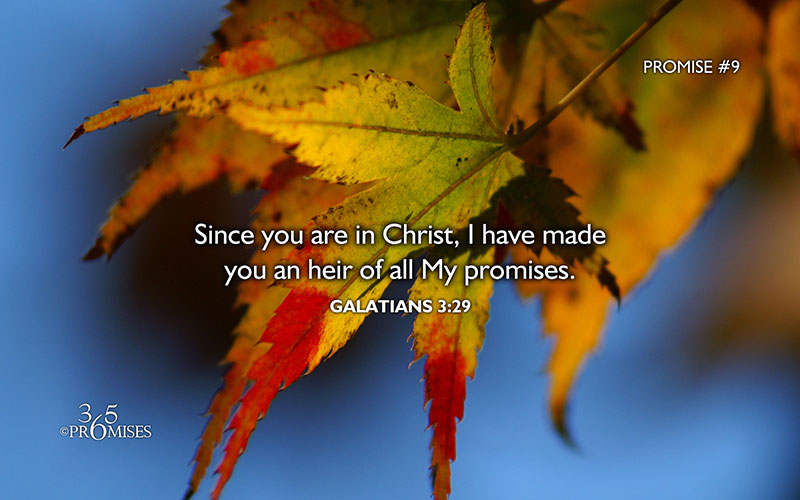
God’s Daily Promise – #9

Galatians 3:29 

If you are Christ’s, then you are Abraham’s seed
and heirs according to promise.
(World English Bible)

Promise #9: Since you are in Christ, I have made you an heir of all My promises.
 
Every one of the promises that God made to Abraham now belongs to you and I because we belong to Jesus Christ and are now heirs according to the promise. Just think of that for a moment. You are an heir of God and a joint heir with Jesus (Romans 8:17). Every promise that God made to Abraham is part of your own spiritual inheritance!

When God said to Abraham that He would be the father of many nations, and a blessing to many (Genesis 12), you were part of that promise.  The New Living Translation says Galatians 3:29 this way… And now that you belong to Christ, you are the true children of Abraham. You are his heirs, and God’s promise to Abraham belongs to you. NLT

May our God and Father give each one of us a revelation today about what it means to be an heir in His amazing kingdom. An heir of God and a co-heir with our elder brother, Jesus Christ. There is no higher call, there is no greater destiny, than to be part of the eternal family of the living God. Be encouraged by the words found in Galatians 4:7 – So you are no longer a bondservant, but a son; and if a son, then an heir of God through Christ.(WEB)

Photo by Jeff Epp

Click here to read Barry Adams’ new daily devotional at Fatherheart.tv

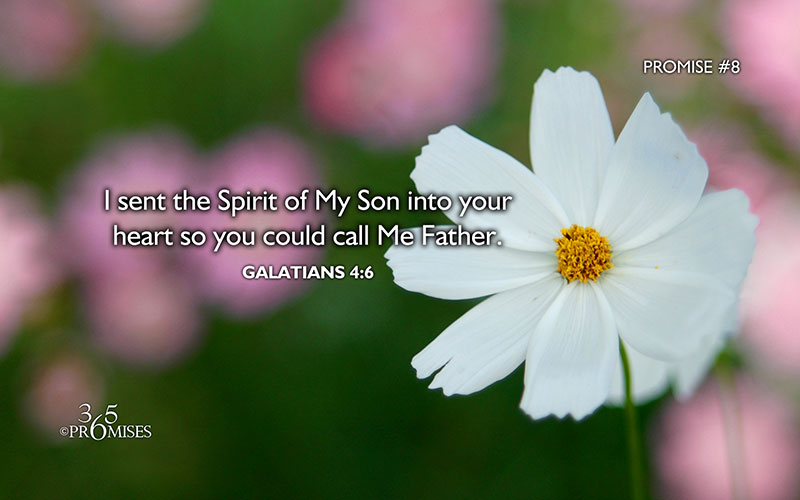
God’s Daily Promise – #8

Galatians 4:6

And because you are children,
God sent out the Spirit of his Son into your hearts, crying,
“Abba, Father!”

 (World English Bible)

Promise #8: I sent the Spirit of My Son into your heart so you could call Me Father.

The greatest gift that the Father could give us was the Spirit of His Son, the Spirit of Sonship. Each one of us who is born again, carries within our being the very life and nature of Jesus Christ Himself. Galatians 4:7 goes on to say… So you are no longer a bondservant, but a son; and if a son, then an heir of God through Christ. (WEB)

The Spirit of the Son that lives within us continually calls out ‘Abba Father!’. Abba is an Aramaic word for father that little children would call out to their dads in New Testament times. It would be like us saying ‘papa’ or ‘daddy’ in the English language. Because we carry within our very being the Spirit of the Son, our spirit man continually cries out ‘Papa’ to God, whether we are aware of this cry in our heart or not.

I believe it delights our heavenly Father when we cry out ‘Abba!’ to Him, for that is the very reason why God has given us the Spirit of His Son… so that He could be a Father to us. So may a cry resonate deep in our heart today as we join with the Spirit of the Son that lives within us that calls out ‘Abba Father!’.
Photo by Jeff Epp

Click here to read Barry Adams’ new daily devotional at Fatherheart.tv

Almond Trees in Israel


I will cause a sprout of righteousness to sprout forth for David, and he will administer justice and righteousness in the Land.  
JEREMIAH (33:15)

אַצְמִיחַ לְדָוִד צֶמַח צְדָקָה וְעָשָׂה מִשְׁפָּט וּצְדָקָה בָּאָרֶץ
ירמיהו ל’’ג:ט’’ו

ahts-mee-OKH le-da-VEED tze-MOKH tze-da-KAH ve-ah-SAH meesh-POT oo-tze-da-KAH ba-ah-RETS

A Taste of Torah for Shabbat
This Shabbat, Jews around the world read Parshat Yitro/Jethro, the Biblical portion (Exodus 18-20) describing the greatest event of human history, when God revealed Himself to man through His giving of the Ten Commandments. Rabbinic commentators point out that Jethro is singled out and rewarded by having this special reading eternally connected with his name because he was a righteous gentile who recognized the great miracles the One True God performed for the Jewish people. Jews have always shown admiration and appreciation for the righteous gentiles throughout our history who have stood by the People of Israel.

About Today’s Photograph
Almond trees, known in Hebrew as שקדיה/she-kay-dee-YA are amongst the first to blossom throughout Israel and are a welcome reminder that spring is just around the corner. The pink and white flowers turn into leaves and finally give way to almonds in just a few months. Almond trees have grown in Israel since Biblical times and were amongst the gifts sent by Jacob to Joseph in Egypt according to Genesis (43:11). Today’s photograph is by Galit Trager.  Happy Birthday Galit  –  יום הולדת שמח גלית

Judah will exist forever

Judah will exist forever, and Jerusalem from generation to generation.
JOEL (4:20)
וִיהוּדָה לְעוֹלָם תֵּשֵׁב וִירוּשָׁלִַם לְדוֹר וָדוֹר
יואל ד:כ

ve-ye-hoo-DAH le-oh-LOHM tay-SHEV vee-roo-sha-la-YEEM le-DOR va-DOR

Today’s Bible Lesson: Guest Post
by Sondra Baras, Director of CFOIC

Judah was Jacob’s fourth son and when the land was divided amongst the Tribes of Israel, Judah received the vast area of land south of Jerusalem extending from the Dead Sea in the east to the Mediterranean in the west. For centuries, this area was known as the Region of Judah, or Judea. Today, many people seek to sever the Jewish people from Judea, the Biblical Heartland of the Jewish People.  But God promised through His prophet Joel, that Judah would exist forever.  “Many are the plans in the mind of a man, but it is the purpose of the Lord that will stand” (Proverbs 19:21).

About Today’s Photograph
Photograph of a father and son walking through the streets of Jerusalem’s Old City by Vladi Alon. Today’s verse and much of Jewish literature connect Jerusalem with eternity.  “While pondering the creation of the world, the sages asked: ‘From where did He create it? And the answer is ‘From Zion.’ And when the Holy One, blessed is He, shall renew the world, He shall renew it out of Zion.” From “Legends of Jerusalem” by Zev Vilnay.

Jesus is our center!

So then, just as you received Christ Jesus as Lord, continue to live in him, rooted and built up in him, strengthened in the faith as you were taught, and overflowing with thankfulness.

Phil Ware

Thoughts on Today’s Verse…

Jesus is our center! He is the hub around which we turn. Rather than trying to add on to the truth of Jesus, we must learn to accept it and trust it in child-like faith. But that child-like faith must be nourished and grown. As Jesus remains our central focus and our hearts remain thankful to God for his grace, we will that our faith is strengthened and that Jesus is more real than ever.

Prayer…

Holy and Righteous God, please give me eyes to see evil and avoid it. Please give me wisdom to know deceptive and false teaching when it is placed before me. Empower me to live a thankful life of holiness so that I can live in Jesus to your honor and glory. In Jesus’ name I pray. Amen.

God’s Daily Promise – #7

John 3:16 

For God so loved the world, that he gave his one and only Son,
that whoever believes in him should not perish, but have eternal life.

(World English Bible)

Promise #7: I have given you eternal life because you have believed in Jesus Christ.
John 3:16 is one of the most quoted, most loved Bible verses in the New Testament. This Scripture has been used by evangelists over the years to invite many people to come to Christ. The foundation of this much loved verse is and always will be, the love of the Father. For God (the Father) so loved the world…

It was the great love of our heavenly Father that caused Him to give up His most treasured possession, the life of His Son, so that we too could share in Jesus’ eternal life. What a glorious promise! We were loved so much by God, that He gave up all that He loved in order to gain our love!

May we never take the wonder of John 3:16 for granted, but may we continue to revel in the amazing love our God and Father has for us every day in our lives. Thank you Father for loving us so much, that you sent your only begotten Son to the world in order to purchase our redemption! ~ Barry Adams

God’s Daily Promise – #6

Colossians 1:12-13 

12 giving thanks to the Father, who made us fit to be partakers of the inheritance of the saints in light; 13 who delivered us out of the power of darkness, and translated us into the Kingdom of the Son of his love;
(World English Bible)

Promise #6: I delivered you from darkness into the kingdom of My beloved Son.
Each one of us were once held captive by the power of darkness before we were set free by the power of Christ and brought into His kingdom. For every one who have said ‘yes’ to Jesus, our old life is now in the past tense and our new life in Christ is our present reality…
Whether we feel like it or not.

May the Holy Spirit give us revelation today to know that we have already been translated into the kingdom of our elder brother. The power of darkness has no more hold on us because of our royal position in Christ. We now live in an upside down kingdom, where the last will be first, the weak will be strong, and the poor will inherit the riches of our Father’s kingdom.

May each and every one of us echo the prayer that Paul prayed in Ephesians that our God and Father would give us the spirit of wisdom and revelation to know Him better. That the eyes of our heart would be opened so that we could really see the hope of His calling and our glorious inheritance in the saints!

Ephesians 1:15-23…
15 For this cause I also, having heard of the faith in the Lord Jesus which is among you, and the love which you have toward all the saints, 16 don’t cease to give thanks for you, making mention of you in my prayers, 17 that the God of our Lord Jesus Christ, the Father of glory, may give to you a spirit of wisdom and revelation in the knowledge of him; 18 having the eyes of your hearts enlightened, that you may know what is the hope of his calling, and what are the riches of the glory of his inheritance in the saints, 19 and what is the exceeding greatness of his power toward us who believe, according to that working of the strength of his might 20 which he worked in Christ, when he raised him from the dead, and made him to sit at his right hand in the heavenly places, 21 far above all rule, and authority, and power, and dominion, and every name that is named, not only in this age, but also in that which is to come. 22 He put all things in subjection under his feet, and gave him to be head over all things for the assembly, 23 which is his body, the fullness of him who fills all in all. (WEB)

Excerpt from Great Quotes from Great Leaders

Cover of "Great Quotes from Great Leaders...
Cover of Great Quotes from Great Leaders

1. “The best thing about the future is that it comes only one day at a time.
Abraham Lincoln
(1809-1865)

2. “Life is a series of experiences, each of which makes us bigger, even though it is hard to realize this. For the world was built to develop character, and we must learn that the setbacks and griefs which we endure help us in our marching onward.
Henry Ford
(1863-1947)

3. “Kind words can be short and easy to speak, but their echoes are truly endless.
Mother Teresa
(1910-1997)

4. “Success is not final, failure is not fatal. It’s the courage to continue that counts.
Winston Churchill
(1874-1965)

5. “A good head and good heart are always a formidable combination.
Nelson Mandela
(1918 – )

6. “Leaders aren’t born, they are made. They are made by hard effort, which is the price which all of us must pay to achieve any goal which is worthwhile.
Vince Lombardi
(1913-1970)

7. “Worry is the interest paid by those who borrow trouble.
Thomas Jefferson
(1743-1826)

8. “We gain strength, and courage, and confidence by each experience in which we really stop to look fear in the face…we must do that which we think we cannot.
Eleanor Roosevelt
(1884-1962)

9. “A man is but the product of his thoughts. What he thinks, he becomes.
Mahatma Gandhi
(1869-1948)

10. “The ideals which have lighted my way, and time after time have given me new courage to face life cheerfully, have been kindness, beauty, and truth.
Albert Einstein
(1879-1955)

11. “Happiness lies in the joy of achievement and the thrill of creative effort.
Franklin Roosevelt
(1882-1945)

12. “Constant kindness can accomplish much. As the sun makes ice melt, kindness causes misunderstanding, mistrust and hostility to evaporate.
Albert Schweitzer
(1875-1965)

13. “I believe the unarmed truth and unconditional love will have the final word in reality.
Martin Luther King, Jr.
(1929-1968)

14. “Character cannot be developed in ease and quiet. Only through experience of trial and suffering can the soul be strengthened, vision cleared, ambition inspired and success achieved.
Helen Keller
(1880-1968)

The Love of Jesus

The Love of Jesus

There’s no love more precious,
more costly, more kingly.
There’s no love that’s greater-
that’s more wonderful, more wild,
more passionate, more powerful-
than the love of Jesus.

Believe, receive, and rejoice forever in the greatest love the world has ever known!

For I am convinced that neither death, nor life, nor angels, nor principalities, nor things present, nor things to come, nor powers, nor height, nor depth, nor any other created thing, shall be able to separate us from the love of God, which is in Christ Jesus our Lord. Romans 8:38, 39 NASB

(From: Dayspring.com)

Does Russia Have A Cogent Middle East Strategy?

 February 9, 2012

Russia’s support for Syrian President Bashar Assad has put it at odds with other countries in the Arab world.

Russia drew a lot of flack from Arab countries and the West when it vetoed a U.N. Security Council resolution aimed at pressuring Assad to stop his crackdown on protesters. That has some analysts in Russia doubting whether the Kremlin really has a cogent strategy for the Middle East.

The dilemma for Russia policy in the Arab world can be illustrated by two very different events that took place this week.

On Tuesday, crowds of Assad supporters in Damascus greeted Russian Foreign Minister Sergei Lavrov and the country’s foreign intelligence chief, Mikhail Fradkov.

Lavrov said Russia was willing to serve as a mediator in the conflict, although Assad’s forces continued their assault on the opposition. Meanwhile, a very different scenario was playing out in New York.

Russia’s U.N. ambassador, Vitaly Churkin, appeared at a hastily called news conference to deny rumors that he had threatened the prime minister of Qatar. The rumors, which were widely circulated in the Arab media, said Churkin had warned the Qatari leader that Russia would “wipe Qatar off the map.”

“There was nothing, not even any hints of any threats, intimidation, rudeness from me or from the prime minister of Qatar, for that matter,” Churkin said.

Russia’s relations with Qatar have been strained since December, when customs officials in Doha allegedly manhandled Russia’s ambassador to that country.

Although Churkin denied using any bullying tactics, he added something that sounded vaguely like a warning.

“Apparently somebody is trying very hard in order to drive a wedge between Russia and the Arab world. If it’s somebody who is really coming from the Arab world, I think there is a very good Russian saying, which they, I think, should keep in mind: ‘Don’t spit into a well. You may well need it for a drink of water,’ ” he said.

At this point, it’s unclear who needs whom.

Analyst Yevgeny Satanovsky, president of the Moscow Institute for Middle Eastern Studies, says Russia doesn’t really need Syria as a trading partner. He says Russia’s support for Syria is part of a pragmatic effort to contain Islamic extremism by balancing opposing factions.

“Russians understand there are no nondictatorship regimes in the Middle East. There is no chance for democracy of the Western style in the Middle East. And we try to make balance,” Satanovsky says.

But other analysts say Russia needs to be careful of its image in the Arab world.

Dmitri Trenin, director of the Carnegie Moscow Center, points out that Russia’s stand on Syria puts it at odds with important members of the Arab League, such as Saudi Arabia.

“Saudi Arabia has enormous leverage on the global oil market. Saudi Arabia has resources that could be used to minimize Russia’s control of parts of its own country,” Trenin says. He means the North Caucasus, the region that includes volatile areas such as Chechnya.

Trenin says that what Lavrov, the Russian foreign minister, tried to do in Damascus this week should have been done months ago, when the Arab Spring protests first erupted.

“If Russia wanted to uphold its prestige as an important player, it needed to engage more fully in looking for a peaceful resolution to the Syrian conflict,” he says.

Both analysts say one of Russia’s main concerns is keeping a lid on Islamic radicalism, the kind that is spreading in the Muslim parts of Russia’s own territory.

Satanovsky says Russian policy seeks to play off the Islamic fundamentalist regimes of the Arab world against Iran.

In putting such strong and public support behind the Syrian regime, though, Russia has put itself at a pivot point in the major struggles of the Arab World.

It’s not clear whether it has a strategy to affect the balance there.

Related Articles:

https://sharinhislove.wordpress.com/2011/06/28/20-major-prophetic-events-yet-to-be-fulfilled-compiled-by-dr-tim-lahaye/

Map of Middle East Countries involved in War of Gog and Magog

Syria Revolution: Why Is Russia Supporting Syria? (ibtimes.com)

What is the War of Gog and Magog?


Middle East Burning


A riveting and timely survey of things to come!


Widespread revolutions in multiple Arab nations. New powers rising to challenge entrenched despots and ruling bodies. Bitter new conflicts further enflaming the many already in place. And a pall of uncertainty over how it will all play out.
Indeed the Middle East is burning.

How can we make sense of it all?

At first glance the many hotspots may seem without a pattern, without rhyme or reason. But Bible prophecy expert Mark Hitchcock takes a look at Scripture and helps paint a clear picture of what’s taking place, giving insight on current events in Egypt, Libya, Sudan, Russia, Turkey, Iran, Syria, and more.

=================================================================================

(Sharon’s note:)  To read an excerpt from this book, click on the link below. I think you will find it very interesting, as we relate it to our study of prophecy.

http://harvesthousepublishers.com/media/epr/excerpts/9780736939966_exc.pdf


God’s Daily Promise #5

Ephesians 1:4-5 

4 even as he chose us in him before the foundation of the world, that we would be holy and without blemish before him in love; 5 having predestined us for adoption as children through Jesus Christ to himself, according to the good pleasure of his desire,
(World English Bible)

Promise #5: I chose you to be adopted into My family before creation.
It pleased the Father to choose us before the foundation of the world. In love, He saw the day when we would say yes to the free gift of His Son’s life for our life and become born into His amazing family. Before He even spoke the world into existence, He saw us!

And our adoption is not like any human adoption, for God has given us His own Spirit as a deposit to guarantee our inheritance. We are not servants in His house, but actual sons and daughters, joint heirs with our elder brother Jesus, seated in Christ in heavenly places.

What an amazing promise! Every other promise and precept rests on God’s eternal plan to make us part of His family. As Ephesians 1:4 says, we are holy and without blame before Him in love all because of the finished work of Jesus Christ. What Jesus did on our behalf has secured our place forever as God’s kids!

1 John 3:1 – Behold, how great a love the Father has bestowed on us, that we should be called children of God! For this cause the world doesn’t know us, because it didn’t know him. (WEB)


The Gift

Thoughts on Today’s Verse…

As a child, I loved to receive gifts. In such a simple time of life, a gift meant I was loved. I didn’t worry about the significance or hidden message in a gift. I wasn’t concerned about the “strings attached” to the gift. It was just a gift — a free expression of love I didn’t deserve, given to me by someone who truly cared for me. Isn’t it great to get to be God’s child and receive his gift and know we can receive it as a child?!

Prayer…

Thank you, generous Father, for the gift of grace, the gift of faith, the gift of salvation, and most of all, the gift of Jesus. I know I can never repay these gifts, but I look forward to saying “Thank you!” through my lifestyle now and I look forward to continuing to say “Thank you!” through all eternity. In Jesus’ name I pray. Amen.

~ Phil Ware

Vineyards – Israel

“You will yet plant vineyards in the mountains of Samaria;

the planters will plant and redeem.”
JEREMIAH (31:5)

Enjoy this photo of stunning vineyards!

Today marks the 15th day of the Hebrew month of Shvat,

and throughout Israel, children and adults alike will plant trees and vines throughout Samaria

and will celebrate Jeremiah’s prophecy coming to life!

Jerusalem in Depth

A fascinating millennia-old subterranean world of tunnels, caves, aqueducts, plazas, and even a church are exciting evidence from an iota of the city of eternity’s history
Shahar Shilo, allaboutJerusalem.com

You won’t believe what’s hidden under Jerusalem. A fascinating millennia-old subterranean world of tunnels, caves, aqueducts, plazas, and even a church are exciting evidence from an iota of the city of eternity’s history. Come on a tour through the depths of the earth, under 21st century Jerusalem

Many cities in the world boast mysterious and interesting subterranean complexes that attract adventure seekers and history buffs. Jerusalem, being an ancient city, has also been blessed with an abundance of subterranean sites, some better known than others.
The Entrance to the Warren Shaft System

Photo By: Ron Peled

Jerusalem’s subterranean world is comprised of two types of sites: those that were quarried or intentionally built underground, and others that used to be at ground level but are now deep under the modern city due to the repeated ruin and destruction throughout history that the city endured. This article offers an in-depth tour, pun intended, of worlds hidden deep under the surface of modern-day Jerusalem.

The ancient water system in the City of David: This is a hidden and sheltered subterranean water system under the holy city of Jerusalem, within the City of David National Park. This monumental system, excavated about 3,800 years ago by the Canaanites-Jebusites residing in Jerusalem, was used to connect the fortressed city with the Gihon Spring, which was the only source of water available around Jerusalem.

One thousand years later, at the height of the Kingdom of Judah’s Israelite Period, King Hezekiah’s laborers dug a 582-yard long tunnel that channeled the Gihon Spring waters to the Pool of Siloam, which was built within the walls in the ancient city’s central ravine. You can now visit the entire water system and enjoy a unique experience – walking through flowing water, in Hezekiah’s Tunnel, by flashlight.

Following in the steps of the Second Temple Period pilgrims: After the Israelite Period, in the time of the Second Temple, Jerusalem grew a great deal, and according to historical sources, it became one of the most resplendent cities in the ancient world.

Thousands of pilgrims flocked to Jerusalem on holy days, the Second Temple as their destination. An exciting subterranean path connecting the Pool of Siloam with the Western Wall, at the foot of the Temple Mount, was recently exposed in Jerusalem. You can now walk through the Jerusalem of the Second Temple era on a 765-yard long underground path – from the Pool of Siloam in the southern City of David to the Davidson Center Archeological Park and to the Western Wall plaza. See up close the city’s prestige and grandeur during King Herod’s reign in the Roman period, about 2,000 years ago.
Facing the Holy of Holies in the Western Wall Tunnel

Photo By: Ron Peled

The Western Wall Tunnels: A remarkable and awe-inspiring subterranean world that also belongs to the Second Temple era has recently been revealed to visitors, in the northern corner of the Western Wall plaza, under the houses of the Moslem Quarter. Years of destruction and construction next to the Temple Mount buried the city deep beneath the present. Subterranean guided tours will take you along the length of the Western Wall, but including the underneathunderground part of it. The several hundred yard long path exits onto the Via Dolorosa, and will introduce visitors to an ancient and magnificent world of palatial construction, coupled with engaging explanations about the customs of ancient Jerusalem residents and the city’s character during the days of the Second Temple.

Hasmonean Aqueduct Tunnel on the ridge of Armon Hanatziv (Government Governor House): An unforgettable subterranean adventure. During Jerusalem’s heyday, it required a lot of water, which could not be found in the city. To meet this vital need, aqueducts were built to channel water to Jerusalem from large natural springs south of the city, around Bethlehem.

The lower aqueduct, which led water to the Temple Mount, crossed the highest ridge of Armon Hanatziv through an excavated 437-yard long tunnel. You can tour the entire length of the excavated tunnel by flashlight and be dazzled by the superb construction quality and the original plaster that has survived here for more than 2,000 years.
The Hasmonean Aqueduct in Armon Hanatziv

Photo By: Ron Peled

Zedekiah’s Cave (also known as Solomon’s Quarries): A small and unassuming opening can be found at the northern part of the Old City, next to Nablus Gate, and whoever enters it is surprised to find themselves in an enormous cave, more than 2.2 acres large.

Some of the most important Jerusalem researchers searched for this mysterious and picturesque place, until it was accidentally discovered in 1854 by Dr. James Turner Barclay, who went looking for his lost dog. The gigantic cave sparked the imagination of researchers, and it was quickly named Zedekiah’s Cave, since it is associated with the tragic story of King Zedekiah, the last king of Judah.

Music at the Tzidkiyau cave during Hamshushalaim Festival

Photo By: Ron Peled

Accoridng to tradition, the king tried to escape the Babylonian conquerors through the tunnel, but they caught him as he emerged from the cave, blinded him, and led him to Babylon, where he was imprisoned for life. But the truth is that the cave is actually a huge quarry for Jerusalem building stones, which masons used throughout most of the city’s historical periods. Captain Charles Warren, Jerusalem’s famous archeologist, conducted the founding gathering of the Freemasons movement in the Holy Land in this cave, in 1868. Additional areas and galleries totaling an area of almost 1.2 acres were recently discovered inside the cave.

The End of the Western Wall Tunnel – Lithostrotos and the Strouthion Pool

Photo By: Ron Peled

: 0n the northern end of the Via Dolorosa, near the first station, lies the Ecce Homo Convent of the Sisters of Zion. The modest opening, visible from the side of the street, does not allude to the rich subterranean world that lies beneath.

Through the small convent, you enter an ancient Roman Jerusalem site from the second century C.E. The path crosses the large Roman floor tiles (a style called Lithostrotos, meaning “pavement”) and along ancient water pools, one of which is the Strouthion Pool, found in the northern area of the Western Wall Tunnels, right next to the street exit. To wrap up a fascinating tour of life during the Roman Period in Aelia Capitolina (Jerusalem’s Roman name) don’t miss the impressive Roman Square under Nablus Gate.

The Church of the Ascension of Mary

Photo By: Ron Peled

Mary’s Tomb at the Church of the Assumption: Located in the Kidron Valley, next to Gethsemane, lies one of the oldest, most beautiful and impeccable churches in Jerusalem. This Crusader church, which according to Christian tradition is where St. Mary, Mother of Jesus, is buried.

The church is resplendently built from Jerusalem stone and lies in its full glory in the ancient level of the Kidron Stream, found deep under modern-day street level. To reach the church’s outdoor plaza, you need to go down a large stairwell, from which a dim and mysterious stairwell descends into the belly of the earth – to Mary’s Tomb and to the dark galleries infused with the fragrance of frankincense.

This does not conclude Jerusalem’s subterranean wonders. Other great destinations include Nicanor Cave, an ancient cave in the botanical garden at Mount Scopus, the Well of Souls, a natural cave located under the Foundation Stone inside the Dome of the Rock at the top of the Temple Mount, the Burnt House and Herodian Quarter under the Jewish Quarter, and more. See these sites during an extended and leisurely visit to Jerusalem.

The Old City of Jerusalem

The Old City of Jerusalem is one of the most intense places on Earth! At the heart of the Jewish, Islamic, and Christian religions, this walled one kilometer area in the center of Jerusalem is beyond words and cannot be missed.

The Old City of Jerusalem as seen from David's TowerThe Old City of Jerusalem as seen from Tower of David Museum by Brian Negin, on Flickr

The Old City is home to the Western Wall (aka Wailing Wall and in Hebrew Kotel). This is the last remaining wall of what was the Jewish Temple, and is today the holiest site in the world for Jews.

Above the Western Wall lies the Dome of the Rock important for Muslims as the site where the prophet Muhammad is said to have risen to heaven.

Dome Of The RockDome Of The Rock by mockstar, on Flickr

And, just a few minutes walk away, lies the Church of the Sepulcher, where some believe  Jesus was crucified and buried.

The Old City of Jerusalem is divided into four quarters; The Jewish Quarter, The Armenian Quarter, The Christian Quarter, and The Muslim Quarter. The walled city is entered by one of seven entry gates, although the busiest for tourists is the Jaffa Gate next to which is the Tower of David Museum, providing the history of Jerusalem within the Old City Walls. Each quarter has its own unique atmosphere and observations, sites and smells, and experiences.

Going to prayJewish men going to pray in the Old City of Jerusalem by chany14, on Flickr

In the Jewish Quarter, for instance, the narrow alleyways are lined by the homes of Ultra-Orthodox (Haredi) Jewish families, and Yeshivas (schools for Torah study). Walking and observing the residents of the Jewish quarter rush about on their daily life, whether teenage students in the Yeshivas who are often here from around the world for extended periods of time, children as they walk with school between lessons, or the men, as they rush around between places of worship, and the Western Wall. The houses of the Old City, and the Jewish quarter in particular, are for good reason, hotly contested real estate, and command spectacular prices when they rarely trade hands.

The Jewish Quarter’s narrow alleyways open up as you reach the Western Wall Plaza and the wall itself. At times of Jewish festival the wall can be crowded, and observing the tourists brushing alongside daily prayers here is an interesting site. Anybody can go up to the wall, although men and women have separate areas, and men should cover their heads (there are paper kuppels available), and women wear modest clothing. It is customary to place a small prayer on a piece of paper within a crack on the wall. Amazingly the vast Western Wall represents just a tiny percentage of this elevation of the Temple, and the Western Wall Tunnels accessed via the plaza, allow visitors to see even more of the wall underground. Also interestingly, within the Muslim Quarter is whats known as the Little Western Wall where the wall is once again exposed and visible. This is argued to be holier than the iconic section of wall because it is closer to the ‘Holy of Holies’ – the holiest part of the Temple.

Old City of JerusalemOld City ‘Shuk’ by RonAlmog, on Flickr

The Muslim Quarter is a huge contrast to the Jewish Quarter its streets are busier, more crowded, with vendors, especially within the famous Shuk selling all varieties of products. In contrast to the other quarters where shops are generally selling religious or tourist-appealing products, here the Shuk is literally an ancient shopping mall in the 21st century where one can practicing their bartering skills and buy almost anything imaginable. As in the Jewish Quarter, and the rest of the Old City, tourists wondering the streets of the Muslim Quarter find it hard to imagine how the locals go about their everyday business so normally in what is such an intense and looked upon place. Kids play in the street, and men sit out in cafes smoking nargila (hookah or shisha).

Old City of JerusalemOld City of Jerusalem by RonAlmog, on Flickr

The Dome of the Rock sits above the Western Wall Plaza and whilst non-Muslims are not allowed to enter the building itself, tourists are able to tour the compound and nearby Al-Aqsa Mosque.

Moving into the Christian Quarter of the Old City of Jerusalem, there is yet another change. Home to about 40 holy sites to Christians, in the streets here you will see priests and pilgrims from around the world. This quarter was constructed around the Church of the Holy Sepulchre where Jesus is said to have been crucified and buried. Within this hot patch of real estate, even the Church is divided, with different parts controlled by different Christian sects, meaning that there are often disputes over maintenance and some parts are in poor condition.

Behind the doorBehind a door in the Armenian Quarter by chany14, on Flickr

The smallest quarter of the Old City is the Armenian Quarter. This area is home to some 2,500 Armenians, an ancient community who have resided here for over 2,000 years.

Arabian Oryx – Yotvata

Yotvata

From Wikipedia, the free encyclopedia
“Yotvata” is also the Hebrew name for Tiran Island.
Yotvata
Yotvata and Edom Mountains.jpg
Yotvata (Edom Mountains in the background).
Hebrew יָטְבָתָה
Founded 1957
Region Aravah
District South
Affiliation Kibbutz Movement
Coordinates 29°53′44.16″N 35°3′36.35″ECoordinates: 29°53′44.16″N 35°3′36.35″E
Population 640[1] (2009)
Yotvata is located in Israel

{{{alt}}}
Yotvata
Website www.yotvata.org.il

Yotvata (Hebrew: יָטְבָתָה‎‎) is a kibbutz along the Aravah road in the southern Negev in Israel. It has approximately 310 members and a total of 700 residents. The Aravah valley is an arid desert where the average annual rainfall is less than 30 mm and temperatures often exceed 40 °C (104 °F) in summer, and 21 °C (70 °F) in winter.[2]

Contents

[hide]

 Location

Located approximately 40 km north of the Red Sea, Yotvata is the first, biggest, and most prosperous Kibbutz in Hevel Eilot Regional Council. Being relatively far from major urban centers (41 kilometers north of Eilat and 130 kilometers south of Dimona), it is the center of the region, where most regional facilities are based: regional school, regional council offices, community center, sports center, movies and concerts hall and local airfield.

 Economy and Community

Yotvata is a cooperative community, where most adult residents work on the kibbutz in production, services or education. The revenues are equally distributed among the members regardless of their position, along the idea of each one gives as much as he can and gets as much as he needs. Most of daily affairs are conducted communally – education, holidays, dining (three meals a day conducted in the commune dining-room are giving the community more relaxed time to get together) and more.[3]

Yotvata Dairy is a milk products factory which provides the kibbutz with its main source of income and occupies the highest number of members.

Agriculture is second in income but perhaps the first in importance for the community character and pride. Agriculture branches are Irrigated land (onions, potatoes, corn, animal feed, garlic and pumpkins), Plantations (dates and mangos) and a big and modern Dairy Farming.[3]

Yotvata’s road stop

There is also a big road stop shop on the Aravah Road providing refreshments for the travelers.

Other small branches are a picturesque horse stable that lies in the dates plantation east to the kibbutz and few artistic studios.

All members take turns contributing to the kibbutz service branches – kitchen, dining-room, laundry, security, etc.

The kibbutz gets all its drinking and irrigation water from aquifer wells in the Aravah valley.

History

 The Making of the Kibbutz

Ein Radian Nahal Settlment

Yotvata started in 1951 as a Nahal settlement named Ein Radian. In 1957 it was established as the first kibbutz in the southern Aravah region by Ihud HaKvutzot VeHaKibbutzim. The kibbutz is named after an Israelite encampment mentioned in Numbers 33:34 and Deuteronomy 10:7: “…from there they went to Gudgodah, and then to Jotbatha, a land of streaming water.”[4][5][6] Although there are some debates over the exact location of the biblical Yotvata (some say that it is closer to the Red Sea near Taba), the idea of a desert oasis for Israelis was in the founders’ mind; the local oasis was the Ein Radian wellspring.[3]

The founders, a small group of men and women 20 years of age and just out of the military service, decided to pursue a life of pioneering and built their home in the desert. They had massive challenges presented by the desert: the burning sun, the heat, shortage of water, salty land and water, limited transportation and no secure source of income. They started making all kinds of agricultural trials growing grapes, pomegranates and vegetables; they raised cattle and chickens – all with little success. The dates plantation proved more suitable to the arid conditions.

Yotvata – 2003

And then came the initiative to found a dairy that would provide milk to Eilat, which was expected to grow rapidly. Breeding milking cows in the desert was considered an impossible mission. In 1962 the dairy was founded, with four cows, the member who led the vision and the operation was Ori Horazo (1939-1966).[3] The members tried to get funds from the Jewish Agency, but failed. Eventually, they received funding from the Israeli Trade and Industry Minister, Pinhas Sapir. In the first year, the dairy produced 500,000 liters of milk. By 2008, it was producing 62 million liters a year and controlled 63% of the Israeli dairy beverages market (making NIS400 million a year), and 49% of the fortified milk market (making NIS 250 million a year). It employed 130 workers and had 700 cows.[7] The dairies of Kibbutz Yahel, Lotan, and Ketura provide milk for Yotvata.

In 1960 the first children of the community were born, and six years later the school opened with three first graders; today there are 200 kids in the kibbutz, and 600 students from all of the region communities attend Maale Shaharut School (from 1st to 12th grades)[3] in Yotvata.

 Archeology

Judging by the numerous historic forts surrounding the Kibbutz, Yotvata’s location was a strategic one:[8]

  • Southwest of the kibbutz lies a Roman fortress built during the reign of the Emperor Diocletian (dated ±300 AD) as part of a line of border fortresses (the Limes Arabicus) in the Negev, in order to protect the trade route from marauding Arab nomads.[8][9][10]
  • East of the kibbutz lies an ancient Arab resting fortress with towers in its corners, dating from the Nabataeans era (±700 AD) and served as a resting station for the convoys crossing the desert.[8]
  • On a hill west of the kibbutz (50 m), there is an ancient fort dating from the Iron age (~ 11-13 Centuries BC). The fort overlooks the wellspring, and is considered to have served the Egyptians copper miners.[8]
  • East of the kibbutz to the north and to the south there is a wells-chain (known as Fugaras) connected with an underground tunnel that leads the aquifer water to the surface. Fugaras is an ancient but sophisticated irrigation system.[8]
  • North of the kibbutz are found two ancient leopard traps. Leopards are known to have inhabited this area.[8]

 Attractions

Yotvata Hai-Bar Nature Reserve is dedicated to reintroducing extinct species mentioned in the Bible, as well as other endangered desert animals, to the wild. It has three parts: a park for herbivorous animals; the Predators Center that displays reptiles, small desert animals and large predators; and the Desert Night Life Exhibition Hall to observe nocturnal animals during their active hours.[11]

15 km south of Yotvata lies Timna valley, where the sandstone and calcareous rock formations present some breathtaking desert features such as the Solomon’s Pillars, Mushrooms, Arches and more. Timna is also known for its ancient copper mines.

The area provides many great desert walks including canyons, roman routes, sand dunes, fossil hunting, rock-climbing and more.

 References

  1. ^ “Locality File” (XLS). Israel Central Bureau of Statistics. 2009. Retrieved 2011-02-06.
  2. ^ “Israel In Numbers”. Central Bureau of Statistic.
  3. ^ a b c d e “Yotvata website”.
  4. ^ http://www.mfa.gov.il/mfa/history/early%20history%20-%20archaeology/archaeological%20excavations%20in%20israel%202002#yotvata
  5. ^ http://fr.jpost.com/servlet/Satellite?cid=1212041487654&pagename=JPArticle%2FShowFull
  6. ^ Mapa’s concise gazetteer of Israel. Yuval El’azari (ed.). Tel-Aviv: Mapa Publishing. 2005. p. 217. ISBN 9657184347. (Hebrew)
  7. ^ Peretz, Sapir (2008-07-30). “How did Yotvata turn from a small dairy in the middle of the desert to one of the market’s strongest brands?”. Globes. Retrieved 2008-10-01. (Hebrew)
  8. ^ a b c d e f Hevel Eilot Survey. Menachem Marcus. Hevel Eilot Regional Council. 1979. pp. 214–220.
  9. ^ “The Eilat Region”. Jewish Virtual Library. Retrieved 2008-10-01.
  10. ^ “Israel Antiquities Authority”.
  11. ^ “The Yotvata Hai-Bar Nature Reserve”. Haaretz. 2008-04-16. Retrieved 2008-10-01.

External links

Wikimedia Commons has media related to: Yotvata

Ein Gedi – Israel

Ein Gedi is where David hid from King Saul and where he wrote many of the Psalms.

You can visit the breathtaking nature reserve located just west of the Dead Sea less than an hour drive from Jerusalem.

Sinai Ibex

“The Lord, God is my strength, and He makes my legs as swift as hinds’ feet; and He leads me to walk upon my high places. To the conductor, with my songs.”

HABAKKUK 3:19

Do you know what type of beautiful animal this is?

It’s actually called a Sinai Ibex, and its favorite habitat is the desert mountains of Israel!

The Mount of Transfiguration

The Transfiguration Lodovico Carracci 1594
Image via Wikipedia
English: Church of Transfiguration, Mount Tabo...
Image via Wikipedia

Luke 9:28-36
The Transfiguration
…after Jesus said this,… went up onto a mountain to pray. As he was praying, the appearance of his face changed, and his clothes became as bright as a flash of lightning….
Location: Mount of Transfiguration – Israel

— with LX Atsa and Sylvia Murray.

Mount of Transfiguration

From Wikipedia, the free encyclopedia

English: Church of Transfiguration, Mount Tabo...
Image via Wikipedia

One of the unknowns of the New Testament is the identification of the mountain where Jesus underwent his Transfiguration. The Matthew account of the Transfiguration is as follows.

“And after six days Jesus taketh Peter, James, and John his brother, and bringeth them up into an high mountain apart, And was transfigured before them: and his face did shine as the sun, and his raiment was white as the light. And, behold, there appeared unto them Moses and Elijah talking with him. Then answered Peter, and said unto Jesus, Lord, it is good for us to be here: if thou wilt, let us make here three tabernacles; one for thee, and one for Moses, and one for Elijah. While he yet spake, behold, a bright cloud overshadowed them: and behold a voice out of the cloud, which said, This is my beloved Son, in whom I am well pleased; hear ye him. And when the disciples heard it, they fell on their face, and were sore afraid. And Jesus came and touched them, and said, Arise, and be not afraid. And when they had lifted up their eyes, they saw no man, save Jesus only. And as they came down from the mountain, Jesus charged them, saying, Tell the vision to no man, until the Son of man be risen again from the dead.” (Matthew 17:1-9, KJV)

Three candidates for this mountain have been suggested:

  • Mount Hermon, for two reasons: It is the highest in the area (and the Transfiguration took place on “an high mountain” (Matthew 17:1)), and it is located near Caesarea Philippi (Matthew 16:13), where the previous events reportedly took place.

(Note* – However, it is important to note that this location was extremely far from Jerusalem, and Yeshua & his Disciples would have been in Jerusalem for the Feast of Sukkot (Tabernacles), as it is one of three Pilgrimage feasts set forth in Leviticus 23, thereby making Mt. Hermon an unlikely reality for the place of Transfiguration)

Mount Hermon = 9,232 feet High. (33°24′N, 35°51′E; Hebrew: הר חרמון‎, Har Hermon) More Information on Mount Hermon

Mount Tabor = 1,886′ High. (Hebrew: הר תבור‎), For more information on Mount Tabor: Mount Tabor

  • Mount Sinai. This has been suggested by Benjamin Urrutia on the basis of the presence of Moses and Elijah (two prophets traditionally associated with Mount Sinai). This is, however, unlikely since Sinai is rather geographically remote.

Mount Sinai = 7497′ High. (Arabic: طور سيناء , Hebrew: הר סיני), For more information on Mount Sinai: Mount Sinai

Jesus was claimed to stand on the Mountain with Elijah and Moses. These would be the three figures which had the most miracles surrounding them in the Bible. Moses, representing the law and Elijah, the prophets. In Luke Jesus spoke to Moses of Jesus departure( in Greek exodus ).

29And as he was praying, the appearance of his face was altered, and his clothing became dazzling white. 30And behold, two men were talking with him, Moses and Elijah, 31who appeared in glory and spoke of his departure,[a] which he was about to accomplish at Jerusalem. ( Luke 9:29-31 ESV)

Peter who was one of the claimed eyewitnesses with James and John reflects on this in 2 Peter about Peter’s own departure – exodus.

13I think it is right to refresh your memory as long as I live in the tent of this body, 14because I know that I will soon put it aside, as our Lord Jesus Christ has made clear to me. 15And I will make every effort to see that after my departure you will always be able to remember these things. 16We did not follow cleverly invented stories when we told you about the power and coming of our Lord Jesus Christ, but we were eyewitnesses of his majesty. 17For he received honor and glory from God the Father when the voice came to him from the Majestic Glory, saying, “This is my Son, whom I love; with him I am well pleased.” 18We ourselves heard this voice that came from heaven when we were with him on the sacred mountain. (2 Peter 1:13-18 ESV )

This account is one of three in the New Testament where God is heard audibly speaking. All three accounts concern Jesus. They are:

  • Jesus’ baptism ( Mk 1:9-11)
  • The mount of transfiguration ( Mk 9:14-29 )
  • At the temple when Greeks approach Jesus ( Jn 12: 20-26 )

The account of the Transfiguration occurs six (Matthew 17:1, Mark 9:2) or eight (Luke 9:28) days after Peter’s confession that Jesus is the Messiah at Caesarea Phillipi and immediately followed by coming down off the mountain and healing an epileptic boy. Peter’s confession and Jesus’ announcement He would die and rise are both in a sense confirmed with the discussion of Jesus’ “exodus – departure” with Moses. The mountain top experience contrasts with the difficulties of life and healing of the boy ( Mk:14-29).

Rainbow by Eliyahu Alpern, of Safed, Israel


Photograph of rainbow by Eliyahu Alpern, of Safed, Israel.

The rainbow symbolizes God’s first covenant with mankind, promising to remember His promise to Noah.

The next Biblical covenant represents God’s eternal promise of the Land to Abraham and his descendants.

Herd of Camels in the Negev Desert – Israel

Enjoy this cool shot of a herd of camels in the Negev desert (photo by Ilan Rosen). Camels have been an important part of the Holy Land’s landscape from Biblical times as described by Isaiah, “they carry their wealth…and riches upon the camels’ hump” (30:6).

Verse of the Day – 2/2/12

From inside the fish Jonah prayed … “In my distress I called to the LORD, and he answered me.
From the depths of the grave I called for help, and you listened to my cry.”
Jonah 2:1-2 (NIV)

Phil Ware

Thoughts on Today’s Verse…

Jonah was disobedient, rebellious, and selfish. He had run from the Lord. He had shunned the Lord’s command. He had endangered the lives of those on the ship where he had tried to hide. Yet even in the middle of his rebellion, God heard his cry and delivered him. If you are in rebellion, if you are seeking to hide some secret and all-consuming sin, please know the Lord wants to ransom and redeem you! Things won’t be easy, but coming back to the Lord means ultimate redemption and deliverance.

Prayer…

Holy and righteous Father, please forgive me for the times that I am in rebellion to your will. Help me to recognize those times and give me the strength to avoid those temptations. In your grace, dear Father, please not only help me to live as you want me to live but also lead me to someone else who needs to know of your grace and redemption. Please use me to help them escape from their bondage to sin and shame. In Jesus’ name I pray. Amen.