
If you keep My commandments, you will abide in My love, just as I have kept My Father’s commandments and abide in His love.
Tag: Spiritual Growth
Daily Promises – July 13

Philippians 4:19 KJV
19 But my God shall supply all your need
according to his riches in glory by Christ Jesus.
Promise: I will meet your every need through My eternal riches in Jesus Christ.
Our God and Father has promised to meet our every need according to the vast riches in the glorious storehouse of heaven that is in Jesus Christ. In an orphan world system that makes people feel all alone and responsible to claw and scratch for everything they get, this is really good news!
Our God knows what we need before we need it and He delights to provide for us what we need…when we need it. Whether a felt need or a spiritual one, our heavenly Dad is a Father who provides for His kids. In this particular passage, Paul is writing to the Philippians and is thanking them for the gift that they sent to help further the work of the kingdom.
Paul is encouraging them that as they have been obedient to share what they have, God will continue to pour in heaven’s resources when they need it. While we may not have an ample bank account stored up on earth, we can rest in the fact that we have access to the true eternal riches that are stored up in heaven for us through the glorious riches in our elder brother, Jesus Christ.
Photo by Steve Taylor
Was Jesus ever angry?
When Jesus cleared the temple of the moneychangers and animal-sellers, He showed great emotion and anger (Matthew 21:12-13; Mark 11:15-18; John 2:13-22). Jesus’ emotion was described as “zeal” for God’s house (John 2:17). His anger was pure and completely justified because at its root was concern for God’s holiness and worship. Because these were at stake, Jesus took quick and decisive action. Another time Jesus showed anger was in the synagogue of Capernaum. When the Pharisees refused to answer Jesus’ questions, “He looked around at them in anger, deeply distressed at their stubborn hearts” (Mark 3:5).
Many times, we think of anger as a selfish, destructive emotion that we should eradicate from our lives altogether. However, the fact that Jesus did sometimes become angry indicates that anger itself, as an emotion, is amoral. This is borne out elsewhere in the New Testament. Ephesians 4:26 instructs us “in your anger do not sin” and not to let the sun go down on our anger. The command is not to “avoid anger” (or suppress it or ignore it) but to deal with it properly, in a timely manner. We note the following facts about Jesus’ displays of anger:
1) His anger had the proper motivation. In other words, He was angry for the right reasons. Jesus’ anger did not arise from petty arguments or personal slights against Him. There was no selfishness involved.
2) His anger had the proper focus. He was not angry at God or at the “weaknesses” of others. His anger targeted sinful behavior and true injustice.
3) His anger had the proper supplement. Mark 3:5 says that His anger was attended by grief over the Pharisees’ lack of faith. Jesus’ anger stemmed from love for the Pharisees and concern for their spiritual condition. It had nothing to do with hatred or ill will.
4) His anger had the proper control. Jesus was never out of control, even in His wrath. The temple leaders did not like His cleansing of the temple (Luke 19:47), but He had done nothing sinful. He controlled His emotions; His emotions did not control Him.
5) His anger had the proper duration. He did not allow His anger to turn into bitterness; He did not hold grudges. He dealt with each situation properly, and He handled anger in good time.
6) His anger had the proper result. Jesus’ anger had the inevitable consequence of godly action. Jesus’ anger, as with all His emotions, was held in check by the Word of God; thus, Jesus’ response was always to accomplish God’s will.
When we get angry, too often we have improper control or an improper focus. We fail in one or more of the above points. This is the wrath of man, of which we are told “Everyone should be quick to listen, slow to speak and slow to become angry, for man’s anger does not bring about the righteous life that God desires” (James 1:19-20). Jesus did not exhibit man’s anger, but the righteous indignation of God.
Article from http://www.gotquestions.org/
How can I overcome feelings of rejection?
We are all prone to disappointment and feelings of rejection, and that is especially true in the aftermath of a broken relationship. However, as born-again believers we have a resource in God’s Word that can bring comfort and clarity to the situation. One person’s rejection does not mean we are unlovable. But we can allow that one rejection to determine how we feel and allow that feeling to color our idea of who we are, or we can choose to put that behind us and move forward on the basis of something that is far more lasting.
What is that? For believers, it is our position in Christ. When we are born again, we are accepted. “Praise be to the God and Father of our Lord Jesus Christ, who has blessed us in the heavenly realms with every spiritual blessing in Christ. For he chose us in him before the creation of the world to be holy and blameless in his sight. In love he predestined us to be adopted as his sons through Jesus Christ, in accordance with his pleasure and will— to the praise of his glorious grace, which he has freely given us in the One he loves” (Ephesians 1:3-6).
Even though we do not deserve it nor can we earn it (Ephesians 2:8-9), the Lord Jesus Christ has blessed us with every spiritual blessing and has made us accepted in Him. This acceptance is His gift of grace, and it transcends any and all other “feelings” we may have because it is not based on “hope so” but on “know so.” We know that this is true because God’s Word tells us, and as we appropriate this truth by faith, it becomes reality in our hearts and lives.
Walking by our feelings is like walking through the world with our heart on our sleeve. We are bound to be hurt, and we are bound to be disappointed, for we live in a fallen world. What we choose to do with that hurt and disappointment will either allow us to grow stronger in our walk with the Lord or it will mean that we are walking wounded. Both outcomes are our choice. God makes it possible for us to walk through the disappointments in life with a knowledge that His provision for us works. His grace and His comfort are ours as we rest in Him. Every born-again child of God has all of these provisions and blessings in Christ, but we have to choose to utilize them. It is sort of like having a million dollars in the bank and choosing to starve to death because we don’t use that money to buy food. It is also true that we cannot use what we do not know. Therefore, it behooves every believer to “know” the God who knows us and loves us, and that means more than a devotional reading of God Word but study that changes our perspective (2 Timothy 3:16-17) and allows us to face life armed with real understanding about the reality of walking by faith.
As believers we are not defined by our past failures or by disappointment or by the rejection of others. We are defined as children of God, born again to newness of life and endowed with every spiritual blessing and accepted in Christ Jesus. That is the defining factor when it comes to victorious living. God has prepared for each of us unique opportunities to walk through the “all things” of this life. We can either walk in our own strength and what the Apostle Paul calls our “flesh,” or we can walk in the power of the provision God has made for us through the Holy Spirit. It is our choice. God has provided us with armor (Ephesians 6:11-18), but it is up to us to put it on by faith.
Therefore, if you are a child of God, you may suffer disappointment in this life, but you need to remember that as a child of the King, this rejection is a momentary bump in the road. You have a choice to either allow that bump to derail you and walk wounded, or you can choose to claim the heritage of a child of God and move forward in grace. Forgiveness of others and of self is a gift that you can give because it is the gift given to you by the Lord Jesus Christ (Ephesians 4:32).
Article from http://www.gotquestions.org/overcome-rejection.html
What does the Bible say about anger?
Question: “What does the Bible say about anger?”
Answer: Handling anger is an important topic. Christian counselors report that 50 percent of people who come in for counseling have problems dealing with anger. Anger can shatter communication and tear apart relationships, and it ruins both the joy and health of many. Sadly, people tend to justify their anger instead of accepting responsibility for it. Everyone struggles, to varying degrees, with anger. Thankfully, God’s Word contains principles regarding how to handle anger in a godly manner, and how to overcome sinful anger.
Anger is not always sin. There is a type of anger of which the Bible approves, often called “righteous indignation.” God is angry (Psalm 7:11; Mark 3:5), and believers are commanded to be angry (Ephesians 4:26). Two Greek words are used in the New Testament for our English word “anger.” One means “passion, energy” and the other means “agitated, boiling.” Biblically, anger is God-given energy intended to help us solve problems. Examples of biblical anger include Paul’s confronting Peter because of his wrong example in Galatians 2:11-14, David’s being upset over hearing Nathan the prophet sharing an injustice (2 Samuel 12), and Jesus’ anger over how some of the Jews had defiled worship at God’s temple in Jerusalem (John 2:13-18). Notice that none of these examples of anger involved self-defense, but a defense of others or of a principle.
Anger turns to sin when it is selfishly motivated (James 1:20), when God’s goal is distorted (1 Corinthians 10:31), or when anger is allowed to linger (Ephesians 4:26-27). Instead of using the energy generated by anger to attack the problem at hand, it is the person who is attacked. Ephesians 4:15-19 says we are to speak the truth in love and use our words to build others up, not allow rotten or destructive words to pour from our lips. Unfortunately, this poisonous speech is a common characteristic of fallen man (Romans 3:13-14). Anger becomes sin when it is allowed to boil over without restraint, resulting in a scenario in which hurt is multiplied (Proverbs 29:11), leaving devastation in its wake, often with irreparable consequences. Anger also becomes sin when the angry one refuses to be pacified, holds a grudge, or keeps it all inside (Ephesians 4:26-27). This can cause depression and irritability over little things, often things unrelated to the underlying problem.
We can handle anger biblically by recognizing and admitting our selfish anger and/or our wrong handling of anger as sin (Proverbs 28:13; 1 John 1:9). This confession should be both to God and to those who have been hurt by our anger. We should not minimize the sin by excusing it or blame-shifting.
We can handle anger biblically by seeing God in the trial. This is especially important when people have done something to offend us. James 1:2-4, Romans 8:28-29, and Genesis 50:20 all point to the fact that God is sovereign and in complete control over every circumstance and person that enters our path. Nothing happens to us that He does not cause or allow. And as these verses share, God is a good God (Psalm 145:8, 9, 17) who allows all things in our lives for our good and the good of others. Reflecting on this truth until it moves from our heads to our hearts will alter how we react to those who hurt us.
We can handle anger biblically by making room for God’s wrath. This is especially important in cases of injustice, when “evil” men abuse “innocent” people. Genesis 50:19 and Romans 12:19 both tell us to not play God. God is righteous and just, and we can trust Him who knows all and sees all to act justly (Genesis 18:25).
We can handle anger biblically by not returning evil for good (Genesis 50:21; Romans 12:21). This is key to converting our anger into love. As our actions flow from our hearts, so also our hearts can be altered by our actions (Matthew 5:43-48). That is, we can change our feelings toward another by changing how we choose to act toward that person.
We can handle anger biblically by communicating to solve the problem. There are four basic rules of communication shared in Ephesians 4:15, 25-32:
1) Be honest and speak (Ephesians 4:15, 25). People cannot read our minds. We must speak the truth in love.
2) Stay current (Ephesians 4:26-27). We must not allow what is bothering us to build up until we lose control. Dealing with and sharing what is bothering us before it gets to that point is important.
3) Attack the problem, not the person (Ephesians 4:29, 31). Along this line, we must remember the importance of keeping the volume of our voices low (Proverbs 15:1).
4) Act, not react (Ephesians 4:31-32). Because of our fallen nature, our first impulse is often a sinful one (v. 31). The time spent in “counting to ten” should be used to reflect upon the godly way to respond (v. 32) and to remind ourselves how anger is to be used to solve problems and not create bigger ones.
Finally, we must act to solve our part of the problem (Acts 12:18). We cannot control how others act or respond, but we can make the changes that need to be made on our part. Overcoming a temper is not accomplished overnight. But through prayer, Bible study, and reliance upon God’s Holy Spirit, ungodly anger can be overcome. Just as we may have allowed anger to become entrenched in our lives by habitual practice, we must also practice responding correctly until it becomes a habit itself.
Recommended Resource: The Other Side of Love: Handling Anger in a Godly Way by Gary Chapman.
Article from GotQuestions.org Home
The Rule of the Kingdom
We must not become tired of doing good.
Galatians 6:9
When we are mistreated, our animalistic response is to go on the hunt. Instinctively, we double up our fists. Getting even is only natural. Which incidentally, is precisely the problem. Revenge is natural, not spiritual. Getting even is the rule of the jungle. Giving grace is the rule of the kingdom . . .
To forgive someone is to admit our limitations. We’ve been given only one piece of life’s jigsaw puzzle. Only God has the cover of the box.
Max Lucado
The Mythology of Forgiveness
Posted: 02 Jan 2009 01:00 AM CST
By Jon Walker
And when you stand praying, if you hold anything against anyone, forgive him, so that your Father in heaven may forgive you your sins. Mark 11:25 (NIV)
Jesus doesn’t categorize sins by which ones to forgive instantly and which ones we can hold over the offender’s head until we decide it’s time to forgive.
We live in mythology when we think forgiveness is based on our feelings, or on our authority. Some of the myths we live by are explained by Rick Warren in his book The Purpose Driven Life:
- “I’ll forgive when he proves he should be forgiven.” Biblical forgiveness doesn’t carry any conditions. It can’t be earned; it isn’t deserved; it can’t be part of a bargain as in, “Do this and I’ll forgive you.” God gives you forgiveness freely because Jesus paid the bloody price of your sin debt on the cross.
- “If I forgive, she’ll get away with what she did.” Forgiveness doesn’t mean you condone or agree with what has happened. When you forgive, you’re not letting her get away with what she did; she’ll still face the consequences of her behavior. You may choose to remove some, or all, of the consequences, but that is a choice independent of forgiveness.
- “If I forgive him, he’ll keep hurting me.” Forgiveness doesn’t mean your relationship remains the same. You may need time to trust again, to see if his repentance is genuine, and if he’s faithful toward rebuilding your trust in him. And if his offense is abusive or places you in danger, you can forgive him, but maintain your distance.
- “If I forgive her, she’ll be free to do it again.” Frankly, she’s free to do it again anyway, whether or not you forgive her. On the other hand, you’re free to forgive her, even if she doesn’t seek forgiveness or show any sign of remorse.
If you’d like to receive these devotionals regularly, you can sign-up at www.gracecreates.com/subscribe/. Jon Walker writes from www.gracecreates.com. He is a Zondervan author, and the former writer/editor of the Purpose Driven Life On-Line Devotionals. This devotional is copyrighted 2008 by Jon Walker. Used by permission.
Verse of the Day – July 12
But He answered and said, “It is written, ‘Man shall not live by bread alone, but by every word that proceeds from the mouth of God.’
Forgiveness
I was particularly drawn to this subject because of the problem I’ve had in my life when it comes to forgiveness and anger.
I had a seething anger that dominated my thinking and affected everything for 52 years of my 63 years of life. When I chose to finally address it (by the way it was a problem with my grandmother who had preached hell, fire, and damnation and was totally anal when it came to anything that didn’t fit within her scope of thinking from her spiritual point of view. She had been extremely judgmental and required us to follow her ideas or never hear the end of it. When I was a child, she would come into our home, requiring my mother to leave the room when she wanted to speak to my father. She would rant and rave to us if we had on shorts, or lipstick, and tell us we were going to go to hell, etc., ad nauseum. Being the adamant, outspoken upstart that I was, I would cringe with anger and inwardly want to beat the crap out of her.)
These feelings, as I mentioned pervaded my subconscious thoughts, and I think I acted them out toward other people, rather than my grandmother, for most of my life.
Why? ‘Cause I was taught NOT to be disrespectful to my elders when I was a child, so certainly I couldn’t say a word in my growing-up home life. I moved away from my hometown and lived far away for years until I was 52. Then I moved back to my hometown area at that time. Consequently I was in closer proximity to her (I called her the battle-axe).
Long story, hopefully a little shorter now:
One day I purposely decided to go see my grandmother. My husband and daughter and I went and picked her up from a group home and took her for a picnic. I had determined I was going to address that old lady right then and there and give her a piece of my mind. (Obviously, she had already possessed a piece of my mind for all those years, ’cause I had allowed her to.) LOL
Lo and behold, as I talked to her, it hit me like a ton of bricks as I listened to her side of the story (after having told her how I had hated her all those years).
I allowed myself to try to see her point of view from her. As I listened, I realized she actually had had a horrible life herself.
Something inside of me snapped into place during that time with her. God worked a miracle inside of me, and I was able to actually love her and forgive her.
You see, anger had eaten me alive.
Unforgiveness had done the same. In those moments, I realized that “unforgiveness” and turning from anger is actually more detrimental to the one who holds onto those feelings, not the one those feelings are related to.
I realized we have choices. We can either give those thoughts and feelings over to God and let Him be in charge, or we can go our own way full of anger and unforgiveness and let it gnaw away at us like a cancer.
I hope if you relate to this story, you’ll feel free to share it with me.
Sharon
You Have Value… Just As You Are
With you very own hands you formed me; now breathe your wisdom over me. Psalm 119:73 MSG
Listen closely, Jesus’ love does not depend on what we do for him. Not at all. In the eye of the King, you have value simply because you are. You don’t have to look nice or perform well, Your value is inborn.
You are valuable…not because of what you do or what you have done, but simply because you are. Remember that.
God takes you however he finds you. No need to clean up or climb up. Just look up.
Excerpted from Safe in the Shepherd’s Arms by Max Lucado.
Forgiven

Forgiven
Grace is the kindness
and favor of God
extended to you. It is nothing
you can earn or deserve.
Grace is God saying to you,
You can do nothing to
to save yourself;
there is no need to even try
because I have done it all.
I have given My Son
to die for you and He has
made the perfect sacrifice
for your sin.
Come and receive
My free gift.
The scripture reference that I would like to share with you follows:
Psalm 103 (NKJV)
A Psalm of David.
1 Bless the LORD, O my soul;
And all that is within me, bless His holy name!
2 Bless the LORD, O my soul,
And forget not all His benefits:
3 Who forgives all your iniquities,
Who heals all your diseases,
4 Who redeems your life from destruction,
Who crowns you with lovingkindness and tender mercies,
5 Who satisfies your mouth with good things,
So that your youth is renewed like the eagle’s.
6 The LORD executes righteousness
And justice for all who are oppressed.
7 He made known His ways to Moses,
His acts to the children of Israel.
8 The LORD is merciful and gracious,
Slow to anger, and abounding in mercy.
9 He will not always strive with us,
Nor will He keep His anger forever.
10 He has not dealt with us according to our sins,
Nor punished us according to our iniquities.
11 For as the heavens are high above the earth,
So great is His mercy toward those who fear Him;
12 As far as the east is from the west,
So far has He removed our transgressions from us.
13 As a father pities his children,
So the LORD pities those who fear Him.
14 For He knows our frame;
He remembers that we are dust.
15 As for man, his days are like grass;
As a flower of the field, so he flourishes.
16 For the wind passes over it, and it is gone,
And its place remembers it no more.[a]
17 But the mercy of the LORD is from everlasting to everlasting
On those who fear Him,
And His righteousness to children’s children,
18 To such as keep His covenant,
And to those who remember His commandments to do them.
19 The LORD has established His throne in heaven,
And His kingdom rules over all.
20 Bless the LORD, you His angels,
Who excel in strength, who do His word,
Heeding the voice of His word.
21 Bless the LORD, all you His hosts,
You ministers of His, who do His pleasure.
22 Bless the LORD, all His works,
In all places of His dominion.
Bless the LORD, O my soul!
What the Bible Says About Prayer
DOUBLE CLICK ON CHART TO MAKE IT LARGER.
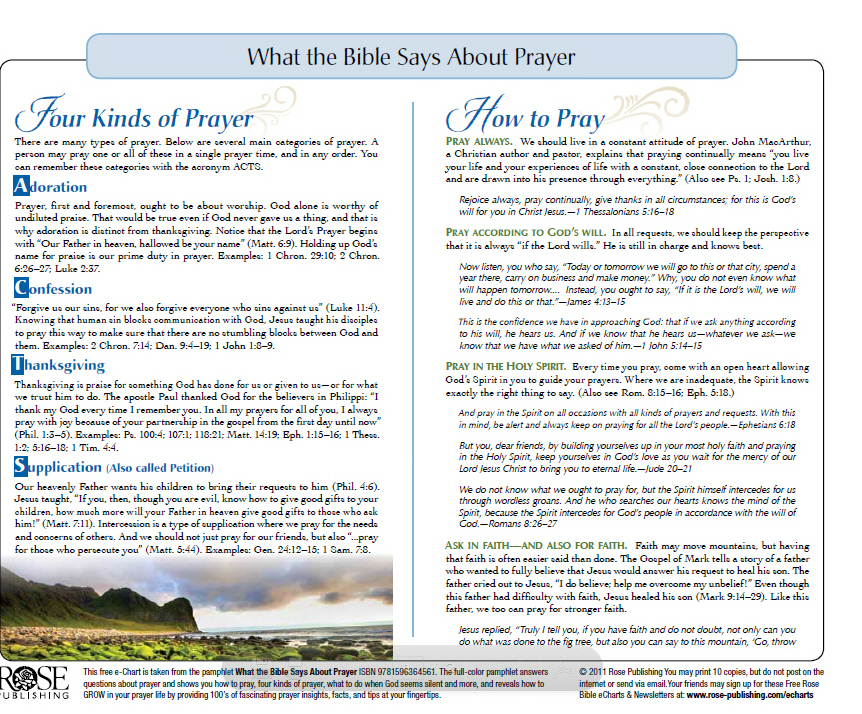
From: Rose Publishing Free Charts
He gave His blood
“It is impossible for the blood of bulls and goats to take away sins.”
Hebrews 10:4 NIV
Sacrifices could offer temporary solutions, but only God could offer the eternal one.
So he did.
Beneath the rubble of a fallen world, he pierced his hands. In the wreckage of a collapsed humanity, he ripped open his side . . . He gave his blood.
It was all he had.
Max Lucado
Verse of the Day – July 11
Ah, Sovereign LORD, you have made the heavens and the earth by your great power and outstretched arm. Nothing is too hard for you.
Some of the Greatest, Ugliest, Deadliest things in the world
The most destructive habit………………………………..Worry
The greatest Joy………………………………………………Giving
The greatest loss…………………………Loss of self-respect
The most satisfying work…………………….Helping others
The ugliest personality trait………………………Selfishness
The most endangered species……….Dedicated leaders
Our greatest natural resource……………………..Our youth
The greatest “shot in the arm”…………..Encouragement
The greatest problem to overcome……………………..Fear
The most effective sleeping pill……………Peace of mind
The most crippling failure disease…………………Excuses
The most powerful force in life……………………………Love
The most dangerous pariah……………………….A gossiper
The world’s most incredible computer…………The brain
The worst thing to be without……………………………. Hope
The deadliest weapon……………………………….The tongue
The two most power-filled words…………………….”I Can”
The greatest asset………………………………………………Faith
The most worthless emotion…………………………Self-pity
The most beautiful attire……………………………..A SMILE!
The most prized possession………………………….Integrity
The most powerful channel of communication…Prayer
The most contagious spirit………………………Enthusiasm
Spiritual Warfare
(Scripture is from The New Living Translation)
For the purposes of discussion, let’s call this spiritual warfare Good vs. Evil.
Good influence is from God.
The source of evil influence is from Satan.
We can grow spiritually by involving ourselves in the fight against any form of evil.
Of course we know that this spiritual warfare is far-reaching and encompasses much more than the simplistic terms of good vs. evil, but at least this is a beginning to understand the opposed forces that are present around us.
Spiritual growth means deciding to do whatever is necessary to move closer to God. It is similar to our human relationships.
If we don’t exercise movement toward the other person, we become stagnant, and are in jeopardy of even moving in the other direction.
We have powerful resources from God to grow spiritually. They are
- the Bible (His Word),
- the power of love,
- God’s grace,
- the Holy Spirit,
- spiritual leaders,
- and our understanding of truth and reality.
Knowing the truth is what sets free.
The opposite forces that influence us are powerful forces too:
- hate,
- bigotry,
- selfishness,
- fear,
- ignorance and
- falsehood.
When we can at least recognize that we are in a spiritual battle and understand the forces that are influencing our lives, we can become victorious through God by using the powerful resources He has given us.
From the moment we are born, we have two forces pulling us.
One is God.
The other is Satan.
Since we are in the middle, we need to have scripture and knowledge to recognize the forces that each use to influence us. God tells us in Romans 1:19-20:
19
For the truth about God is known to them instinctively. God has put this knowledge in their hearts.
20
From the time the world was created, people have seen the earth and sky and all that God made. They can clearly see his invisible qualities–his eternal power and divine nature. So they have no excuse whatsoever for not knowing God.
As the scripture states in these verses, there is no excuse for not knowing God. He put a natural inquiring nature in each of us to search for our Creator. We look around us and know there is someone who created all things.
God pulls us to know Him, to know Jesus his only begotten son.
John 3:16-21:
16
“For God so loved the world that he gave his only Son, so that everyone who believes in him will not perish but have eternal life.
17
God did not send his Son into the world to condemn it, but to save it.
Satan is constantly doing everything he can to hold us back from seeking the Creator and doing good. God has given us scripture that clearly shows us that this is true:
John 3:18-21:
18
“There is no judgment awaiting those who trust him. But those who do not trust him have already been judged for not believing in the only Son of God.
19
Their judgment is based on this fact: The light from heaven came into the world, but they loved the darkness more than the light, for their actions were evil.
20
They hate the light because they want to sin in the darkness. They stay away from the light for fear their sins will be exposed and they will be punished.
21
But those who do what is right come to the light gladly, so everyone can see that they are doing what God wants.
So, how do we determine good? It is expressed through knowing God and His terms. We can test the spirits–fear and confusion is not of God.
It could be a simple analysis of whether one is
- “doing unto others as he would have them do unto him.”
- we love the Lord our God with all our heart, soul, mind, and strength, and love others as we love ourselves.
A person would therefore show unselfishness, always putting others first, be always caring and considering what is best for others, what is best for their spiritual growth and well-being. These are God’s ways.
Conversely, Evil is expressed through extreme selfishness, seeking our own desires, and totally disregarding the well being of others.
That could be manifest through many forms such as
- stealing,
- lying,
- murder,
- rape,
- gossip, and
- misuse of the name of the Lord, our God,
- and all other of the 10 commandments.
Evil is further shown through refusing to follow God.
Test what the Holy Spirit says within us.
Romans 1:21-32
21
Yes, they knew God, but they wouldn’t worship him as God or even give him thanks. And they began to think up foolish ideas of what God was like. The result was that their minds became dark and confused.
22
Claiming to be wise, they became utter fools instead.
23
And instead of worshiping the glorious, ever-living God, they worshiped idols made to look like mere people, or birds and animals and snakes.
24
So God let them go ahead and do whatever shameful things their hearts desired. As a result, they did vile and degrading things with each other’s bodies.
25
Instead of believing what they knew was the truth about God, they deliberately chose to believe lies. So they worshiped the things God made but not the Creator himself, who is to be praised forever. Amen.
26
That is why God abandoned them to their shameful desires. Even the women turned against the natural way to have sex and instead indulged in sex with each other.
27
And the men, instead of having normal sexual relationships with women, burned with lust for each other. Men did shameful things with other men and, as a result, suffered within themselves the penalty they so richly deserved. 28When they refused to acknowledge God, he abandoned them to their evil minds and let them do things that should never be done.
29
Their lives became full of every kind of wickedness, sin, greed, hate, envy, murder, fighting, deception, malicious behavior, and gossip.
30
They are backstabbers, haters of God, insolent, proud, and boastful. They are forever inventing new ways of sinning and are disobedient to their parents.
31
They refuse to understand, break their promises, and are heartless and unforgiving.
32
They are fully aware of God’s death penalty for those who do these things, yet they go right ahead and do them anyway. And, worse yet, they encourage others to do them, too.
Before we ask Jesus to come into our hearts and have a personal relationship with us as our Lord and Master, our conscience lets us know what is right and wrong, good or evil.
After we are saved, the Holy Spirit resides in us to quicken our spirits to know the difference. If Satan can delude us into thinking he doesn’t exist, then we will not recognize that we need to fight. And without fighting, we will be automatically tripped up. Without going into the battle wearing the whole armor of God, we will also be tripped up. God shows us truth, and truth will set us free.
We don’t need to overemphasize Satan, but we do need to recognize that we are in the battle. Since Jesus already defeated Satan when He died on the cross, then winning the battle is in recognizing Satan yipping at our heels, trying to trip us up, and trusting God’s armor to shield us during the battle.
Satan can only fight.
He can’t win.
He can fight in a myriad of ways, but we need to remember the battle has already been won.
God’s victory in us is won when we remain faithful to Him with constant determination to “NEVER GIVE UP”.
When we love unconditionally, as God does (agape love), no matter what, we give our trust to God.
Putting On the Whole Armor of God
Therefore take up the whole armor of God, that you may be able to withstand in the evil day, and having done all, to stand. NKJV
Ephesians 6:13
To Read and Understand the Bible, as well as to walk with the Lord, you need, everyday to put on the “Whole Armor of God”.
Each part of the armor is very, very important!
- The helmet covers your mind,
- the breastplate covers your heart,
- the shoes teach you how to walk,
- the shield protects you
- and the sword helps you to win the war.
Each part of the armor also shows us what God has done for us.
The whole armor is very important for Living the Christian Life and Studying the Word of God.
A new heart
“You were taught to be made new in your hearts, to become a new person.” Ephesians 4:23
What if, for one day and one night, Jesus lives your life with his heart? Your heart gets the day off, and your life is led by the heart of the Christ. His priorities govern your actions. His passions drive your decisions. His love directs your behavior . . .
Would people notice a change? Would you still do what you had planned to do for the next twenty-four hours?
Max Lucado
What do I do when Satan attacks?
God will guard us from the evil one.
As we are aware of God’s Word, and choose to follow God’s Way to resist the devil, the devil has no choice but to flee from us.
Memorizing Scripture helps to bring to our minds the right thing to say to diffuse the attack. Our words hold no power over the enemy, but God’s words are as powerful as a two-edged sword.
Be careful! Watch out for attacks from the Devil, your great enemy. He prowls around like a roaring lion, looking for some victim to devour. Take a firm stand against him, and be strong in your faith. Remember that your Christian brothers and sisters all over the world are going through the same kind of suffering you are.
1 Peter 5:8-9 NLT
So humble yourselves before God. Resist the Devil, and he will flee from you. Draw close to God, and God will draw close to you.
James 4:7-8 NLT
What is a blessing?
God is faithful to those who love him
Oh, the joys of those who do not follow the advice of the wicked, or stand around with sinners, or join in with scoffers.
Psalm 1:1 NLT
A lot of public figures end their public appearances by saying, “God bless America.” This week, we’re going to look at what God’s blessing means — to us as individuals and as a nation.
Blessings have to do with both giving and receiving. It was a vital part of life in Bible times. To bless someone meant many things…to praise them, pray for them, and commit them to God’s care. It also meant to dedicate and challenge them to live forever committed to God, to keep hold of spiritual things. It was a call for abundance and prosperity for another. And it was also a way of officially passing on the family inheritance to the oldest son.
Wishes for a rich and abundant life were inherent in a blessing, although not always in a material sense. God was recognized as the ultimate source of the blessing. The person blessed would walk with the Lord and receive his benefits.
To receive God’s blessing meant not only to enjoy innumerable tangible gifts but in a much deeper way to be welcomed into a special relationship with him, a relationship to be affirmed and practiced. Part of this, in turn, means being a blessing to others, a way of saying we have been a godly help for others.
adapted from the TouchPoint Bible Tyndale House Publishers, p 1158
Content is derived from the Holy Bible, New Living Translation and other publications of Tyndale Publishing House
Finding and Fulfilling Your Destiny
For a wide door of opportunity for effectual [service] has opened to me [there, a great and promising one], and [there are] many adversaries.
—1 Corinthians 16:9
God promotes us into the fullness of His will in degrees or stages. Satan opposes each new phase of our progress. If we do not understand this fact we will become confused and think we have made a mistake.
Satan seeks to wear us out. He wants to bring such opposition against us that we become so weary and discouraged we give up. With opportunity comes opposition.
We must beware of compromise. Satan doesn’t want us in the will of God, fulfilling our destiny. If he cannot keep us completely out of God’s will, his next tactic is to tempt us to do a little less than what God has said.
Satan tempts us to compromise. But he fails to tell us that in the end we will feel empty, regretful, lonely, discouraged, and unfulfilled.
Procrastination is another deceptive tool of the devil. Good intentions do not bring us into the blessings of God—only obedience does. Our willful choice to obey God promptly is the lifeline between heart’s desire and finished product.
Press on! Don’t look back! Satan may think he is destroying you, but often he is giving you valuable experience that will keep you out of trouble.
“No more deals. No more compromise and procrastination. Henceforth, I am walking in the will of God.”
He began a good work in you and He will complete it
“being confident of this, that he who began a good work in you will carry it on to completion until the day of Christ Jesus.”
What is the difference between a need and a want?
A need facilitates something.
The object of need is like the road to your destination.
There are also different levels of needs.
For example, we need air more than we need clothes,
and we need a heart more than we need a hand.
Our greatest need is God because he is the source
(facilitator) of all good things.
A want, in essence, does not affect the course.
It simply makes the journey more enjoyable.
~A MountainWings Original, Coyette Clunie, Jamaica W.I.~
How can I defend myself against Satan’s attacks?
Be strong with the Lord’s mighty power. Put on all of God’s armor so that you will be to stand firm against all the strategies and tricks of the Devil. For we are not fighting against people made of flesh and blood, but against the evil rulers and authorities of the unseen world, against those mighty powers of darkness who rule this world, and against wicked spirits in the heavenly realms.
Ephesians 6:10-12 NLT
Tricking Houdini
During his life, Harry Houdini had a standing challenge that he could escape from any jail cell within an hour. A small town in the British Isles had just constructed a new jail cell they thought was escape-proof, and they wanted to put it to the test. Houdini entered the cell and immediately went to work. After two grueling hours — an hour past his deadline — Houdini finally withdrew his file from the lock and leaned against the door in exhaustion. To his amazement, the cell door swung open.
The jailors had tricked the great magician by closing the jail door but never bolting the lock. He was free all along, he just didn’t know it.
Satan has the same strategy, doesn’t he? His greatest weapon is to make us think that we are trapped, when in reality the cell door is always open. Satan can’t bind us, so he tricks us into making us believe the cell door is locked.
Adapted from a devotional by Frank Martin in Embracing Eternity (Tyndale House) p 292
Content is derived from the Holy Bible, New Living Translation and other publications of Tyndale Publishing House
10 Rules for A Good Day
1. TODAY I WILL NOT STRIKE BACK:
If someone is rude,
if someone is impatient,
if someone is unkind
I will not respond in a
like manner.
2. TODAY I WILL ASK FOR BLESSINGS ON MY “ENEMY”:
If I come across someone who treats me harshly
or unfairly,
I will quietly ask to bless that individual.
I understand my idea of the “enemy” could be a
family member,
neighbor,
co-worker,
or a stranger.
3. TODAY I WILL BE CAREFUL ABOUT WHAT I SAY:
I will carefully choose and guard my words
being certain that I do not spread gossip.
4. TODAY I WILL GO THE EXTRA MILE:
I will find ways to help share the burden
of another person.
5. TODAY I WILL FORGIVE:
I will forgive any hurts or injuries
that come my way.
6. TODAY I WILL DO SOMETHING NICE FOR SOMEONE,
WHETHER DONE OPENLY OR SECRETLY:
I will reach out and bless
the life of another.
7. TODAY I WILL TREAT OTHERS THE WAY I WISH TO BE TREATED:
I will practice the golden rule –
“Do unto others as I would have them do unto me” –
with everyone I encounter.
8. TODAY I WILL RAISE THE SPIRITS OF SOMEONE:
My smile,
my words,
my expression of support,
can make the difference to someone
who is wrestling life.
9. TODAY I WILL NUTURE MY BODY:
I will try to eat less and
I will try to eat only healthy foods.
10. TODAY I WILL GROW SPIRITUALLY:
I will spend a little more time in prayer today:
I will begin reading something spiritual
or inspirational today;
I will find a quiet place ( at some point during
the day )
and listen for, and to, God’s voice,
and obey!
You have magnified Your Word above all Your name
“I will worship toward Your holy temple, And praise Your name For Your lovingkindness and Your truth; For You have magnified Your word above all Your name.”
Daily Promises – July 8

You have won!
“This is the victory that conquers the world—our faith.”
1 John 5:4
What is unique about the kingdom of God is that you are assured of victory. You have won!
If you have no faith in the future, then you have no power in the present.
If you have no faith in the life beyond this life, then your present life is going to be powerless.
But if you believe in the future and are assured of victory, then there should be a dance in your step and a smile on your face.
Max Lucado
Learning to Live Loved
God’s love does not hinge on yours.
The abundance of your love does not increase his.
The lack of your love does not diminish his.
Your goodness does not enhance his love,
nor does your weakness dilute it.
What Moses said to Israel is what God says to us:
“The LORD did not choose you and lavish his love on you
because you were larger or greater than other nations,
for you were the smallest of all nations!
It was simply because
the LORD loves you.” (Deut. 7:7-8 NLT)
God loves you simply because he has chosen to do so.
He loves you when you don’t feel lovely.
He loves you when no one else loves you.
Others may abandon you, divorce you, and ignore you,
but God will love you. Always. No matter what.
This is his sentiment: “I’ll call nobodies and make them somebodies;
I’ll call the unloved and make them beloved.”
(Rom. 9:25 MSG).
This is his promise. “I have loved you, my people,
with an everlasting love.
With unfailing love I have drawn you to myself. (Jer. 31:3 NLT).
Our love depends on the receiver of the love.
Let a thousand people pass before us,
and we will not feel the same about each.
Our love will be regulated by their appearance,
by their personalities.
Even when we find a few people we like,
our feelings will fluctuate.
How they treat us will affect how we love them.
the receiver regulates our love.
Not so with the love of God.
We have no thermostatic impact on his love for us.
The love of God is born from within him,
not from what he finds in us.
His love is uncaused and spontaneous.
As Charles Wesley said, “He hath loved us.
He hath loved us.
Because he would love.”
Does he love us because of our goodness?
Because of our kindness?
Because of our great faith?
No, he loves us because of his goodness,
kindness, and great faith.
John says it like this: “This is love: not that we loved God,
but that he loved us” (I John 4:10 NIV).
Do you know what else that means?
You have a deep aquifer of love from which to draw.
When you find it hard to love,
then you need a drink!
Drink deeply! Drink daily!
Don’t forget, love is a fruit.
Step into the orchard of God’s work,
and what is the first fruit you see?
“Love, joy, peace, patience, kindness, goodness, faithfulness,
gentleness, and self-control” (Gal.5:22 NIV, emphasis mine).
Love is a fruit.
A fruit of whom?
Of your hard work?
Of your deep faith?
Of your rigorous resolve?
No.
Love is a fruit of the Spirit of God.
“The Spirit produces the fruit” (Gal.5:22).
And, this is so important,
you are a branch on the vine of God.
“I am the vine, and you are the branches” (John 15:5).
Need a refresher course on how vines function?
What is the role of the branch in the bearing of fruit?
Branches don’t exert a lot of energy.
You never hear of gardeners treating branches for exhaustion.
Branches don’t attend clinics on stress management.
Nor do they groan and grunt.
I’ve got to get this grape out.
I’m going to bear this grape if it kills me!”
No, the branch does none of that.
The branch has one job–to receive nourishment
from the vine.
And you have one job–to receive nourishment from Jesus.
“I am the Vine, you are the branches.
When you’re joined with me and I with you,
the relation is intimate and organic,
the harvest is sure to be abundant.
Separated, you can’t produce a thing” (John 15:5 MSG).
Our Lord gets no argument from us on that last line, does he?
We have learned the hard way apart from him we can’t produce a thing.
Don’t you think it’s time we learn what happens
if we stay attached?
His job is to bear fruit.
Our job is to stay put.
The more tightly we are attached to
Jesus, the more purely his love can pass through us.
And oh, what a love it is!
Patient.
Kind.
Does not envy.
Does not boast.
Is not proud.
Let’s rewrite 1 Corinthians 13:4-8 one more time.
Not with your name or Jesus’ name but with both.
Read it aloud with your name in the blank, and see what you think.
Christ in _____ is patient, Christ in _____ is kind. Christ in _____ does not envy,
Christ in _____ does not boast, Christ in _____ is not proud.
Christ in _____ is not rude, Christ in _____ is not self-seeking,
Christ in _____ is not easily angered,
Christ in _____ keeps no record of wrongs.
Christ in _____ does not delight in evil but rejoices
with the truth.
Christ in _____ always protects, always perseveres.
Christ in _____ never fails.
Will we ever love like that?
will we ever love perfectly?
No.
This side of heaven only God will.
but we will love better than we have.
By being loved, we will love.
My Wish For You
- Where there is pain; I wish you peace and mercy.
- Where there is self-doubting, I wish you a renewed
confidence in your ability to work through it. - Where there is tiredness, or exhaustion, I wish you
understanding, patience, and renewed strength. - Where there is fear; I wish you love, and courage.
INSTALLING LOVE
INSTALLING LOVE
Tech Support: Yes, … how can I help you?
Customer: Well, after much consideration, I’ve decided to install Love. Can you guide me though the process?
Tech Support: Yes. I can help you. Are you ready to proceed?
Customer: Well, I’m not very technical, but I think I’m ready. What do I do first?
Tech Support: The first step is to open your Heart. Have you located your Heart?
Customer: Yes, but there are several other programs running now. Is it okay to install Love while they are running?
Tech Support: What programs are running?
Customer: Let’s see, I have Past Hurt, Low Self-Esteem, Grudge and Resentment running right now
Tech Support: No problem, Love will gradually erase Past Hurt from your current operating system. It may remain in your permanent memory but it will no longer disrupt other programs. Love will eventually override Low Self-Esteem with a module of its own called High Self-Esteem. However, you have to completely turn off Grudge and Resentment. Those programs prevent Love from being properly installed. Can you turn those off?
Customer: I don’t know how to turn them off. Can you tell me how?
Tech Support: With pleasure. Go to your start menu and invoke Forgiveness. Do this as many times as necessary until Grudge and Resentment have been completely erased.
Customer: Okay, done! Love has started installing itself. Is that normal?
Tech Support: Yes, but remember that you have only the base program. You need to begin connecting to the Hearts in order to get the upgrades.
Customer: Oops! I have an error message already. It says, “Error – Program not run on external components .” What should I do?
Tech Support: Don’t worry. It means that the Love program is set up to run on Internal Hearts, but has not yet been run on your Heart. In non-technical terms, it simply means you have to Love yourself before you can Love others.
Customer: So, what should I do?
Tech Support: Pull down Self-Acceptance; then click on the following files: Forgive-Self; Realize Your Worth; and Acknowledge your Limitations.
Customer: Okay, done.
Tech Support: Now, copy them to the “My Heart” directory. The system will overwrite any conflicting files and begin patching faulty programming. Also,you need to delete Verbose Self-Criticism from all directories and empty your Recycle Bin to make sure it is completely gone and never comes back.
Customer: Got it. Hey! My heart is filling up with new files. Smile is playing on my monitor and Peace and Contentment are copying themselves all over My Heart. Is this normal?
Tech Support: Sometimes. For others it takes awhile, but eventually everything gets it at the proper time. So Love is installed and running. One more thing before we hang up. Love is Freeware. Be sure to give it and its various modules to everyone you meet. They will in turn share it with others and return some cool modules back to you.
Customer: Thank you.
WHOLENESS AND MEANING IN LIFE
by Neil Anderson
July 7
Galatians 3:26
You are all sons of God through faith in Christ Jesus
Several years ago a 17-year-old girl drove a great distance to talk with me. I have never met a girl who had so much going for her. She was cover-girl pretty with a wonderful figure. She was immaculately dressed. She had completed 12 years of school in 11 years, graduating with a very high grade point average. As a talented musician, she had received a music scholarship to a Christian university. And she drove a brand-new sports car her parents gave her for graduation. I was amazed that one person could have so much.
She talked with me for half an hour and I realized that what I saw on the outside wasn’t matching what I was beginning to see on the inside. “Mary,” I said finally, “have you ever cried yourself to sleep at night because you felt inadequate and wished you were somebody else?”
She began to cry. “How did you know?”
“Truthfully, Mary,” I answered, “I’ve learned that people who appear to have it all together are often far from being together inside.”
Often what we show on the outside is a false front designed to disguise who we really are and cover up the secret hurts we feel about our identity. Somehow we believe that if we appear attractive or perform well or enjoy a certain amount of status, then we will have it all together inside as well. But that’s not necessarily true. External appearance, accomplishment and recognition don’t necessarily reflect–or produce–internal peace and maturity. All the stuff and status you can acquire don’t add up to personal wholeness. Millions of people climb those ladders to success, only to discover when they reach the top that they are leaning against the wrong wall!
Wholeness and meaning in life are not the products of what you have or don’t have, what you’ve done or haven’t done. You are already a whole person and possess a life of infinite meaning and purpose because of who you are–a child of God. The only identity equation that works in God’s kingdom is you plus Christ equals wholeness and meaning.
Prayer: Father God, I wouldn’t trade the wholeness and meaning You have brought to my life for anything the world can produce.
Love The LORD Your God
Love The LORD Your God
“The LORD your God is one LORD; and you shall love the LORD your God with all your heart, and with all your soul, and with all your might. And these words which I command you this day shall be upon your heart; and you shall teach them diligently to your children, and you shall talk of them when you sit in your house, and when you walk by the way, and when you lie down, and when you rise.” Deuteronomy 6:4-7
Do we love the LORD our God with ALL our heart, ALL our soul and ALL our might? If so, we will be doing what He has commanded us to do here, to share with our children our love for the LORD and all that He has done for us.
Think about the legacy that we have been given to pass on to our children and to our children’s children. What joy to be able to share with them the love of the Lord and all that He is to us and has been throughout our walk with Him! We can pass on to them the wonder of His grace and forgiveness. We can share our joy in being the sons and daughters of the King!
There is no greater gift that we can give to our children than to pass on to them the excitement and joy of knowing the LORD. It is so easy to get caught up in the things of this world and to let weariness overtake us, but when we sit down to dinner with our families let us resolve today that we will talk of the way the LORD has led us and that we will share with our children the things He has done for us.
When we kiss them good night, let the love of the LORD be on our lips, so the last thing that they are thinking about before they slip into sleep is Him.
Keep the legacy going: tell your children, or your grandchildren, or a niece or a nephew what the LORD has done in your life and watch that seed take root in their hearts.
Father, Your love has reached me and it is changing me. Help me to leave my children, grandchildren, nieces and nephews the legacy of that love. Help me to express to them just what a wonderful Father You are.
Help me to live in such a way that they will see it is good to walk with You. May Your presence be evident in every part of my life. Use me to draw your little ones to You. Amen
~~~~~~~~~~~~~~~~~~~~
God’s Way is Perfect
“As for God, His way is perfect; The word of the LORD is proven; He is a shield to all who trust in Him.”
God’s Words will never pass away
“Heaven and earth will pass away, but My words will by no means pass away.” Matthew 24:35 NKJV
Daily Promises – July 6 (Please read the whole message)

(Note: I was a bit edgy when I posted this daily promise, because it didn’t feel right to me. So I looked up the verse in the NKJV, in its context. I would admonish us all to be aware of what the Holy Spirit’s job is…to lead us into all truth. The whole truth. And to be careful what we say, how we say it, and make sure that it is not misleading. I really liked the concept of the Lord healing all of our diseases, but as we see, people are not necessarily healed here on the earth. We are healed, fully, when we get to heaven. So . . . read the scripture in it’s entirety. Let’s discuss the meaning. My understanding is that there are conditions to his promise. I will be thinking and praying about these verses, and as the Holy Spirit leads me, I will add any new understanding that God gives me.)
New King James Version (NKJV)
Exodus 15
The Song of Moses
1 Then Moses and the children of Israel sang this song to the LORD, and spoke, saying:
“I will sing to the LORD,
For He has triumphed gloriously!
The horse and its rider
He has thrown into the sea!
2 The LORD is my strength and song,
And He has become my salvation;
He is my God, and I will praise Him;
My father’s God, and I will exalt Him.
3 The LORD is a man of war;
The LORD is His name.
4 Pharaoh’s chariots and his army He has cast into the sea;
His chosen captains also are drowned in the Red Sea.
5 The depths have covered them;
They sank to the bottom like a stone.
6 “Your right hand, O LORD, has become glorious in power;
Your right hand, O LORD, has dashed the enemy in pieces.
7 And in the greatness of Your excellence
You have overthrown those who rose against You;
You sent forth Your wrath;
It consumed them like stubble.
8 And with the blast of Your nostrils
The waters were gathered together;
The floods stood upright like a heap;
The depths congealed in the heart of the sea.
9 The enemy said, ‘I will pursue,
I will overtake,
I will divide the spoil;
My desire shall be satisfied on them.
I will draw my sword,
My hand shall destroy them.’
10 You blew with Your wind,
The sea covered them;
They sank like lead in the mighty waters.
11 “Who is like You, O LORD, among the gods?
Who is like You, glorious in holiness,
Fearful in praises, doing wonders?
12 You stretched out Your right hand;
The earth swallowed them.
13 You in Your mercy have led forth
The people whom You have redeemed;
You have guided them in Your strength
To Your holy habitation.
14 “The people will hear and be afraid;
Sorrow will take hold of the inhabitants of Philistia.
15 Then the chiefs of Edom will be dismayed;
The mighty men of Moab,
Trembling will take hold of them;
All the inhabitants of Canaan will melt away.
16 Fear and dread will fall on them;
By the greatness of Your arm
They will be as still as a stone,
Till Your people pass over, O LORD,
Till the people pass over
Whom You have purchased.
17 You will bring them in and plant them
In the mountain of Your inheritance,
In the place, O LORD, which You have made
For Your own dwelling,
The sanctuary, O Lord, which Your hands have established.
18 “The LORD shall reign forever and ever.”
19 For the horses of Pharaoh went with his chariots and his horsemen into the sea, and the LORD brought back the waters of the sea upon them. But the children of Israel went on dry land in the midst of the sea.
The Song of Miriam
20 Then Miriam the prophetess, the sister of Aaron, took the timbrel in her hand; and all the women went out after her with timbrels and with dances. 21 And Miriam answered them:
“Sing to the LORD,
For He has triumphed gloriously!
The horse and its rider
He has thrown into the sea!”
Bitter Waters Made Sweet
22 So Moses brought Israel from the Red Sea; then they went out into the Wilderness of Shur. And they went three days in the wilderness and found no water. 23 Now when they came to Marah, they could not drink the waters of Marah, for they were bitter. Therefore the name of it was called Marah.[a] 24 And the people complained against Moses, saying, “What shall we drink?” 25 So he cried out to the LORD, and the LORD showed him a tree. When he cast it into the waters, the waters were made sweet.
There He made a statute and an ordinance for them, and there He tested them, 26 and said, “If you diligently heed the voice of the LORD your God and do what is right in His sight, give ear to His commandments and keep all His statutes, I will put none of the diseases on you which I have brought on the Egyptians. For I am the LORD who heals you.”
27 Then they came to Elim, where there were twelve wells of water and seventy palm trees; so they camped there by the waters.
Praise the Lord
“And in that day you will say: “ Praise the LORD, call upon His name; Declare His deeds among the peoples, Make mention that His name is exalted.”
Daily Promises – July 5

Long to be more loving?
“Let us love one another, for love is of God.”
I John 4:7, NKJV
Long to be more loving? Begin by accepting your place as a dearly loved child.
“Be imitators of God, therefore, as dearly loved children”
(Ephesians 5:1, NIV).
Want to learn to forgive? Then consider how you’ve been forgiven.
“Be kind and compassionate to one another, forgiving each other, just as in Christ God forgave you”
(Ephesians 4:32, NIV)
Max Lucado
Blessed is the nation whose God is the Lord
“Blessed is the nation whose God is the LORD, The people He has chosen as His own inheritance.”
Daily Promises – July 4

Daily Promises – July 3

Righteousness exalts a nation
“Righteousness exalts a nation, But sin is a reproach to any people.”
As Independence Day, July 4th approaches, this verse should really speak to us–to remember to pray for our country– that its righteousness remain in tact.
Who can know the heart?
“ The heart is deceitful above all things, And desperately wicked; Who can know it? I, the LORD, search the heart, I test the mind, Even to give every man according to his ways, According to the fruit of his doings.”
Daily Promise – July 2

Serve God with Spiritual Gifts
“[Serve God with Spiritual Gifts] For I say, through the grace given to me, to everyone who is among you, not to think of himself more highly than he ought to think, but to think soberly, as God has dealt to each one a measure of faith.”
The State of your Heart
“The good man brings good things out of the good stored up in his heart.”
Luke 6:45, NIV
When you are offered a morsel of gossip marinated in slander, do you turn it down or pass it on? That depends on the state of your heart . . . The state of your heart dictates whether you harbor a grudge or give grace, seek self-pity or seek Christ, drink human misery or taste God’s mercy.
Max Lucado
The Lord shall be King over all the earth
“And the LORD shall be King over all the earth. In that day it shall be— “ The LORD is one,” And His name one.”
Daily Promises – June 30

Can evil overcome me?
Can evil overcome me?
I look up to the mountains—does my help come from there? My help comes from the Lord, who made the heavens and the earth!
He will not let you stumble and fall; the one who watches over you and will not sleep. Indeed, he who watches over Israel never tires and never sleeps. The Lord himself watches over you! The Lord stands beside you as your protective shade. The sun will not hurt you by day, nor the moon at night. The Lord keeps you from all evil and preserves your life. The Lord keeps watch over you as you come and go, both now and forever.
Psalm 121 NLT
Protection for the soul
Psalm 121 is one of a collection of “songs of ascent” sung by Jewish pilgrims on their way to Jerusalem for one of Israel’s great feasts. Basically it is hymn of trust that God will watch over his people as they journey along potentially dangerous roads, up through the hills of Judea to the Holy City.
Does God say that his people will never encounter trouble? No. The awful truth is that even Christians get robbed and mugged, raped and murdered. Statistics indicate that more followers of Jesus were martyred for their faith in the twentieth century than in the previous nineteen centuries combined. You will not find any biblical evidence to suggest that believers are exempt from the ugly violence of a fallen world.
As Jesus said in Matthew 10:28: At worst, evil people “can only kill your body; they cannot touch your soul.”
Based on Praying God’s Promises in Tough Times by Len Woods (Tyndale) p 94
Content is derived from the Holy Bible, New Living Translation and other publications of Tyndale Publishing House
Daily Promises – June 29

God sees your future with perfect clarity

From the world’s point of view the future seems unclear, uncertain, and unstable.
When it comes to your future, God has a different point of view. God sees your future with perfect clarity, He knows your future with absolute certainty, and He is directing your future toward a glorious destiny.
How can you be assured of the future God has for you? You can be assured because God is already there, because He is preparing the way ahead of you, and because He will take you by the hand lead you into His plans for your future.
You can trust Him with your future because He is wise and will not make a mistake; He is all-knowing and will not lose His way; He is good and will not bring you harm.
God does not ask you to plan your future, but He does ask you to trust Him and follow His plan. Trusting His plan will keep you from being worried, fearful, or anxious about the future. Your future is as bright as the promises of God.
As you think about your future, let your faith embrace these bright promises of God:
“God’s way is perfect. All the LORD’s promises prove true.” II Samuel 22:31 NLT
Trust in the LORD with all your heart; do not depend on your own understanding. Seek His will in all you do, and He will show you which path to take. Proverbs 3:5-6 NLT
The Lord says, “I will guide you along the best pathway for your life. I will advise you and watch over you.”” Psalm 32:8 NLT
“For I know the plans I have for you,” says the LORD. “They are plans for good and not for disaster, to give you a future and a hope.” Jeremiah 29:12 NLT
Roy Lessin
Co-founder DaySpring Cards
6/29/11
“The LORD will perfect that which concerns me; Your mercy, O LORD, endures forever; Do not forsake the works of Your hands.”
What hope do I have to face evil?
God will guard you from the evil one
In the year that King Uzziah died, I saw the Lord. He was seated on a lofty throne, and the train of his robe filled the Temple. Hovering around him were mighty seraphim, each with six wings.…In a great chorus they sang, “Holy, holy, holy is the Lord Almighty! The whole earth is filled with his glory!”
Isaiah 6:1-4 NLT
Lead on, O King eternal,
Till sin’s fierce war shall cease,
And holiness shall whisper
The sweet amen of peace.
For not with swords’ loud clashing,
Nor roll of stirring drums,
With deeds of love and mercy
The heavenly kingdom comes.
Ernest Warburton Shurtleff
The day of march has come
In 1887, Ernest Shurtleff was about to graduate from Andover Seminary. Ernest wrote a hymn for the entire graduating class to sing. He told his fellow seminarians, “We’ve been spending days of preparation here at seminary. Now the day of march has come, and we must go out to follow the leadership of the King of kings, to conquer the world under His banner.”
Thus, “Lead On, O King Eternal” was written for a seminary graduating class. Our commencements are not always so dramatic, but there is no reason our eternal King cannot open a new door for us today. We can step out and march under His banner, “not with fears, for gladness breaks like morning where’er thy face appears.”
From The One Year Book of Hymns (Tyndale House) entry for January 15
Content is derived from the Holy Bible, New Living Translation and other publications of Tyndale Publishing House
Lead on, O King eternal,
The day of march has come
Henceforth in fields of conquest
They tents shall be our home.
Through days of preparation
Thy grace has made us strong,
And now, O King eternal,
We lift our battle song.
Lead on, O King eternal,
Till sin’s fierce war shall cease.
And holiness shall whisper
The sweet amen of peace.
For not with swords loud clashing,
Nor roll of stirring drums,
With deeds of love and mercy,
The heavenly kingdom comes.
Lead on, O King eternal,
We follow, not with fears.
For gladness breaks like morning
Where’er Thy face appears.
Thy cross is lifted o’er us;
We journey in it’s light.
The crown awaits the conquest,
Lead on, O God of might.
The whole earth will hear
To those who have not heard
My ambition has always been to preach the Good News where the name of Christ has never been heard, rather than where a church has already been started by someone else. I have been following the plan spoken of in Scriptures, where it says, “Those who have never been told about him will see, and those who have never heard of him will understand.”
Romans 15:20-21 NLT
Under a haystack
Williams College in Williamstown, Massachusetts, was just twelve years old in 1805 when the Second Great Awakening reached the school. In the spring of 1806 Samuel Mills joined the freshman class with a passion to spread the gospel around the world. He began leading a group of four other students, who met three afternoons a week in a nearby maple grove.
One sultry day in August 1806 a violent thunderstorm interrupted their prayer time, and they took refuge on the sheltered side of a large haystack. God spoke to them as they prayed, and four of the five committed themselves to serving God overseas if he so led. The Haystack Prayer Meeting was not only the beginning of the first American student mission society but also the beginning of the American foreign missionary movement itself.
Two years later many of the group enrolled at Andover Seminary where they were joined by Adoniram Judson and others interested in foreign missions, but there was no foreign missions board in America to send them. Acting on the advice of a teacher, the students wrote a letter to the General Association of the Congregational Church. Two days later, on June 29, 1810, the association responded by forming the American Board of Commissioners for Foreign Missions.
From that humble beginning the foreign missions force of the United States has grown to over sixty thousand missionaries sent out by hundreds of mission boards.
Adapted from The One Year® Book of Christian History by E. Michael and Sharon Rusten (Tyndale, 2003), entry for June 29.
Content is derived from the Holy Bible, New Living Translation and other publications of Tyndale Publishing House
How can I please the Lord?
But Samuel replied [to Saul], “What is more pleasing to the Lord, your burnt offerings and sacrifices or your obedience to his voice? Obedience is far better than sacrifice. Listening to him is much better than offering the fat of rams. Rebelling is as bad as the sin of witchcraft, and stubbornness is as bad as worshiping idols.
1 Samuel 15:22-23 NLT
If you love me, obey my commandments.… You are my friends if you obey me.
John 14:15; 15:14 NLT
True Friends of Jesus Obey Him
How do we demonstrate our friendship with Jesus? Quite simply, we do what he says. If we refuse, we have no right to call ourselves his friends.
In 1 Samuel 15 the Bible tells how King Saul disobeyed the Lord’s command to completely destroy the enemies and their livestock. When Samuel asked the king why he heard the bleating of sheep and the lowing of cattle, Saul basically replied, “Oh, right, thanks for reminding me. We’re saving those to offer to the Lord later!”
Samuel recognized a lie when he heard one and replied, “To obey is better than sacrifice, and to heed is better than the fat of rams.” (1 Samuel 15:22 NIV). God wants the same from us, not some great annual recommitment that we soon break. He wants consistency. Regularity. Faithfulness. He wants our obedience.
Adapted from Breakfast with Jesus by Greg Laurie,
(Tyndale House) p 162
(Tyndale House) p 162
Content is derived from the Holy Bible, New Living Translation and other publications of Tyndale Publishing House
Why is obedience important to my spiritual life?
Today I am giving you the choice between a blessing and a curse! You will be blessed if you obey the commands of the Lord your God that I am giving you today. You will receive a curse if your reject the commands of the Lord your God and turn from his way by worshipping foreign gods.
Deuteronomy 11:26-28 NLT
If you will obey me and keep my covenant, you will be my own special treasure from among all nations of the earth; for all the earth belongs to me.
Exodus 19:5 NLT
“Those who obey my commandments are the ones who love me. And because they love me, my Father will love them, and I will love them.”
John 14:21 NLT
Countercultural Obedience
To speak positively of obedience today is be profoundly countercultural. The valid suspicion of talk about obedience is grounded in the experience of authoritarianisms, both past and present. Obedience is confused with “blind obedience,” which is normally odious. Obedience is confused with conformity, with going along, with asking no questions. But obedience really means responsiveness; it is related to the Latin audire, to hear, to listen, to respond appropriately. Obedience is not the surrender of responsibility but the acceptance of responsibility for what we respond to and how.
Richard John Neuhaus
Quoted in 1001 Great Stories and Quotes by R. Kent Hughes (Tyndale House), p 295
Content is derived from the Holy Bible, New Living Translation and other publications of Tyndale Publishing House
Achieving Success
An excerpt from
Goals
by Gary Ryan Blair
The odds that you’ll succeed without taking action are about the same as winning the lottery without buying a ticket!
For those times when you feel trapped, stressed, or in a prison of your own making, take purposeful action. It’s your Get-Out-Of-Jail-Free card.
In real estate, it’s location, location, location. In goal-setting, it’s action, action, action.
You can’t just stick out your thumb and hitchhike your way to success, you’ve got to roll up your sleeves and do the work that needs to be done.
Be seduced by the attractiveness of your goal. Inaction leads to impotence. Taking purposeful action immunizes you from “Goal Parkinson’s,” a long, slow goodbye to your dreams, talents and destiny.
A quality life is accomplished when thoughtful attention, goal setting, and purposeful action click into position. Whether your dream is to be or not to be is largely dependent upon your actions.
The cure for the ills of procrastination is a heavy prescription of action, until the day arrives when your dreams and their achievement are one in the same. When that day arrives, dream bigger dreams and take more action.
A good plan will almost always get you in the door, but it is action that seals the deal. So you want a guarantee? Well here it is: Without purposeful action, the only guarantee is failure and mediocrity!
Don’t tiptoe toward your goal, walk confidently before it waltzes off into the arms of neglect. Dreams become reality through one simple mode of transportation: purposeful action.
The continuation of bad habits, such as procrastination and poor follow through, is like having an addiction to weapons of mass destruction.
It is tragically un-hip to procrastinate. Unfortunately, the vast majority of people never display their true potential; it never has an opening night…never makes a debut.
The bulk of potential resides deep within each individual just waiting to come out, and it stays there because people are afraid. The mechanics of achieving a goal makes it easy for people to relate t the necessity of action. But when action is not purposeful, it can be an Achilles heel.
When we operate without planning, we remain forever scattered and confused. You’re always busy, but not much gets accomplished. Without a deeper appreciation and application of planning the most you can expect is marginal improvement.
Intimidate your fears through purposeful goal-directed activity. Since when is being the underdog any reason for not pursuing your dreams? Remember, it’s not the size of the dog in the fight…it’s the fight in the dog!
Don’t just pursue your goal…inhabit it. Wear it, act it, live it, taste it! Get committed – take action. Life is not a scratch-and-sniff test!
When you set a goal, there’s a distance between your current reality and desired reality. Procrastination increases the distance and minimizes the chances of achievement. Procrastination is the mother of regret. It postpones the future, aborts liftoff at the last minutes.
Unless you take action to achieve your goals, life becomes a constant series of postponements, cancellations, and missed opportunities.
You will never attain your goals simply by thinking and talking about them. You must take action as all success comes down to execution.
A New Creation
“If anyone belongs to Christ, there is a new creation.”
2 Corinthians 5:17
At our new birth God remakes our souls and gives us what we need, again. New eyes so we can see by faith. A new mind so we can have the mind of Christ. New strength so we won’t grow tired. A new vision so we won’t lose heart. A new voice for praise and new hands for service. And most of all, a new heart. A heart that has been cleansed by Christ.
Max Lucado
We Wear Jesus
“All of you who were baptized into Christ have clothed yourselves with Christ.” Galatians 3:27, NIV
We wear Jesus. And those who don’t believe in Jesus note that we do. They make decisions about Christ by watching us. When we are kind, they assume Christ is kind. When we are gracious, they assume Christ is gracious. But if we are brash, what will people think about our King? When we are dishonest, what assumptions will an observer make about our Master? . . Courteous conduct honors Christ.
Max Lucado
Understanding what Salvation means
Erick and I both agree that Sharin’HisLove is to be used for encouragement in our growing personal relationship with our Lord and Savior, Jesus Christ. Primarily, however, this website was a vision given from God to bring His message of Salvation to all who come here. When one asks the question, “What shall I do to inherit eternal life?”, we feel Jesus himself gave the answer in Luke 10 (KJV):
25 And, behold, a certain lawyer stood up, and tempted him, saying, Master, what shall I do to inherit eternal life?
26 He said unto him, What is written in the law? how readest thou?
27 And he answering said, Thou shalt love the Lord thy God with all thy heart, and with all thy soul, and with all thy strength, and with all thy mind; and thy neighbour as thyself.
28 And he said unto him, Thou hast answered right: this do, and thou shalt live.
29 But he, willing to justify himself, said unto Jesus, And who is my neighbour?
30 And Jesus answering said, A certain man went down from Jerusalem to Jericho, and fell among thieves, which stripped him of his raiment, and wounded him, and departed, leaving him half dead.
31 And by chance there came down a certain priest that way: and when he saw him, he passed by on the other side.
32 And likewise a Levite, when he was at the place, came and looked on him, and passed by on the other side.
33 But a certain Samaritan, as he journeyed, came where he was: and when he saw him, he had compassion on him,
34 And went to him, and bound up his wounds, pouring in oil and wine, and set him on his own beast, and brought him to an inn, and took care of him.
35 And on the morrow when he departed, he took out two pence, and gave them to the host, and said unto him, Take care of him; and whatsoever thou spendest more, when I come again, I will repay thee.
36 Which now of these three, thinkest thou, was neighbour unto him that fell among the thieves?
37 And he said, He that shewed mercy on him. Then said Jesus unto him, Go, and do thou likewise.
During the weeks since the discussion regarding “eternal security” began, Erick and I have been praying diligently, searching the Bible, and trying to write a response that would reflect our beliefs on this subject.
We both have read and reread the following article that we found, and believe it addresses the questions that we have been discussing in a manner in which we concur. It is very important that everyone search their own heart, read the scriptures, and most of all listen to the Holy Spirit within. It is also critical that we be aware of satan’s attempts to use the differing of beliefs within the group to thwart the expression of love that we are sharing here. Our group is not founded on anything other than the verse that remains dominant in our every thought: Luke 10:27
“27 And he answering said, Thou shalt love the Lord thy God with all thy heart, and with all thy soul, and with all thy strength, and with all thy mind; and thy neighbour as thyself.”
That being said, here is an article written by Dave Hunt.
ONCE SAVED – ALWAYS SAVED?
By Dave Hunt
—————————————————————————————————-
The question of the “eternal security of the believer” is often raised in letters we receive. This subject has been the cause of much controversy in the church for centuries- and still creates confusion and distress for many Christians. It is too much to expect to dispel this problem completely for everyone in a brief tract, but perhaps we can at least help in that direction.
Those who believe in “falling away” accuse those who believe in “eternal security” of promoting “cheap grace.” The latter in itself is an unbiblical expression. To call it “cheap” is really a denial of grace, since it implies that too small a price has been paid. Grace, however, must be absolutely free and without any price at all on man’s part; while on God’s part the price He paid was infinite. Thus for man to think that his works can play any part in either earning or keeping his salvation is what cheapens grace, devaluing this infinite gift to the level of human effort.
To speak of “falling from grace” involves the same error. Since our works had nothing to do with meriting grace in the first place, there is nothing we could do that would cause us to no longer merit it and thus “fall” from it. Works determine reward or punishment-not one’s salvation, which comes by God’s grace. The crux of the problem is a confusion about grace and works.
First of all, we must be absolutely clear that these two can never mix. Paul declares, “…if by grace, then is it no more of works: otherwise grace is no more grace. But if it be of works, then is it no more grace: otherwise work is no more work” (Rom 11:6). Salvation cannot be partly by works and partly by grace.
Secondly, we must be absolutely certain that works have nothing to do with salvation. Period. The Bible clearly states, “For by grace are ye saved… not of works” (Eph 2:8-10). True to such Scriptures, evangelicals firmly declare that we cannot earn or merit salvation in any way. Eternal life must be received as a free gift of God’s grace, or we cannot have it.
Thirdly, salvation cannot be purchased even in part by us, because it requires payment of the penalty for sin-a payment we can’t make. If one receives a speeding ticket, it won’t help to say to the judge, “I’ve driven many times within the 55 mph limit. Surely my many good deeds will make up for the one bad deed.” Nor will it do to say, “If you let me off this time, I promise never to break the law again.” The judge would reply, “To never break the law again is only to do what the law demands. You get no extra credit for that. The penalty for breaking the law is a separate matter and must be paid.” Thus Paul writes,”…by the deeds of the law there shall no flesh be justified in his sight…” (Rom 3:20).
Fourthly, if salvation from the penalty of breaking God’s laws cannot be earned by good deeds, then it cannot be lost by bad deeds. Our works play no part in either earning or keeping salvation. If it could, then those who reach heaven could boast that while Christ saved them they, by their good lives, kept their salvation. Thus God would be robbed of having all the glory in eternity.
Fifthly, salvation can be given to us as a free gift only if the penalty has been fully paid. We have violated infinite Justice, requiring an infinite penalty. We are finite beings and could not pay it: we would be separated from God for eternity. God is infinite and could pay an infinite penalty, but it wouldn’t be just because He is not a member of our race. Therefore God, in love and grace, through the virgin birth, became a man so that He could pay the debt of sin for the entire human race!
In the Greek, Christ’s cry from the cross, “It is finished!” is an accounting term, meaning that the debt had been paid in full. Justice had been satisfied by full payment of its penalty, and thus God could “be just, and the justifier of him which believeth in Jesus” (Rom 3:26). On that basis, God offers pardon and eternal life as a free gift. He cannot force it upon anyone or it would not be a gift. Nor would it be just to pardon a person who rejects the righteous basis for pardon and offers a hopelessly inadequate payment instead-or offers his works even as “partial payment.”
Salvation is the full pardon by grace from the penalty of all sin, past, present or future; eternal life is the bonus thrown in. Denying this cardinal truth, all cultists, such as Jehovah’s Witnesses, for example, reject salvation by grace and insist that it must be earned by one’s good works. They accuse evangelicals of teaching that all we need to do is to say we believe in Christ and then we can live as we please, in the grossest of sins, yet be sure of heaven. Evangelicals don’t teach that at all, yet a similar complaint is made by those who believe in “falling away.” They say that “once saved, always saved” encourages one to live in sin because if we know we cannot be lost then we have no incentive for living a holy life. On the contrary, love for the One who saved us is the greatest and only acceptable motive for living a holy life; and surely the greater the salvation one has received, the more love and gratitude there will be. So to know one is secure for eternity gives a higher motive for living a good life than the fear of losing one’s salvation if one sins!
While those who believe in “falling from grace” are clear that good works cannot earn salvation, they teach that salvation is kept by good works. Thus one gets saved by grace, but thereafter salvation can be lost by works. To teach that good works keep salvation is almost the same error as to say that good works earn salvation. It denies grace to say that once I have been saved by grace I must thereafter keep myself saved by works.
Such teaching, says Hebrews 6:4-9, rather than glorifying Christ, holds him up to shame and ridicule before the world once again for two reasons: if we could lose our salvation, then (1) Christ would have to be crucified again to save us again; and (2) He would be ridiculed for dying to purchase a salvation but not making adequate provision to preserve it-for giving a priceless gift to those who would inevitably lose it. If Christ’s dying in our place for our sins and rising again was not sufficient to keep us saved, then He has foolishly wasted His time. If we could not live a good enough life to earn salvation, it is certain we can- not live a good enough life to keep it! To make the salvation he procured ultimately dependent upon our works would be the utmost folly.
“Falling away” doctrine makes us worse off after we are saved than before. At least before conversion we can get saved. But after we are saved and have lost our salvation (if we could), we can’t get saved again, but are lost forever. Hebrews 6:4 declares, “If [not when] they shall fall away… it is impossible (v.4)…to renew them again unto repentance.” That “falling away” is hypothetical is clear (v.9): “But beloved, we are persuaded better things of you, and things that accompany salvation, though we thus speak” So “falling away” does not “accompany salvation.” The writer is showing us that if we could lose our salvation, we could never get it back without Christ dying again upon the cross. This is folly! He would have to die an infinite number of times (i.e., every time every person who was once saved sinned and was lost and wanted to be “saved again”). Thus, those who reject “once saved, always saved,” can only replace it with, “once lost, always lost!”
John assures us, “These things have I written unto you that believe on the name of the Son of God; that ye may know [present knowledge] that ye have [present possession] eternal life…” (1 Jn 5:13). To call it eternal life, if the person who had it could lose it and suffer eternal death, would be a mockery. On the contrary, eternal life is linked with the promise that one cannot perish-a clear assurance of “eternal security” or “once saved, always saved.” John 3:16 promises those who believe in Jesus Christ that they “should not perish, but have everlasting life.”
John 5:24 again says, “hath everlasting life, and shall not come into condemnation….” One could not ask for clearer or greater assurance than the words of Jesus: “I give unto them [my sheep] eternal life; and they shall never perish” (Jn 10:28). If, having received eternal life, we could lose it and perish, it would make Christ a liar.
If sin causes the loss of salvation, what kind or amount of sin does it take? There is no verse in the Bible that tells us. We are told that if we confess our sins He is faithful and just to forgive us and to cleanse us from all unrighteousness-so apparently any sin can be forgiven. Even those who teach falling away rarely if ever say they got “saved again.” Rather, they confessed their sin and were forgiven. Hebrews 12:3-11 tells us that every Christian sins, and that instead of causing a loss of salvation, sin brings God’s chastening upon us as His children. If when we sinned we ceased to be God’s children, He would have no one to chastise-yet he “scourgeth every son whom he receiveth.” Indeed, chastening is a sign that we are God’s children not that we have lost our salvation: “if ye be without chastisement, whereof all are partakers, then are ye bastards, and not sons.”
Some teach that one must be baptized to be saved; others that one must “speak in tongues.” Both are forms of salvation by works. Some people lack assurance of salvation because they haven’t “spoken in tongues,” others are confident they are saved because they think they have. Both are like those who say, “Lord, Lord, have we not…in thy name done many wonderful works?” (Mt 7:21-23) They are relying on their works to prove they are saved, instead of upon God’s grace. Nor does Jesus say, “You were once saved but lost your salvation” He says, “I never knew you.”
Here is an important distinction. Those who believe in “falling away” would say of a professing Christian who has denied the faith and is living in unrepentant sin, that he has “fallen from grace” and has “lost his salvation.” In contrast, those who believe in “eternal security,” while no more tolerant of such conduct, would say of the same person that probably Christ “never knew him”-he was never a Christian. We must give the comfort and assurance of Scripture to those who are saved; but at the same time we must not give false and un-Biblical comfort to those who merely say they are saved but deny with their lives what they profess with their lips.
Are we not then saved by our works? Indeed not! In I Corinthians 3:12-15 every Christian’s works are tried by fire at the “judgment seat of Christ” before which “we must all appear” (2 Cor 5:10). Good works bring rewards; a lack of them does not cause loss of salvation. The person who hasn’t even one good work (all of his works are burned up) is still “saved; yet so as by fire” (1 Cor 3:15). We would not think such a person was saved at all. Yet one who may seem outwardly not to be a Christian, who has no good works as evidence (if he has truly received the Lord Jesus Christ as his Savior), is “saved as by fire” and shall never perish in spite of his lack of works.
Do we then, on the basis of” once saved, always saved,” encourage Christians to “sin that grace may abound?” With Paul we say, “God forbid!” We offer no comfort or assurance to those living in sin. We don’t say, you’re okay because you once made a “decision for Christ.” Instead, we warn: “If you are not willing right now to live fully for Christ as Lord of your life, how can you say that you were really sincere when you supposedly committed yourself to Him at some time in the past?” And to all we declare with Paul, “Examine yourselves, whether ye be in the faith; prove your own selves” (2 Cor 13:5).
Our confidence for eternity rests in His unchanging love and grace and the sufficiency of God’s provision in Christ-not in our worth or performance. Only when this is clear do we have real peace with God. Only then can we truly love Him and live for Him out of gratitude for the eternal life He has given to us as a free gift of His grace- a gift He will not take back and which He makes certain can never be lost!”
– Dave Hunt
A New Creation
“If anyone belongs to Christ, there is a new creation.”
2 Corinthians 5:17
At our new birth God remakes our souls and gives us what we need, again. New eyes so we can see by faith. A new mind so we can have the mind of Christ. New strength so we won’t grow tired. A new vision so we won’t lose heart. A new voice for praise and new hands for service. And most of all, a new heart. A heart that has been cleansed by Christ.
Max Lucado
What Love Says
“Love covers a multitude of sins.” 1 Peter 4:8, NASB
Have you ever heard anyone gossip about someone you know? . . . What do you have to say?
Here is what love says: Love says nothing. Love stays silent. “Love covers a multitude of sins.” Love doesn’t expose. It doesn’t gossip. If love says anything, love speaks words of defense. Words of kindness. Words of protection.
Max Lucado
Eternal Happiness
“God has planted eternity in the hearts of men.”
Ecclesiastes 3:10, TLB
You will never be completely happy on earth, simply because you were not made for earth. Oh, you will have your moments of joy. You will catch glimpses of light. You will know moments or even days of peace. But they simply do not compare with the happiness that lies ahead.
Max Lucado
We are His
“Thank you for your love, thank you for your faithfulness.”
Psalm 138:2, The Message
We give more applause to a brawny ball-carrier than we do to the God who made us. We sing more songs to the moon than to the Christ who saved us . . .
Though we may not act like our Father, there is no greater truth than this: We are his. Unalterably. He loves us. Undyingly.
Max Lucado
He wants you to fly
“If you believe, you will get anything you ask for in prayer.”
Matthew 21:22
Don’t reduce this grand statement to the category of new cars and paychecks . . .
God wants you to fly. He wants you to fly free of yesterday’s guilt. He wants you to fly free of today’s fears. He wants you to fly free of tomorrow’s grave. Sin, fear, and death. These are the mountains he has moved. These are the prayers he will answer.
Max Lucado
TrueFaced
I have posted some excerpts from the book TrueFaced to give you a desire to read the book. It is by Bill Thrall, Bruce McNicol, and John Lynch. I think it will change your life and your relationship to God if you take it to heart and apply it’s wonderful messages.
God’s Grace Gamble
What if I tell you there are no lists?
What if I tell you I don’t keep a log of past offenses, of how little you pray, how often you have let me down, made promises that you didn’t keep?
What if I tell you – you are righteous with my righteousness, right now?
What if I tell you, I am CRAZY about you!
Live in my grace with your True Face.
God’s dreams for you are ultimately not really about you
Oh, don’t misunderstand. They’ll bring you some of the best days of your life; you will be fulfilled beyond any imaginable expectations. but God’s dreams take form only when they are about others.
- Loving them.
- Guiding them.
- Serving them.
- Influencing them.
- Filling their heads with dreams and hope.
There are no other types of God dreams. Nothing less or else will compel, attract, or seem worthy of this God heart within you. Everything else will always, ultimately, taste chalky and dry. God’s destiny for you will never be so trivial as building a kingdom for you to enhance your acclaim. Such is a kingdom of dust and lint.
The dream he has prepared custom for you is explosively beautiful and alive. It’s about his glorious kingdom–a plan involving you from before there was time!
This stunning dream always involves others.
Others being
- freed,
- healed,
- convinced of who they really are,
- convinced that they can fly,
- convinced his dreams in them can come true.
This unbending intention of God has been at once the source of your best dreaming and your continuous foot shooting.
Think about it–God’s dreams for us reflect His heart. If we are maturing in sync with his heart, how would we distinguish others-centered dreams from self-centered dreams? Many of us remain so wounded and preoccupied with our own stuff that we concoct our own tepid, cheap dreams and call them God’s. After a while we wouldn’t recognize God’s dream for us if it came up and shouted, “Howdy, I’m your dream!:
Note: TrueFaced by Bill Thrall, Bruce McNicol, and John Lynch
God’s Dreams for Us!
God dearly longs for the day when he gets to hand you that ticket, smile, and whisper into your ear, “You have no idea how long I’ve waited to hand this to you. Have a blast! I’ve already seen what you get to do. It’s better than you could have dreamed. Now hurry up and get on that train. A whole lot of folk are waiting for you to walk into your destiny and into their lives.”
Note: * TrueFaced by Bill Thrall, Bruce McNicol, and John Lynch
God has a ticket of destiny with your name on it
God has a ticket of destiny with your name on it–no matter how old, how broken, how tired, or how frightened you are. *
Note: * TrueFaced by Bill Thrall, Bruce McNicol, and John Lynch
Jesus laughed
June 14th, 2011 → 2:00 am @ admin
By Jon Walker
I am coming to you now, but I say these things while I am still in the world, so that they may have the full measure of my joy within them. John 17:13-14 (NIV)
Have you ever considered that Jesus laughed? Can you imagine him as a joyful man, full of humor? Perhaps his eyes twinkled with grace and acceptance?
Jesus said he wanted to pass the full measure of his joy to those who believed in him (John 17:13 NIV).
If we’re always frowning and glowering, is it any surprise that non-believers have difficulty understanding how Jesus brings us into a joyful, abundant life?
I once interviewed Bruce Marchiano, the actor who played Jesus in The Gospel According to Matthew. He said the greatest surprise he found in playing Jesus was portraying him with joy. Bruce said most portraits of Jesus show him as constantly serious; yet, the Gospels reveal Jesus to be full of joy and compassion.
One scene in The Gospel According to Matthew shows Jesus, portrayed by Bruce, healing a man and they both fall on the ground hugging and laughing. It is a joyous moment for Jesus as he gives the man new health, and it is a joyous moment for the man as he receives this gift from Jesus.
Mel Gibson’s The Passion of Christ is known for its bloody presentation of Christ’s final hours, but one scene that is often overlooked is Jesus in a playful conversation with his mother, Mary. He smiles, and he laughs.
Back in the 1960s, Playboy magazine printed a drawing of Jesus—laughing. Although the magazine’s philosophy stood counter to God, their point was that Jesus must have been a joyful man because who is attracted to a frowning, judgmental teacher.
Jesus came enjoying life and he wants us to enjoy life too (Matthew 11:19).
Jon Walker is the author of Costly Grace: A Contemporary View of Bonhoeffer’s ‘The Cost of Discipleship’ and Growing with Purpose. He has served on staff at Saddleback Church and Purpose Driven Ministries and is currently the managing editor of Rick Warren’s Daily Devotionals and the Ministry Toolbox. Contact him at questions@gracecreates.com. This article is copyrighted 2011 by Jon Walker. Used by permission.
We begin again with night
Posted: 22 Jun 2011 12:00 AM PDT
By Jon Walker
“If we are thrown into the blazing furnace, the God we serve is able to save us from it . . . . But even if he does not, we want you to know, O king, that we will not serve your gods or worship the image of gold you have set up.” Daniel 3:17–18 (NIV)
In his book, Night, Elie Wiesel describes the unholy madness he faced during World War II as a prisoner in the German killing-camp Auschwitz and then as one of the few survivors of a death march to the concentration camp at Buchenwald.
Wiesel, an orthodox Jew, lost his faith in God and in humanity as, day by day, he fought to survive in a catastrophic pit of hell where, as one prisoner told him, “. . . There are no fathers, no brothers, no friends. Everyone lives and dies for himself alone.”
When he was finally liberated by Allied Forces in 1945, Wiesel was just 16. He’d witnessed the slow death of his father; his mother and sister were presumably dead; and he felt as if everything had come to an end: “. . . Man, history, literature, religion, God. There was nothing left. And yet we begin again with night” (a reference to the Jewish tradition that a new day starts as night falls).
Wiesel records with honesty his anger at God for appearing to ignore those who cried out for the Almighty’s protection. The evil of Auschwitz and Buchenwald is so mind-wrenching there are no adjectives adequate to convey the horror.
And who can judge a crumbling faith under such circumstances, particularly when we know our faith often crumbles for far lesser things?
The stuff of faith is facing the fire, perhaps the most difficult lesson in the school of Christ. Like Shadrach, Meshach, and Abednego, we stand firm before the blazing furnace, confident the God we serve is able to save us, but also confident if we are not rescued, God’s thoughts for us are not evil but to give us a future and a hope (Jeremiah 29:11, based on NKJV).
We may not be rescued by God, but we will continue to worship him when we allow our heartache and our horrible circumstances to crowd us closer to the One who grieves with us because he loves us more than any other and more than we could ever know.
You ‘nervoused’ me
Posted: 20 Jun 2011 01:00 AM PDT
by Jon Walker
Therefore, since through God’s mercy we have this ministry, we do not lose heart. 2 Corinthians 4:1 (NIV)
My youngest son sometimes gets creative with his use of words. My favorite example is when he said, “Dad, you nervoused me!”—meaning, “You made me nervous!”
I use this illustration to help you remember Paul’s words in 2 Corinthians 4:1, where he says, in effect, “We have been ‘mercied’ by God.”
You have been mercied by God!
The flood of God’s mercy sweeps us toward an intimate relationship with him, the strong current pushing us into oneness with our gracious and merciful Creator.
And so Paul says, because of God’s great mercy, we now have this ministry of reconciliation, a ministry to tell people the good news of God’s grace, news that will lead to God-transformed lives.
It’s a ministry of monumental task—a God-task—but Paul says we need not lose heart, for we are energized by the very Spirit of the Living God.
* This means God works through you. You aren’t called to a God-works-beside-me ministry; the Holy Spirit, the Jesus-deposit, works from within you.
* This means God works for your success. Paul says not to lose heart because, in faith, you can agree you are God’s “workmanship, created in Christ Jesus to do good works . . .” (Ephesians 2:10 NIV).
Jon Walker is the author of Costly Grace: A Contemporary View of Bonhoeffer’s ‘The Cost of Discipleship’ and Growing with Purpose. He has served on staff at Saddleback Church and Purpose Driven Ministries and is currently the managing editor of Rick Warren’s Daily Devotionals and the Ministry Toolbox. Contact him at questions@gracecreates.com. This article is copyrighted 2011 by Jon Walker. Used by permission.
‘We have to shoot back!’
Posted: 23 Jun 2011 12:00 AM PDT
By Jon Walker
Every word of God is flawless; he is a shield to those who take refuge in him. Proverbs 30:5 (NIV)
Historian Stephen Ambrose says that during World War II, “The Allied bombers bristled with machine guns, in the nose, under the belly, on top, in the rear.”
He reports the workhorse of the air war was the B-17 bomber, known as the “Flying Fortress” because it carried thirteen .50 caliber machine guns.
Surprisingly, scientific testing suggested the B-17 would be safer without the guns. Without the weight of the guns and the crew members required to shoot them, the planes could fly faster and higher, increasing the chance of survival during daylight missions.
But the pilots said there was no way they were going on a mission without guns mounted on the plane. They wanted to be able to shoot back.
We make the same choice when it comes to our own battles. God tells us we don’t need the guns; we can soar higher and faster with him. “For though we live in the world, we do not wage war as the world does” (2 Corinthians 10:3 NIV).
God says the weapons he will give us “have divine power to demolish strongholds,” and we no longer need to use the “weapons of the world” (2 Corinthians 10:4 NIV).
But we say, “No thanks. We have to shoot back!” and defend ourselves with an arsenal of angry words, demanding attitudes, manipulative maneuvers, excessive excuses, and bombs of blame.
It takes faith to stop using these weapons of the flesh and instead “take up the shield of faith” and arm ourselves with the weapons of God, starting with the bomb of love (Ephesians 6:16 NIV).
It’s the kind of faith David showed when he approached Goliath, saying, “You come against me with sword and spear and javelin, but I come against you in the name of the Lord Almighty, the God of the armies of Israel, whom you have defied” (1 Samuel 17:45 NIV).
Could God’s spiritual arsenal defend you as well? “He is a shield to those who take refuge in him” (Proverbs 30:5 NIV).
In rhythm with God’s heart
Posted: 23 Jun 2011 01:00 AM PDT
By Jon Walker
“‘Love the Lord your God with all your heart and with all your soul and with all your strength and with all your mind’; and, ‘Love your neighbor as yourself.’” Luke 10:27 (NIV)
God wants your heart to beat in such perfect rhythm with his own that your passions merge with his passions. God wants you to love others as if your heart were one with his heart.
And the way you start loving others with a heart like God’s is to first love God with all your heart. This means you focus your heart on those things that matter most to God and you let go of anything that hinders your ability to align with God’s heart.
Jesus matched his heart with the Father’s heart, obeying everything the Father told him to do. His heart beat so closely with the Father’s that he did nothing without the Father’s direction and blessing. King David was called a man after God’s own heart because he cared about the things that mattered most to God and because he did what God told him to do.
Your heart can beat as one with God’s. That’s his design, and he wouldn’t set you up for failure or ask you to do something he’s unwilling to support. He is working toward bringing your heart into rhythm with his.
Jon Walker is the author of Costly Grace: A Contemporary View of Bonhoeffer’s ‘The Cost of Discipleship’ and Growing with Purpose. He has served on staff at Saddleback Church and Purpose Driven Ministries and is currently the managing editor of Rick Warren’s Daily Devotionals and the Ministry Toolbox. Contact him at questions@gracecreates.com. This article is copyrighted 2011 by Jon Walker. Used by permission.
Jesus and the Brooklyn Dodgers
Posted: 24 Jun 2011 12:00 AM PDT
By Jon Walker
Therefore do not let anyone judge you by what you eat or drink, or with regard to a religious festival, a New Moon celebration or a Sabbath day. Colossians 2:16 (NIV)
During World War II, a common practice among U.S. military guards was to ask questions that, presumably, only someone from the U.S. would know (in the days before the Internet and worldwide television).
They’d ask a question like, “What league do the Chicago Cubs play in?” One legitimate U.S. general was held for several hours by security officers because he put the Cubbies in the American League instead of the National.
Comedian John Belushi, in the early days of Saturday Night Live, spoofed this kind of question in a skit where he was leading an American combat patrol and they came upon a man who was clearly German. Yet, Belushi asked him something like, “Who plays shortstop for the Brooklyn Dodgers?”
The German couldn’t answer, so Belushi put him at gunpoint. And the skit continued something like this:
One of the soldiers in Belushi’s squad asked, “Hey, Sarge, who does play shortstop for the Dodgers?”
Belushi jumps, saying, “Walters, if you don’t know the answer to that, you must be a German spy, too.” And he orders Walters to stand with the German prisoner.
“Jordan, tell them who plays shortstop for the Dodgers,” Belushi says.
“Gee, Sarge, I don’t know who plays shortstop for the Dodgers.” And so it goes until the only one left on the trigger side of the rifle is Belushi.
Then, one of the soldiers says, “Hey Sarge, at least tell us, who does play shortstop for the Dodgers?” Belushi thinks for a moment and then gets a panicked look on his face.
He says, “Oh man, I don’t know. I must be a German spy, too!” And he joins the others.
The apostle Paul says this is the problem with the law: We keep excluding people based on jot-and-tittle questions, such as what they eat or drink, how they celebrate a holiday, or if they wear a tie on Sunday (Colossians 2:16).
God comes in grace, saying, “The only thing that counts is faith expressing itself through love” (Galatians 5:6 NIV).
Because
From Our Daily Bread
June 24, 2011 — by Jennifer Benson Schuldt
Our Daily Bread Radio is hosted by Les Lamborn
One day, my toddler exclaimed, “I love you, Mom!” I was curious about what makes a 3-year-old tick, so I asked him why he loved me. He answered, “Because you play cars with me.” When I asked if there was any other reason, he said, “Nope. That’s it.” My toddler’s response made me smile. But it also made me think about the way I relate to God. Do I love and trust Him just because of what He does for me? What about when the blessings disappear?
Job had to answer these questions when catastrophes claimed his children and demolished his entire estate. His wife advised him: “Curse God and die!” (2:9). Instead, Job asked, “Shall we indeed accept good from God, and shall we not accept adversity?” (v.10). Yes, Job struggled after his tragedy—he became angry with his friends and questioned the Almighty. Still, he vowed, “Though He slay me, yet will I trust Him” (13:15).
Job’s affection for his heavenly Father didn’t depend on a tidy solution to his problems. Rather, he loved and trusted God because of all that He is. Job said, “God is wise in heart and mighty in strength” (9:4).
Our love for God must not be based solely on His blessings but because of who He is.
Shall we accept the good from God
But fuss when trials are in sight?
Not if our love is focused on
The One who always does what’s right. —Sper
Focusing on the character of God
helps us to take our eyes off our circumstances.
Deliberately loving your neighbor
June 24th, 2011 → 2:00 am @ admin // No Comments
By Jon Walker
“Love your neighbor as yourself.” Luke 10:27 (NIV)
The Bible teaches that you should take deliberate action toward loving your neighbor—in the same way you want to be loved by your neighbor.
Yet, God knows this is an impossible assignment unless you have his Spirit working within you, guiding and transforming you. It’s hard enough to love yourself, let alone the contrary (my polite Southern way of saying disagreeable) neighbor down the street.
You will be empowered to love your neighbor as you allow God to empower you; as you trust and obey (for there’s no other way) God’s leading in your life; as you purposefully give your whole being—heart, soul, strength, and mind—to God.
This brings you daily to the door of dependence upon God, a threshold you step through acknowledging that you need him to work through you. In doing this, you’re able to draw upon God’s strength and love; he becomes the power, the infinite love, within you to love others as yourself.
They may waste your love; they may discount your love; they may react angrily to your love; they may never understand your love, yet, your other-centered love demonstrates the depth and breadth of God’s love for us: “While we were still sinners, Christ died for us.” (Romans 5:8 NIV)
God’s Word says God is transforming you from self-centered to other-centered, and that frees you to love without expecting anything in return.
Jon Walker is the author of Costly Grace: A Contemporary View of Bonhoeffer’s ‘The Cost of Discipleship’ and Growing with Purpose. He has served on staff at Saddleback Church and Purpose Driven Ministries and is currently the managing editor of Rick Warren’s Daily Devotionals and the Ministry Toolbox. Contact him at questions@gracecreates.com. This article is copyrighted 2011 by Jon Walker. Used by permission.
No need to worry
Let heaven fill your thoughts. Do not think only about things down here on earth.
Colossians 3:2 NLT
Worry is the interest paid on trouble before it falls due.
Author unknown
It is not work that kills men; it is worry. Worry is rust upon the blade.
Henry Ward Beecher
Lessons of a circuit rider
When Abraham Lincoln was on his way to Washington to be inaugurated, he spent some time in New York with Horace Greeley and told him an anecdote that was meant to be an answer to the question everybody was asking him: Are we really going to have civil war?
In his circuit-riding days, Lincoln and his companions, riding to the next session of court, had crossed many rivers. But the Fox River was still ahead of them; and they said one to another, “If these streams gives us so much trouble, how shall we get over the Fox River?”
When darkness fell, they stopped for the night at a log tavern, where they fell in with the Methodist presiding elder of the district, who rode through the country in all kinds of weather and knew all about the Fox River. They gathered around him and asked him about the present state of the river.
“Oh, yes,” replied the circuit rider, “I know all the Fox River. I have crossed it often and understand it well. But I have one fixed rule with regard to the Fox River — I never cross it till I reach it.”
from 1001 Great Stories and Quotes by R. Kent Hughes (Tyndale) pp 430-31
Content is derived from the Holy Bible, New Living Translation and other publications of Tyndale Publishing House
What is Faith?
Confident assurance
What is faith? It is the confident assurance that what we hope for is going to happen. It is the evidence of things we cannot see. God gave his approval to people in days of old because of their faith.
Hebrews 11:1-2 NLT
Certain of what I could not see!
I led my husband from one room of the condominium to the next.…”It’s perfect for us. Let’s make an offer.” That evening Charles pored over the numbers, making sure we could afford it. “I think we can swing it,” he said. I tingled at the thought of moving into our very own home. When the owners accepted our offer, I whooped with joy. “Thank you, Lord.”
…”We don’t have the money now,” Charles said soberly. “You’re right,” I said. “We don’t have the money. But God does. I’m going to ask him for it.” The sum of $10,000 came to mind. Each morning I prayed in faith, “Lord, thank you for the $10,000 now hidden, to be revealed according to your will.”
Was I treating God like a vending machine? Pop in a prayer and out slides the answer. I remembered times in my life when I have been more focused on my own agenda that on his will. But somehow this time was different. Our new home had come into our lives in such a miraculous way. With a failed job and a bankruptcy in our past, it seemed we had lost our chance to have a place of our own. I prayed, believing, sure of what I hoped for and certain of what I did not see.
Two weeks before closing, Charles flew to Kentucky to visit his ailing parents. Charles told Robert about the condominium and my strange prayer.
A knowing smile spread across Robert’s face. “I think I know the answer,” he said. “Mom just released $10,000 to each of us from Dad’s estate. I planned to tell you about it today.”
What had been hidden was now revealed — and the timing, God’s timing, was perfect.
Karen O’Connor
Adapted from The Prayer Bible Jean E. Syswerda, general editor, Tyndale House Publishers (2003), p 1369.
Content is derived from the Holy Bible, New Living Translation and other publications of Tyndale Publishing House
Pearls of Wisdom
A young lady confidently walked around the room while leading and explaining stress management to an audience; with a raised glass of water, and everyone knew she was going to ask the ultimate question, ‘half empty or half full?’….. she fooled them all… “How heavy is this glass of water?”, she inquired with a smile.
Answers called out ranged from 8 oz. to 20 oz.
She replied, “The absolute weight doesn’t matter. It depends on how long I hold it. If I hold it for a minute, that’s not a problem. If I hold it for an hour, I’ll have an ache in my right arm. If I hold it for a day, you’ll have to call an ambulance. In each case it’s the same weight, but the longer I hold it, the heavier it becomes.” She continued, “and that’s the way it is with stress. If we carry our burdens all the time, sooner or later, as the burden becomes increasingly heavy, we won’t be able to carry on.”
“As with the glass of water, you have to put it down for a while and rest before holding it again. When we’re refreshed, we can carry on with the burden – holding stress longer and better each time practiced. So, as early in the evening as you can, put all your burdens down. Don’t carry them through the evening and into the night… pick them up tomorrow.
Whatever burdens you’re carrying now, let them down for a moment. Relax, pick them up later after you’ve rested. Life is short. Enjoy it and the now ‘supposed’ stress that you’ve conquered!”
1 * Accept the fact that some days you’re the pigeon, and some days you’re the statue!
2 * Always keep your words soft and sweet, just in case you have to eat them.
3 * Always read stuff that will make you look good if you die in the middle of it.
4 * Drive carefully… It’s not only cars that can be recalled by their Maker.
5 * If you can’t be kind, at least have the decency to be vague
6 * If you lend someone $20 and never see that person again, it was probably worth it.
7 * It may be that your sole purpose in life is simply to serve as a warning to others.
8 * Never buy a car you can’t push.
9 * Never put both feet in your mouth at the same time, because then you won’t have a leg to stand on.
10 * Nobody cares if you can’t dance well. Just get up and dance.
11 * Since it’s the early worm that gets eaten by the bird, sleep late.
12 * The second mouse gets the cheese.
13 * When everything’s coming your way, you’re in the wrong lane.
14 * Birthdays are good for you. The more you have, the longer you live.
15 * You may be only one person in the world, but you may also be the world to one person.
16 * Some mistakes are too much fun to make only once.
17 * We could learn a lot from crayons. Some are sharp, some are pretty and some are dull. Some have weird names and all are different colors, but they all have to live in the same box.
18 * A truly happy person is one who can enjoy the scenery on a detour.
19 * Have an awesome day and know that someone has thought about you today.
20 * It was I, your friend!21 * Save the earth….. It’s the only planet with chocolate!
OBEDIENCE – begins with humility
2 Kings 5:
9 So Naaman went with his horses and chariots and waited at the or of Elisha’s house. 10 But Elisha sent a messenger out to him with this message: “Go and wash yourself seven times in the Jordan River. Then your skin will be restored, and you will be healed of your leprosy.” 11 But Naaman became angry and stalked away. âI thought he would certainly come out to meet me!” he said. “I expected him to wave his hand over the leprosy and call on the name of the Lord his God and heal me! 12 Aren’t the rivers of Damascus, the Abana and the Pharpar, better than any of the rivers of Israel? Why shouldn’t I wash in them and be healed?” So Naaman turned and went away in a rage.
13 But his officers tried to reason with him and said, âSir, if the
prophet had told you to do something very difficult, wouldn’t you have done it? So you should certainly obey him when he says simply, ‘Go and wash and be cured!ââ 14 So Naaman went down to the Jordan River and dipped himself seven times, as the man of God had instructed him. And his skin became as healthy as the skin of a young child’s, and he was healed!
15 Then Naaman and his entire party went back to find the man of God. They stood before him, and Naaman said, “Now I know that there is no God in all the world except in Israel. So please accept a gift from your servant.”
Naaman, a great hero, was used to getting respect, and he was outraged when Elisha treated him like an ordinary person. To wash in a great river would be one thing, but the Jordan was small and dirty. To wash in the Jordan, Naaman thought, was beneath a man of his position.
But Naaman had to humble himself and obey Elisha’s commands in order to be healed.
Obedience to God begins with humility.
We must believe that his way is better than our own. We may not always understand his ways of working, but by humbly obeying, we will receive his blessings.
We must remember:
1. God’s ways are best.
2. God want’s our obedience more than anything else.
3. God can use anyhting to accomplish his purposes.
OBEDIENCE – you’re not the only one obeying God
1 Kings 19:
10 Elijah replied, âI have zealously served the Lord God Almighty. But the people of Israel have broken their covenant with you, torn down your altars, and killed every one of your prophets. I am the only one left, and now they are trying to kill me, too.” (New Living Translation)
Elijah thought he was the only one left who was still true to God.
After experienceing great victory at Mount Carmel, he had to run for his life. His resulting loneliness and discouragement made him feel sorry for himself.
Elijah had seen both king’s court and the priesthood become corrupt. In his discouragemnet, he forgot that others had remained faithful in the midst of the nations wickedness.
When you are tempted to to feel you are the only one remaining faithful to a task, don’t stop to feel sorry for yourself – self-pity will dilute the good you are doing.
Be assured, that even if you don’t know who they are, others are faithfully obeying God and carrying out their duties.
OBEDIENCE – can lead to miracles
1 Kings 17:
13 But Elijah said to her, âDonât be afraid! Go ahead and do just what youâve said, but make a little bread for me first. Then use what’s left to prepare a meal for yourself and your son. 14 For this is what the Lord, the God of Israel, says: There will always be flour and olive oil left in your containers until the time when the Lord sends rain and the crops grow again!”
15 So she did as Elijah said, and she and Elijah and her son continued to eat for many days. 16 There was always enough flour and olive oil left in the containers, just as the Lord had promised through Elijah. (New Living Translation)
When the widow of Zarphath met Elijah, she thought she was preparing her last meal. But a simple act of faith produced a miracle.
Faith is the step between promise and assurance.
Miracles seem so out of reach for our feeble faith. But every miracle, large or small, begins with an act of obedience.
We may not see the solution until we make the first step of faith.
OBEDIENCE – developing consistency in
1 Samual 31:
13 Then they took their bones and buried them beneath the tamarisk tree at Jabesh, and they fasted for seven days.
2 Chronicles 26:
21 So King Uzziah had leprosy until the day he died. He lived in isolation in a separate house, for he was excluded from the Temple of the Lord. His son Jotham was put in charge of the royal palace, and he governed the people of the land. (New Living Translation)
Saul’s death was also the death of an ideal – Israel could no longer believe that having a king like the other nations would solve all their problems. The real problem was not the form of government, but the sinful king. Saul tried to please God by spurts of religiosity, but real spirituality takes a lifetime of consistent obedience.
Heroic spiritual lives are built by stacking days of obedience one on top of the other. Like a brick, each obedient act is small in itself, but in time the acts will pile up and a huge wall of strong chraracter will be built – a great defense against temptation. We should strive for consistent obedience each day.
For much of his life, Uziah was “a good king in the Lord’s sight.” But Uzziah turned away from God and died a leper. He is remembered more for his arrogant act and subsequent punishment than for his great reforms. God requires continuous obedience. Spurts of obedience are not enough. Be remembered for your consistent faith; otherwise you, too, may become more famous for the punishment you received than for the faith you lived by
OBEDIENCE – when you must decide between obeying God or man
1 Samual 31:
3 The fighting grew very fierce around Saul, and the Philistine archers caught up with him and wounded him severely.
4 Saul groaned to his armor bearer, “Take your sword and kill me before these pagan Philistines come to run me through and taunt and torture me.” But his armor bearer was afraid and would not do it. So Saul took his own sword and fell on it.
3 The fighting grew very fierce around Saul, and the Philistine archers caught up with him and wounded him severely.
4 Saul groaned to his armor bearer, “Take your sword and kill me before these pagan Philistines come to run me through and taunt and torture me.” But his armor bearer was afraid and would not do it. So Saul took his own sword and fell on it.
Acts 5:
29 But Peter and the apostles replied, “We must obey God rather than any human authority.” (New Living Translation)
29 But Peter and the apostles replied, “We must obey God rather than any human authority.” (New Living Translation)
The Philistines had well-earned reputation for torturing their captives.Saul no doubt knew about Samson’s fate and did not want to risk physical mutilation or other abuse.
When his armor bearer refused to kill him, he took his own life.
The apostles knew their priorities.
While we should try and keep peace with everyone, conflict with the world and its authorities is sometimes inevitable for a Christian. There will be situations where you cannot obey both God and man.
Then you must obey God and trust his Word.
Let Jesus’ words encourage you: “What happiness it is when others hate you and exclude you and insult you and smear your name because you are mine. When that happens, rejoice! Yes, leap for joy! For you will have a great reward awaiting you in heaven.” (Luke 6:22-23)
OBEDIENCE – better than sacrifice or ritual
1 Samuel 15:
22 But Samuel replied,
22 But Samuel replied,
What is more pleasing to the Lord:
your burnt offerings and sacrifices
or your obedience to his voice?
Listen! Obedience is better than sacrifice,
and submission is better than offering the fat of rams.
23 Rebellion is as sinful as witchcraft,
and stubbornness as bad as worshiping idols.
So because you have rejected the command of the Lord,
he has rejected you as king.
your burnt offerings and sacrifices
or your obedience to his voice?
Listen! Obedience is better than sacrifice,
and submission is better than offering the fat of rams.
23 Rebellion is as sinful as witchcraft,
and stubbornness as bad as worshiping idols.
So because you have rejected the command of the Lord,
he has rejected you as king.
Psalms 50:
16 But God says to the wicked:
16 But God says to the wicked:
Why bother reciting my decrees
and pretending to obey my covenant?
17 For you refuse my discipline
and treat my words like trash.
18 When you see thieves, you approve of them,
and you spend your time with adulterers.
19 Your mouth is filled with wickedness,
and your tongue is full of lies.
20 You sit around and slander your brother
your own mother’s son.
21 While you did all this, I remained silent,
and you thought I didnât care.
But now I will rebuke you,
listing all my charges against you.
22 Repent, all of you who forget me,
or I will tear you apart,
and no one will help you.
and pretending to obey my covenant?
17 For you refuse my discipline
and treat my words like trash.
18 When you see thieves, you approve of them,
and you spend your time with adulterers.
19 Your mouth is filled with wickedness,
and your tongue is full of lies.
20 You sit around and slander your brother
your own mother’s son.
21 While you did all this, I remained silent,
and you thought I didnât care.
But now I will rebuke you,
listing all my charges against you.
22 Repent, all of you who forget me,
or I will tear you apart,
and no one will help you.
Romans 12:
1 And so, dear brothers and sisters,[a] I plead with you to give your bodies to God because of all he has done for you. Let them be a living and holy sacrifice the kind he will find acceptable. This is truly the way to worship him. (New Living Translation)
1 And so, dear brothers and sisters,[a] I plead with you to give your bodies to God because of all he has done for you. Let them be a living and holy sacrifice the kind he will find acceptable. This is truly the way to worship him. (New Living Translation)
Was Samuel saying that sacrifice is unimportant? No, he was urging Saul to look at his reasons for making the sacrifice, rather than at the sacrifice itself.A sacrifice was a ritual transaction between God and man that physically demonstrated a relation between them. But if the persons heart was not truly repentant or if he did not truly love God, the sacrifice was a hollow ritual.Religious ceremonies and rituals are empty unless they are perofmed with an attitude of love and obedience.
“Being religious” is not enough if we do not act out of devotion and obedience to God.
Some people glibly recite God’s laws, but are filled with deceit and evil.
They claim his promises, refuse to obey his laws.
This is sin, and God will judge people for it.
We too are hypocrites when we do not live what we believe. To let this inconsistency remain, shows we are not true followers of God.
When sacrificing an animal according to God’s law, a priest killed the animal, cut it in pieces, and placed it on the altar.
Sacrifice was important, but even the Old Testament God made it clear that obedience from the heart was much more important.
God wants us to offer ourselves, not animals as living sacrifices – daily laying aside our own desires to follow him.
We do this out of gratitude that our sins have been forgiven.
OBEDIENCE – God uses delays to test us
1 Samuel 13:
11 but Samuel said, What is this you have done?
11 but Samuel said, What is this you have done?
Saul replied, I saw my men scattering from me, and you didn’t arrive when you said you would, and the Philistines are at Micmash ready for battle. 12 So I said, “The Philistines are ready to march against us at Gilgal, and I haven’t even asked for the Lord’s help!” So I felt compelled to offer the burnt offering myself before you came.” (New Living Translation)
One of the most difficult times to trust God is when you feel your resources slipping away.When Saul felt that time was running out, his impatience caused him to act against God’s will. Thinking that the ritual of sacrifice alone was enough to help, he confused the sacrifice with the God of the sacrifice.When you are faced with a difficult decision, make sure that impatience does not drive you to do what is not in agreement with God’s Word.
When you know what God wants, don’t go against that plan regardless of the circumstances.
God often uses delays to test our obedience and patience.
OBEDIENCE – do what is necessary
Judges 6:
37 prove it to me in this way. I will put a wool fleece on the threshing floor tonight. If the fleece is wet with dew in the morning but the ground is dry, then I will know that you are going to help me rescue Israel as you promised. (New Living Translation)
37 prove it to me in this way. I will put a wool fleece on the threshing floor tonight. If the fleece is wet with dew in the morning but the ground is dry, then I will know that you are going to help me rescue Israel as you promised. (New Living Translation)
Was Gideon really testing God, or was he simply asking for more encouragement?In either case it is clear that Gideon’s motive was right (to obey God and defeat the enemy).
OBEDIENCE – obeying God out of love not fear
Joshua 22:
5 But be very careful to obey all the commands and the instructions that Moses gave to you. Love the Lord your God, walk in all his ways, obey his commands, hold firmly to him, and serve him with all your heart and all your soul. (New Living Translation)
5 But be very careful to obey all the commands and the instructions that Moses gave to you. Love the Lord your God, walk in all his ways, obey his commands, hold firmly to him, and serve him with all your heart and all your soul. (New Living Translation)
Here Joshua briefly restated the central message Moses gave the people in Deuteronomy: obedience should be based on love for God rather than fear of God.Although the Israelites had completed their military responsibility. Joshua reminded them of their spiritual responsibility.Sometimes we think so much about what we are to do that we neglect thinking about who we are to be.
We must not let daily service crowd spiritual growth out of our lives.
OBEDIENCE – one aspect of life we can control
Joshua 11:
15 As the Lord had commanded his servant Moses, so Moses commanded Joshua. And Joshua did as he was told, carefully obeying all the commands that the Lord had given to Moses. (New Living Translation)
15 As the Lord had commanded his servant Moses, so Moses commanded Joshua. And Joshua did as he was told, carefully obeying all the commands that the Lord had given to Moses. (New Living Translation)
Joshua followed every detail of God’s commands to Moses.It is usually difficult to complete someone else’s project, but Joshua stepped into Mose’s job, building upon what Moses had started, and brought it to completion.
A new person starting a new job usually usually brings a new style and personality to that job. But, the church or any other organazation cannot work effectively if every change of personnel means starting from scratch. True servants will step in and continue or complete good work that others have started.
Joshua carefully obeyed all the instructions given by God. This theme of obedience is repeated frequently in the book of Joshua, partly becuase obedience is one aspect of life the individual beleiver can control.
We can’t always control understanding because we may not have all the facts. We can’t always control what other paople do or how thay treat us. However, we can control our response to life’s situations when we choose to obey God.
Whatever new challenges we may face, the Bible contains relevent instructions which we can choose to follow.
OBEDIENCE – sometimes brings opposition
Joshua 9:
1 Now all the kings west of the Jordan River heard about what had happened. These were the kings of the Hittites, Amorites, Canaanites, Perizzites, Hivites, and Jebusites, who lived in the hill country, in the western foothills, and along the coast of the Mediterranean Sea as far north as the Lebanon mountains. 2 These kings combined their armies to fight as one against Joshua and the Israelites.
3 But when the people of Gibeon heard what Joshua had done to Jericho and Ai, 4 they resorted to deception to save themselves. They sent ambassadors to Joshua, loading their donkeys with weathered saddlebags and old, patched wineskins. 5 They put on worn-out, patched sandals and ragged clothes. And the bread they took with them was dry and moldy.2 Chronicles 18:
5 So the king of Israel summoned the prophets, 400 of them, and asked them, “Should we go to war against Ramoth-gilead, or should I hold back?”
1 Now all the kings west of the Jordan River heard about what had happened. These were the kings of the Hittites, Amorites, Canaanites, Perizzites, Hivites, and Jebusites, who lived in the hill country, in the western foothills, and along the coast of the Mediterranean Sea as far north as the Lebanon mountains. 2 These kings combined their armies to fight as one against Joshua and the Israelites.
3 But when the people of Gibeon heard what Joshua had done to Jericho and Ai, 4 they resorted to deception to save themselves. They sent ambassadors to Joshua, loading their donkeys with weathered saddlebags and old, patched wineskins. 5 They put on worn-out, patched sandals and ragged clothes. And the bread they took with them was dry and moldy.2 Chronicles 18:
5 So the king of Israel summoned the prophets, 400 of them, and asked them, “Should we go to war against Ramoth-gilead, or should I hold back?”
They all replied, “Yes, go right ahead! God will give the king victory.”
6 But Jehoshaphat asked, “Is there not also a prophet of the Lord here? We should ask him the same question.”
7 The king of Israel replied to Jehoshaphat, “There is one more man who could consult the Lord for us, but I hate him. He never prophesies anything but trouble for me! His name is Micaiah son of Imlah.”
Jehoshaphat replied, “That’s not the way a king should talk! Let’s hear what he has to say.”
8 So the king of Israel called one of his officials and said, “Quick! Bring Micaiah son of Imlah.”
Micaiah Prophesies against Ahab
9 King Ahab of Israel and King Jehoshaphat of Judah, dressed in their royal robes, were sitting on thrones at the threshing floor near the gate of Samaria. All of Ahab’s prophets were prophesying there in front of them. 10 One of them, Zedekiah son of Kenaanah, made some iron horns and proclaimed, “This is what the Lord says: With these horns you will gore the Arameans to death!”
11 All the other prophets agreed. “Yes,” they said, “go up to Ramoth-gilead and be victorious, for the Lord will give the king victory!”
12 Meanwhile, the messenger who went to get Micaiah said to him, “Look, all the prophets are promising victory for the king. Be sure that you agree with them and promise success.”
13 But Micaiah replied, “As surely as the Lord lives, I will say only what my God says.”
14 When Micaiah arrived before the king, Ahab asked him, “Micaiah, should we go to war against Ramoth-gilead, or should I hold back?”
Micaiah replied sarcastically, “Yes, go up and be victorious, for you will have victory over them!”
15 But the king replied sharply, “How many times must I demand that you speak only the truth to me when you speak for the Lord?” (New Living Translation)
When you want to please or impress someone, it is tempeing to lie to make yourself look good.Ahab’s 400 prophets did just that, telling Ahab only what he wanted to hear.
They were then rewarded for making Ahab happy.
Micaiah, however, told the truth and got arrested.
Obeying God doesn’t always protect us from evil consequences. Obedience may, in fact, provoke them. But it is better to suffer from man’s displeasure than from God’s wrath.
If you are ridiculed for being honest, remember that this can be a sign that you are indeed doing what is right in God’s eyes.
OBEDIENCE – first step to understanding God’s plan for you
Joshua 6:
14 On the second day they again marched around the town once and returned to the camp. They followed this pattern for six days.15 On the seventh day the Israelites got up at dawn and marched around the town as they had done before. But this time they went around the town seven times. 16 The seventh time around, as the priests sounded the long blast on their horns, Joshua commanded the people, “Shout! For the Lord has given you the town! 17 Jericho and everything in it must be completely destroyed[a] as an offering to the Lord. Only Rahab the prostitute and the others in her house will be spared, for she protected our spies.
14 On the second day they again marched around the town once and returned to the camp. They followed this pattern for six days.15 On the seventh day the Israelites got up at dawn and marched around the town as they had done before. But this time they went around the town seven times. 16 The seventh time around, as the priests sounded the long blast on their horns, Joshua commanded the people, “Shout! For the Lord has given you the town! 17 Jericho and everything in it must be completely destroyed[a] as an offering to the Lord. Only Rahab the prostitute and the others in her house will be spared, for she protected our spies.
18 “Do not take any of the things set apart for destruction, or you yourselves will be completely destroyed, and you will bring trouble on the camp of Israel. 19 Everything made from silver, gold, bronze, or iron is sacred to the Lord and must be brought into his treasury.”
20 When the people heard the sound of the rams’ horns, they shouted as loud as they could. Suddenly, the walls of Jericho collapsed, and the Israelites charged straight into the town and captured it. (New Living Translation)
It must have seemed strange to the Israelites that, instead of going to battle, they were going to march around the city for a week. But this was God’s plan, and the Israelites had a guaranteed victory if they would follow it. As strange as the plan sounded, it worked.
God’s instructions may require you to do things that don’t make sense at first. Even as you follow him, you may wander how things could possibly work out.
Like the Israelites, take one day at a time and follow step by step. You may not see the logic of God’s plan until after you obeyed.
OBEDIENCE – do you think it is too difficult?
Deuteronomy 30:
11 “This command I am giving you today is not too difficult for you to understand, and it is not beyond your reach. 12 It is not kept in heaven, so distant that you must ask, ‘Who will go up to heaven and bring it down so we can hear it and obey?’ 13 It is not kept beyond the sea, so far away that you must ask, ‘Who will cross the sea to bring it to us so we can hear it and obey?’ 14 No, the message is very close at hand; it is on your lips and in your heart so that you can obey it. (New Living Translation)God had called us to obey His commandments, while reminding us that His laws are not too difficult to follow.
11 “This command I am giving you today is not too difficult for you to understand, and it is not beyond your reach. 12 It is not kept in heaven, so distant that you must ask, ‘Who will go up to heaven and bring it down so we can hear it and obey?’ 13 It is not kept beyond the sea, so far away that you must ask, ‘Who will cross the sea to bring it to us so we can hear it and obey?’ 14 No, the message is very close at hand; it is on your lips and in your heart so that you can obey it. (New Living Translation)God had called us to obey His commandments, while reminding us that His laws are not too difficult to follow.
Have you ever said you would obey God if you knew what He wanted? Have you ever complained that obedience is too difficult for a mere human?
These are unacceptable excuses.
God’s laws are written in the Bible and are clearly evident in the world around us. Obeying them is reasonable, sensible, and beneficial. The most difficult part of obeying God’s laws is simply deciding to do so.
OBEDIENCE – relationship to success, resolves uncertainity
Joshua 1:
7 Be strong and very courageous. Be careful to obey all the instructions Moses gave you. Do not deviate from them, turning either to the right or to the left. Then you will be successful in everything you do. (New Living Translation)As the book of Joshua opens, the Israelites are camped along the east bank of the Jordan River at the very edge of the Promised Land.
7 Be strong and very courageous. Be careful to obey all the instructions Moses gave you. Do not deviate from them, turning either to the right or to the left. Then you will be successful in everything you do. (New Living Translation)As the book of Joshua opens, the Israelites are camped along the east bank of the Jordan River at the very edge of the Promised Land.
Thirty-nine years earlier (after spending a a year at Mount Sinai receiving God’s law), the Israelites had an opportunity to enter the Promised Land, but they failed to trust God. As a result, God did not allow them to enter the land, but made them wander in the wilderness until the disobedient generation had all died.
During their wilderness wanderings, the Israelites obeyed God’s laws. They also taught the new generation to obey God’s laws so that they might enter the Promised Land. As the children grew, they were often reminded that faith and obedience to God brought victory, while unbelief and disobedience brought tragedy. When the last of the older generation had died and the new generation had become adults, the Israelites prepared to cross the river and claim the long-awaited Promised Land.
OBEDIENCE – take the first step to
 |
Feb 9, ’08 1:45 AM by erick101403 for everyone |
Joshua 3:
13 The priests will carry the Ark of the Lord, the Lord of all the earth. As soon as their feet touch the water, the flow of water will be cut off upstream, and the river will stand up like a wall.”14 So the people left their camp to cross the Jordan, and the priests who were carrying the Ark of the Covenant went ahead of them. (New Living Translation)
13 The priests will carry the Ark of the Lord, the Lord of all the earth. As soon as their feet touch the water, the flow of water will be cut off upstream, and the river will stand up like a wall.”14 So the people left their camp to cross the Jordan, and the priests who were carrying the Ark of the Covenant went ahead of them. (New Living Translation)
The Israelites were eager to enter the Promised Land, conquer nations, and live peacefully. But first they had to cross the flood-level waters of the Jordan River. God gave them specific instructions: in order to cross, they had to step in the water.
What if they had been afraid to take the first step?
Often God provides no solution to our problems until we trust him and move ahead with what we know we should do. What are the rivers, or obstacles, in your life?
In obedience to God, take that first step in the water.
OBEDIENCE – helps us accomplish more
Numbers 2:
34 So the people of Israel did everything as the Lord had commanded Moses. Each clan and family set up camp and marched under their banners exactly as the Lord had instructed them. (New Living Translation) This must have been one of the biggest camp sites the world has ever seen! It would have taken about twelve square miles to set up tents for just the 600,000 fighting men–not to mention the women and children.
34 So the people of Israel did everything as the Lord had commanded Moses. Each clan and family set up camp and marched under their banners exactly as the Lord had instructed them. (New Living Translation) This must have been one of the biggest camp sites the world has ever seen! It would have taken about twelve square miles to set up tents for just the 600,000 fighting men–not to mention the women and children.
Moses must have had a difficult time managing such a group.
In the early stages of the journey and at Mount Sinai, the people were both obedient to God and Moses. Everything went smoothly. But when the people left Mount Sinai, they suddenly began to complain, grumble, and disobey.
Soon problems erupted, and Moses could no longer effectively manage the Isaraelites.
The books of Exodus, Leviticus, and Numbers present a striking contrast between how much we can accomplish when we obey God and how little we can accomplish when we don’t.
OBEDIENCE – important aspect of spiritual growth
Deuteronomy 5:
Moses called all the people of Israel together and said, “Listen carefully, Israel. Hear the decrees and regulations I am giving you today, so you may learn them and obey them! (New Living Translation)The people had entered into a covenant with God, Moses commanded them to listen, learn, and obey.
Moses called all the people of Israel together and said, “Listen carefully, Israel. Hear the decrees and regulations I am giving you today, so you may learn them and obey them! (New Living Translation)The people had entered into a covenant with God, Moses commanded them to listen, learn, and obey.
Christians have also entered into a covenant with God (through Jesus Christ) and should be sensitive to what God expects. Moses’ threefold command to the Israelites is excellent advice for all God’s followers.
1. Listening is absorbing and accepting the information we read and hear about God.2. Learning is understanding its meaning and implications.
3. Obeying is putting into action all we have learned and understood.
All three parts are essential to a growing relationship with God.
OBEDIENCE – gives you a good reputation
Deuteronomy 4:
6 Obey them completely, and you will display your wisdom and intelligence among the surrounding nations. When they hear all these decrees, they will exclaim, ‘How wise and prudent are the people of this great nation!’ (New Living Translation)Some people work hard to make others think they are smart. The books they carry and the facts they quote are impressive. But Moses said that a reputation for wisdom comes by obeying God’s Word.
6 Obey them completely, and you will display your wisdom and intelligence among the surrounding nations. When they hear all these decrees, they will exclaim, ‘How wise and prudent are the people of this great nation!’ (New Living Translation)Some people work hard to make others think they are smart. The books they carry and the facts they quote are impressive. But Moses said that a reputation for wisdom comes by obeying God’s Word.
This may not be the easiest or most glamourous way to earn a reputation, but it is the most authentic.
Do you fall into the trap of trying to makes others think you are intelligent because of what you know or pretend you know? Obeying God’s Word will give a far greater reputation, because it’s not just what you know, but what you do that counts.
OBEDIENCE – causes God to fight for us
Deuteronomy 2:
21 They were also as strong and numerous and tall as the Anakites. But the Lord destroyed them so the Ammonites could occupy their land.22 He had done the same for the descendants of Esau who lived in Seir, for he destroyed the Horites so they could settle there in their place. The descendants of Esau live there to this day. (New Living Translation)
21 They were also as strong and numerous and tall as the Anakites. But the Lord destroyed them so the Ammonites could occupy their land.22 He had done the same for the descendants of Esau who lived in Seir, for he destroyed the Horites so they could settle there in their place. The descendants of Esau live there to this day. (New Living Translation)
Amen.

 sharin' His love & Prophecy Unfolding