The Deadliest Form of Fake News, and How to Identify Reliable Information

12.5.2023

No one likes to learn that there may be errors or falsehoods in their religions, traditions, churches, or personal beliefs. We should find ways to determine the accuracy of our research, use those that we trust, and seek to understand what religions teach or believe to accurately discuss or write concerning those subjects.

An article How to Identify Reliable Information, addresses this topic: 

https://www.stevenson.edu/online/about-us/news/how-to-identify-reliable-information/

 “Whether you are a journalist, researcher writer or someone in the professional fields, it is important to know how to identify real information and use it accurately. That is our real challenge in the 21st century – Lee E Krahenbuhl, Communication Studies Program Coordinator

With the infinite amount of information online, it can be difficult to decipher what is true and accurate and what is not. Once you know the trick to identifying reliable information, you can quickly determine if what you are reading is accurate or not.

What is reliable information?

Reliable information must come from dependable sources. According to UGA Libraries, a reliable source will provide a “thorough, well-reasoned theory, argument, based on strong evidence.”

 Widely credible sources include:

  • Scholarly, peer-reviewed articles and books
  • Trade or professional articles or books, magazine articles, books, and newspaper articles from well-established companies
  • Other sources like websites and blog posts can be dependable but require further evaluation.

You may be asking yourself, “what source is best for me?” Depending on the type of information you need, your sources may vary. Look at journal articles and research-based reports. This is because those types of sources typically include more information on the topic at hand.

How to identify reliable sources

What makes the source reliable?

To determine whether a source is reliable or not, you must look at certain criteria. That criteria are as follows:

Authority:

  • Who is the author?
  • What are their credentials?
  • Do they have knowledgeable experience in the field
  • What is their reputation?

Accuracy: Compare the author’s information to that which you already know is dependable.

  • Are there proper citations?
  • Is the information biased?
  • If so, does it affect research conclusions?

Coverage: Is the information relevant to your topic and does it meet your needs? Consider what you need such as statistics, charts, and graphs.

Currency: Is your topic constantly evolving? Topics in the news require sources that are up to date.

The importance of reliable information

The Internet is scattered with biased, misleading, and altogether incorrect information and that is why it is important to follow the above criteria. The importance of using reliable sources truly boils down to effective communication. If your knowledge is based on unreliable information, you will not be a trustworthy asset.

Credible communication is key in discussing a subject. That is why you should not just grab any information off the Internet. Using unreliable sources results in negative consequences.

Credibility is especially important because using unreliable data can cause questions that may undermine your reliability and may cause others to rely solely on their own opinions rather than factual data.

Using credible sources for information will increase your reputation and trustworthiness. An article by the Ivy Business Journal supports this idea by expressing that trust is a key factor in building loyalty, increasing credibility, and supporting effective communication. It is important to develop your skills in identifying reliable resources, because it will help you become an effective communicator, reader, and/or writer.

War & Peace

This song broke my heart.

We don’t want these scenes to happen in reality. Prayer is needed for all those who are in these horrible situations.

And LOVE!

Click on the CC button and choose English subtitles if you want to see the words in English.

sharinHislove's avatarProphecy Unfolding

If you want to see the English subtitles, click on CC and choose English.

This song broke my heart.

We don’t want these scenes to happen in reality. Prayer is needed for all those who are in these horrible situations.

And LOVE!

View original post

We are the World! Happy New Year!

Praying for blessings to all of you around the world. May we all come together to find what is best in each of us. Love surely is better than hate. Working together, standing together, loving together will make the difference. If you are upset about something, find your voice. Go on Twitter, Facebook, start a Website, care and share positive ideas and progressive thinking instead of crying in a corner. We can all light the place where we stand and that light will shine enough to change things.

Be blessed with much love, joy, and happiness!

Sharon & Erick

We are the world!

There comes a time when we heed a certain call
When the world must come together as one
There are people dying
And its time to lend a hand to life
The greatest gift of all

We can’t go on pretending day by day
That someone, somehow will soon make a change
We are all a part of Gods great big family
And the truth, you know,
Love is all we need

We are the world, we are the children
We are the ones who make a brighter day
So lets start giving

Worried Enough to Pray?

by Max Lucado
Last week’s blog struck a nerve. I wrote a piece entitled “Decency for President.” The premise was a simple one. Shouldn’t a presidential candidate who claims to be Christian talk like one? When a candidate waves a Bible in one speech and calls a reporter “bimbo” in the next, isn’t something awry? Specifically, when Donald Trump insists that he is a Christian (“a good Christian” to use his descriptor) and then blasts, belittles, and denigrates everyone from Barbara Bush to John McCain to Megyn Kelly, shouldn’t we speak up?

If the candidate is not a Christian, then I have no right to speak. But if the candidate does what Trump has done, wave a Bible and attempt to quote from it, then we, his fellow Christians need to call him to at least a modicum of Christian behavior, right?

Again, I struck a nerve. More than three million of you read the article in the first 36 hours! Thousands of you weighed in with your comments. They were fascinating to read. (Not all of them pleasant to read, mind you. The dozens of you who told me to stick to the pulpit and stop meddling in politics– I get it. By the way, I’d like to invite you to attend our services. My upcoming message is “Kindness”.) Detractors notwithstanding, your comments were heartfelt and passionate.

I detected a few themes.

You have a deep sense of love for our country. Patriotism oozed through your words. You cherish the uniqueness and wonder of the USA. You have varying opinions regarding leadership style, role of government, and political strategy. But when it comes to loving the country, you are unanimously off the charts.

You have an allergy to “convenient” Christians. You resist people who don the Christian title at convenient opportunities (i.e., presidential campaigns). You would prefer the candidate make no mention of faith rather than leave the appearance of a borrowed faith that will be returned to the lender after the election.

You are concerned, profoundly concerned, about the future of our country. The debt. Immorality. National security. The role of the Supreme Court. Immigration. Religious liberty. The list is as long as the worries are deep.

So where does this leave us? When a person treasures the country, but has trepidation about its future, what is the best course of action?

Elijah can weigh in on this question.

He lived during one of the darkest days in the history of Israel. The Northern Kingdom had 19 kings, each one of whom was evil. Hope had boarded the last train and optimism the final flight. The leaders were corrupt and the hearts of the people were cold. But comets are most visible against the black sky. And in the midst of the darkness, a fiery comet by the name of Elijah appeared.

The name Elijah means, “My God is Jehovah.” And he lived up to his name. He appeared in the throne room of evil King Ahab with a weather report. “‘As the LORD, the God of Israel, lives, whom I serve, there will be neither dew nor rain in the next few years except at my word’” (1 Kings 17:1).

Elijah’s attack was calibrated. Baal was the fertility god of the pagans, the god to whom they looked for rain and fertile fields. Elijah called for a showdown: the true God of Israel against the false god of the pagans. How could Elijah be so confident of the impending drought? Because he had prayed.

Eight centuries later the prayers of Elijah were used as a model.

“The prayer of a righteous person is powerful and effective. Elijah was a human being, even as we are. He prayed earnestly that it would not rain, and it did not rain on the land for three and a half years. Again he prayed, and the heavens gave rain, and the earth produced its crops” (James 5:16-18).

James was impressed that a prayer of such power came from a person so common. Elijah was “a human being” but his prayers were heard because he prayed earnestly. This was no casual prayer, comfortable prayer, but a radical prayer. “Do whatever it takes, Lord,” Elijah begged, “even if that means no water.”

What happened next is one of the greatest stories in the Bible. Elijah told the 450 prophets of Baal: You get a bull, I’ll get a bull. You build an altar, I’ll build an altar. You ask your god to send fire; I’ll ask my God to send fire. The God who answers by fire is the true God.

The prophets of Baal agreed and went first.

“At noon Elijah began to taunt them. ‘Shout louder!’ he said. ‘Surely he is a god! Perhaps he is deep in thought, or busy, or traveling. Maybe he is sleeping and must be awakened.’

“So they shouted louder and slashed themselves with swords and spears, as was their custom, until their blood flowed. Midday passed, and they continued their frantic prophesying until the time for the evening sacrifice. But there was no response, no one answered, no one paid attention” (1 Kings 18:27-29).

(Elijah would have flunked a course in diplomacy.) Though the prophets cut themselves and raved all afternoon, nothing happened. Finally Elijah asked for his turn.

“Then Elijah said to all the people, ‘Come here to me.’ They came to him, and he repaired the altar of the LORD, which had been torn down. Elijah took twelve stones, one for each of the tribes descended from Jacob, to whom the word of the LORD had come, saying, ‘Your name shall be Israel’” (1 Kings 18:30-31).

Elijah poured four jugs of water (remember, this was a time of drought) over the altar three times. Then Elijah prayed.

“LORD, the God of Abraham, Isaac and Israel, let it be known today that you are God in Israel and that I am your servant and have done all these things at your command.   Answer me, LORD, answer me, so these people will know that you, LORD, are God, and that you are turning their hearts back again” (1 Kings 18:36-37).

Note how quickly and dramatically God answered.

“Then the fire of the LORD fell and burned up the sacrifice, the wood, the stones and the soil, and also licked up the water in the trench. When all the people saw this, they fell prostrate and cried, ‘The LORD—he is God! The LORD—he is God!’” (1 Kings 18:38-39).

“Pow!” the altar was ablaze. God delighted in and answered Elijah’s prayer. God delights in and answers our prayers as well.

Let’s start a fire, shall we?

If your responses to my blog are any indication, you are anxious. You love this country, yet you are troubled about the future. You wonder what the future holds and what we can do. Elijah’s story provides the answer. We can pray. We can offer earnest, passionate prayers.

It’s time to turn our concerns into a unified prayer. Let’s join our hearts and invite God to do again what he did then; demonstrate His power. Super Tuesday, March 1, is the perfect day for us to step into the presence of God.

Dear Lord,

You outrank any leader. You hold sway over every office. Greater is the occupant of Heaven’s throne than the occupant of the White House.

You have been good to this country. You have blessed us in spite of our sin and guarded us in spite of our rebellion.

We unite our hearts in one prayer. Let your kingdom come. Let your will be done. Please, speak through the electoral process to reveal your leader.

This we pray in the name of Jesus,

Amen

© Max Lucado
February 29, 2016

Judah will exist forever

Judah will exist forever, and Jerusalem from generation to generation.
JOEL (4:20)
וִיהוּדָה לְעוֹלָם תֵּשֵׁב וִירוּשָׁלִַם לְדוֹר וָדוֹר
יואל ד:כ

ve-ye-hoo-DAH le-oh-LOHM tay-SHEV vee-roo-sha-la-YEEM le-DOR va-DOR

Today’s Bible Lesson: Guest Post
by Sondra Baras, Director of CFOIC

Judah was Jacob’s fourth son and when the land was divided amongst the Tribes of Israel, Judah received the vast area of land south of Jerusalem extending from the Dead Sea in the east to the Mediterranean in the west. For centuries, this area was known as the Region of Judah, or Judea. Today, many people seek to sever the Jewish people from Judea, the Biblical Heartland of the Jewish People.  But God promised through His prophet Joel, that Judah would exist forever.  “Many are the plans in the mind of a man, but it is the purpose of the Lord that will stand” (Proverbs 19:21).

About Today’s Photograph
Photograph of a father and son walking through the streets of Jerusalem’s Old City by Vladi Alon. Today’s verse and much of Jewish literature connect Jerusalem with eternity.  “While pondering the creation of the world, the sages asked: ‘From where did He create it? And the answer is ‘From Zion.’ And when the Holy One, blessed is He, shall renew the world, He shall renew it out of Zion.” From “Legends of Jerusalem” by Zev Vilnay.

Jerusalem in Depth

A fascinating millennia-old subterranean world of tunnels, caves, aqueducts, plazas, and even a church are exciting evidence from an iota of the city of eternity’s history
Shahar Shilo, allaboutJerusalem.com

You won’t believe what’s hidden under Jerusalem. A fascinating millennia-old subterranean world of tunnels, caves, aqueducts, plazas, and even a church are exciting evidence from an iota of the city of eternity’s history. Come on a tour through the depths of the earth, under 21st century Jerusalem

Many cities in the world boast mysterious and interesting subterranean complexes that attract adventure seekers and history buffs. Jerusalem, being an ancient city, has also been blessed with an abundance of subterranean sites, some better known than others.
The Entrance to the Warren Shaft System

Photo By: Ron Peled

Jerusalem’s subterranean world is comprised of two types of sites: those that were quarried or intentionally built underground, and others that used to be at ground level but are now deep under the modern city due to the repeated ruin and destruction throughout history that the city endured. This article offers an in-depth tour, pun intended, of worlds hidden deep under the surface of modern-day Jerusalem.

The ancient water system in the City of David: This is a hidden and sheltered subterranean water system under the holy city of Jerusalem, within the City of David National Park. This monumental system, excavated about 3,800 years ago by the Canaanites-Jebusites residing in Jerusalem, was used to connect the fortressed city with the Gihon Spring, which was the only source of water available around Jerusalem.

One thousand years later, at the height of the Kingdom of Judah’s Israelite Period, King Hezekiah’s laborers dug a 582-yard long tunnel that channeled the Gihon Spring waters to the Pool of Siloam, which was built within the walls in the ancient city’s central ravine. You can now visit the entire water system and enjoy a unique experience – walking through flowing water, in Hezekiah’s Tunnel, by flashlight.

Following in the steps of the Second Temple Period pilgrims: After the Israelite Period, in the time of the Second Temple, Jerusalem grew a great deal, and according to historical sources, it became one of the most resplendent cities in the ancient world.

Thousands of pilgrims flocked to Jerusalem on holy days, the Second Temple as their destination. An exciting subterranean path connecting the Pool of Siloam with the Western Wall, at the foot of the Temple Mount, was recently exposed in Jerusalem. You can now walk through the Jerusalem of the Second Temple era on a 765-yard long underground path – from the Pool of Siloam in the southern City of David to the Davidson Center Archeological Park and to the Western Wall plaza. See up close the city’s prestige and grandeur during King Herod’s reign in the Roman period, about 2,000 years ago.
Facing the Holy of Holies in the Western Wall Tunnel

Photo By: Ron Peled

The Western Wall Tunnels: A remarkable and awe-inspiring subterranean world that also belongs to the Second Temple era has recently been revealed to visitors, in the northern corner of the Western Wall plaza, under the houses of the Moslem Quarter. Years of destruction and construction next to the Temple Mount buried the city deep beneath the present. Subterranean guided tours will take you along the length of the Western Wall, but including the underneathunderground part of it. The several hundred yard long path exits onto the Via Dolorosa, and will introduce visitors to an ancient and magnificent world of palatial construction, coupled with engaging explanations about the customs of ancient Jerusalem residents and the city’s character during the days of the Second Temple.

Hasmonean Aqueduct Tunnel on the ridge of Armon Hanatziv (Government Governor House): An unforgettable subterranean adventure. During Jerusalem’s heyday, it required a lot of water, which could not be found in the city. To meet this vital need, aqueducts were built to channel water to Jerusalem from large natural springs south of the city, around Bethlehem.

The lower aqueduct, which led water to the Temple Mount, crossed the highest ridge of Armon Hanatziv through an excavated 437-yard long tunnel. You can tour the entire length of the excavated tunnel by flashlight and be dazzled by the superb construction quality and the original plaster that has survived here for more than 2,000 years.
The Hasmonean Aqueduct in Armon Hanatziv

Photo By: Ron Peled

Zedekiah’s Cave (also known as Solomon’s Quarries): A small and unassuming opening can be found at the northern part of the Old City, next to Nablus Gate, and whoever enters it is surprised to find themselves in an enormous cave, more than 2.2 acres large.

Some of the most important Jerusalem researchers searched for this mysterious and picturesque place, until it was accidentally discovered in 1854 by Dr. James Turner Barclay, who went looking for his lost dog. The gigantic cave sparked the imagination of researchers, and it was quickly named Zedekiah’s Cave, since it is associated with the tragic story of King Zedekiah, the last king of Judah.

Music at the Tzidkiyau cave during Hamshushalaim Festival

Photo By: Ron Peled

Accoridng to tradition, the king tried to escape the Babylonian conquerors through the tunnel, but they caught him as he emerged from the cave, blinded him, and led him to Babylon, where he was imprisoned for life. But the truth is that the cave is actually a huge quarry for Jerusalem building stones, which masons used throughout most of the city’s historical periods. Captain Charles Warren, Jerusalem’s famous archeologist, conducted the founding gathering of the Freemasons movement in the Holy Land in this cave, in 1868. Additional areas and galleries totaling an area of almost 1.2 acres were recently discovered inside the cave.

The End of the Western Wall Tunnel – Lithostrotos and the Strouthion Pool

Photo By: Ron Peled

: 0n the northern end of the Via Dolorosa, near the first station, lies the Ecce Homo Convent of the Sisters of Zion. The modest opening, visible from the side of the street, does not allude to the rich subterranean world that lies beneath.

Through the small convent, you enter an ancient Roman Jerusalem site from the second century C.E. The path crosses the large Roman floor tiles (a style called Lithostrotos, meaning “pavement”) and along ancient water pools, one of which is the Strouthion Pool, found in the northern area of the Western Wall Tunnels, right next to the street exit. To wrap up a fascinating tour of life during the Roman Period in Aelia Capitolina (Jerusalem’s Roman name) don’t miss the impressive Roman Square under Nablus Gate.

The Church of the Ascension of Mary

Photo By: Ron Peled

Mary’s Tomb at the Church of the Assumption: Located in the Kidron Valley, next to Gethsemane, lies one of the oldest, most beautiful and impeccable churches in Jerusalem. This Crusader church, which according to Christian tradition is where St. Mary, Mother of Jesus, is buried.

The church is resplendently built from Jerusalem stone and lies in its full glory in the ancient level of the Kidron Stream, found deep under modern-day street level. To reach the church’s outdoor plaza, you need to go down a large stairwell, from which a dim and mysterious stairwell descends into the belly of the earth – to Mary’s Tomb and to the dark galleries infused with the fragrance of frankincense.

This does not conclude Jerusalem’s subterranean wonders. Other great destinations include Nicanor Cave, an ancient cave in the botanical garden at Mount Scopus, the Well of Souls, a natural cave located under the Foundation Stone inside the Dome of the Rock at the top of the Temple Mount, the Burnt House and Herodian Quarter under the Jewish Quarter, and more. See these sites during an extended and leisurely visit to Jerusalem.

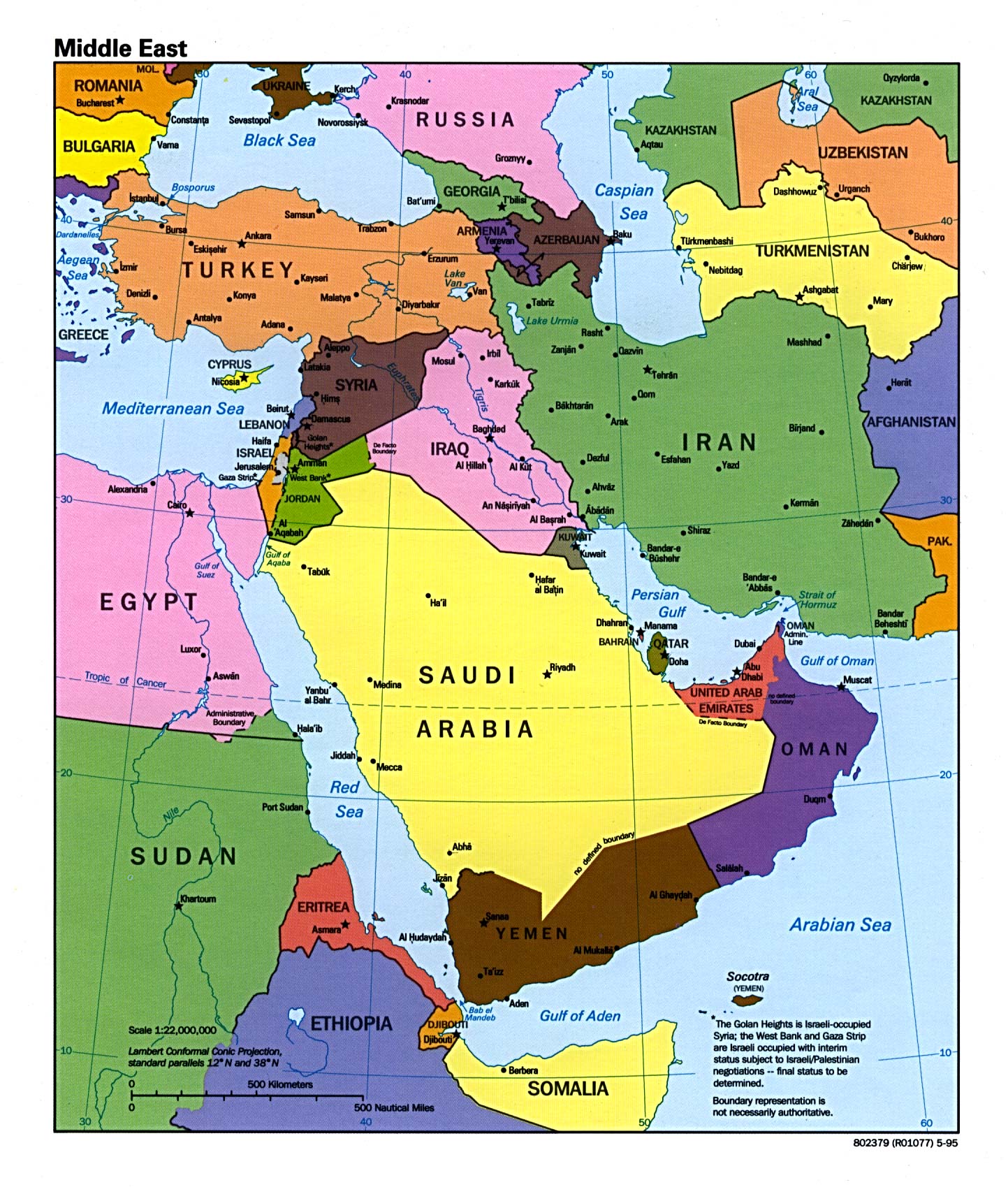
Middle East Map


(Note: This map is significant as we study  the “War of Gog and Magog”, based on the book of Ezekiel,  indicating the countries of present day Russia, Persia (present day Iran), Cush (present day Sudan), Gomer (present day Turkey), Beth Togarmah (present day countries where turkish-speaking people  spread out from Turkey and settled in  Causasus and the areas of Central Asia, and Put (present day Libya and Algeria –those countries are on a different map in the Maps in Light of Biblical Prophecy category).