The Deadliest Form of Fake News, and How to Identify Reliable Information

12.5.2023

No one likes to learn that there may be errors or falsehoods in their religions, traditions, churches, or personal beliefs. We should find ways to determine the accuracy of our research, use those that we trust, and seek to understand what religions teach or believe to accurately discuss or write concerning those subjects.

An article How to Identify Reliable Information, addresses this topic: 

https://www.stevenson.edu/online/about-us/news/how-to-identify-reliable-information/

 “Whether you are a journalist, researcher writer or someone in the professional fields, it is important to know how to identify real information and use it accurately. That is our real challenge in the 21st century – Lee E Krahenbuhl, Communication Studies Program Coordinator

With the infinite amount of information online, it can be difficult to decipher what is true and accurate and what is not. Once you know the trick to identifying reliable information, you can quickly determine if what you are reading is accurate or not.

What is reliable information?

Reliable information must come from dependable sources. According to UGA Libraries, a reliable source will provide a “thorough, well-reasoned theory, argument, based on strong evidence.”

 Widely credible sources include:

  • Scholarly, peer-reviewed articles and books
  • Trade or professional articles or books, magazine articles, books, and newspaper articles from well-established companies
  • Other sources like websites and blog posts can be dependable but require further evaluation.

You may be asking yourself, “what source is best for me?” Depending on the type of information you need, your sources may vary. Look at journal articles and research-based reports. This is because those types of sources typically include more information on the topic at hand.

How to identify reliable sources

What makes the source reliable?

To determine whether a source is reliable or not, you must look at certain criteria. That criteria are as follows:

Authority:

  • Who is the author?
  • What are their credentials?
  • Do they have knowledgeable experience in the field
  • What is their reputation?

Accuracy: Compare the author’s information to that which you already know is dependable.

  • Are there proper citations?
  • Is the information biased?
  • If so, does it affect research conclusions?

Coverage: Is the information relevant to your topic and does it meet your needs? Consider what you need such as statistics, charts, and graphs.

Currency: Is your topic constantly evolving? Topics in the news require sources that are up to date.

The importance of reliable information

The Internet is scattered with biased, misleading, and altogether incorrect information and that is why it is important to follow the above criteria. The importance of using reliable sources truly boils down to effective communication. If your knowledge is based on unreliable information, you will not be a trustworthy asset.

Credible communication is key in discussing a subject. That is why you should not just grab any information off the Internet. Using unreliable sources results in negative consequences.

Credibility is especially important because using unreliable data can cause questions that may undermine your reliability and may cause others to rely solely on their own opinions rather than factual data.

Using credible sources for information will increase your reputation and trustworthiness. An article by the Ivy Business Journal supports this idea by expressing that trust is a key factor in building loyalty, increasing credibility, and supporting effective communication. It is important to develop your skills in identifying reliable resources, because it will help you become an effective communicator, reader, and/or writer.

There’s a fork in the road.

If we choose the way of personally accepting Jesus (which is the decision to do everything through love, and as a result gives us a new heart-set), then we don’t ever have to go down the road of destruction that the other decision leads to.

Despite the clouds

Written by Blake Rackley)

(Forgive typos…Today has been long. Well, this year has been long.) So much is weighing heavy on the hearts of others. This week I listened to those who grieve the loss of identity, the loss of love, the loss of faith, and the loss of purpose. So many questions that have so few answers or at least answers that satisfy and calm their fears. They feel aimless and stuck. Maybe you feel similar. Maybe it is your job, the future, a relationship. You simply feel stuck by not knowing what decision is the “right” decision so you make no decision at all. Maybe you are nursing scars no one see. Maybe you are bleeding from wounds that do not bleed crimson and bandages do not help. The running theme of many who are experiencing this level of pain is that they do not want to burden another person with their “stuff”. Sadly, they suffer in silence and feel totally alone. Think for a moment. Have you ever seen a lone goose? A solitary, Canadian, turd dropping, Christmas goose flying all by their lonesome? My guess is that you haven’t. If you do, that is one lost goose. They are most always in a flock. They take turns with the burden of leading. They encourage by those obnoxious honks. They rest often. They have a destination, but it is often arrived at in the company of others. They will fly despite the clouds and gloom around them. They will fly at times in the rain, but they seek shelter together. They do not feel the need to do anything singularly. Why then do we believe we have to do anything by ourselves? We are called to bear one another’s burdens. So, I’m calling my brothers and sisters in Christ to help those around them. Sit with them. Eat with them. Shelter with them. Listen to their story. Encourage them with hope. But more than anything, fly with them through their clouds of depression, anxiety, abuse, loss, hopelessness, and failure. We all are more likely to fly on, fly farther, and fly with purpose when we have others behind us despite the dark clouds hanging over us. Quit saying, “If you need me, I’m always here.” They will almost never call you. If we want the world to know we love Jesus, we must intentionally bear the burdens of others by vulnerability and loving one another.

What Are the Characteristics of a Man of God in the 21st Century?

Emma Danzey| Contributing Writer202117 Aug

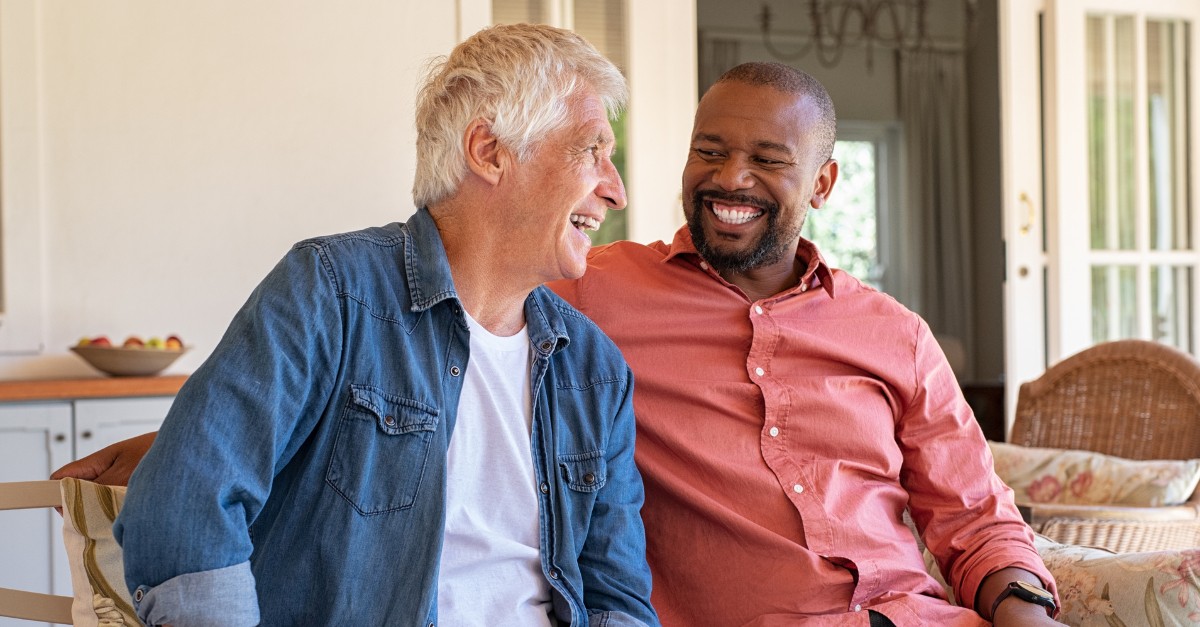
two men having a conversation smiling

I once had a profound moment with a boy in fourth grade. I gave some words of encouragement to young boys about how the Lord has a purpose for every man of God. I told them that they were special and had a unique calling to be men one day. Afterward, one young man came up and said thank you because he had two sisters and his mom who were always watching female-empowering shows and movies. He wanted to be encouraged too. Today we are going to study some of the main characteristics of a man of God.

What Is the Meaning of the Phrase ‘Man of God’?

1 Timothy 4:8 says, “For physical training is of some value, but godliness has value for all things, holding promise for both the present life and the life to come.”

When I think about men around me who have dedicated their lives to Christ, I think of humility, courage, and leadership. They may not always be the quarterbacks or the CEO types, but they are faithful to the Lord no matter what their personalities and giftings include. When I was praying for my husband, I prayed specifically that he would be a man of God. What I meant by this, was a man pursuing the Lord, who surrendered His life to Christ. I think of men who acknowledge that they are sinners, but still, choose to live by the Spirit and not by their flesh (Galatians 5:16).

The phrase, “A man of God” is used in the Bible 35 times. Aaron Brown from Crosswalk says, “Being a man of God is not something to be condemned but rather encouraged. For any boy becoming a man, or men trying to commit themselves more thoroughly to God, there is an answer to the question.” A man seeking to know Jesus more and living like Him more is a man of God. He is not a perfect man, but he is a godly one. A man of God admits he is not able to represent the Lord without the help of the Holy Spirit (Ephesians 5:18). He will be strong through Christ and seek Him each day (Psalm 105:3-4).

What Are Some Key Characteristics of Men of God?

There are some qualities of a Christian man that are the same in a Christian woman. Everyone who has Christ has the Holy Spirit and can live a godly life. So what are some specific characteristics in which men of God obtain?

Gentle

This might sound like an interesting trait to begin with, but it reminds me of the word gentleman. In the book “Gentle and Lowly” by Dane C. Ortlund, he describes that Jesus Himself describes his heart once in the Bible as “gentle and lowly” (Matthew 11:29). When someone thinks of a manly man by the world’s standards, he might imagine a physically tough guy who shows no weaknesses, gets angry, and has no fear. This is not an accurate depiction of biblical manhood. Gentleness is a character trait that does not come naturally but reveals the interworking of the Lord to enable men to be slow to anger and quick to listen. It leads to great patience and steadiness.

Courageous

One of the main qualities described when discussing a man of God is courage. Nelson Mandela once said, “Courage is not the absence of fear, but the triumph over it. The brave man is not he who does not feel afraid, but he who conquers that fear.” Men have fear, but God gives them the strength to walk in the midst of that fear and have victory through the Lord. Men many times are called upon to be brave. Bravery could look like anything from killing a spider to sharing about a struggle in a men’s group. It could be carrying a heavier load because of the gift of physical strength. Courage is even the great faith in the Lord it takes to lead a family and point them to Christ (Joshua 1:9).https://2132aa14c9f9630258fbcb5475bfd650.safeframe.googlesyndication.com/safeframe/1-0-38/html/container.html

Honest

Cole Douglas Claybourn from Crosswalk says, “Men have been trained and socialized to avoid and ignore knowing their insecurities, which is one of the reasons they are less verbal than women about their insecurities, Vierra said. ‘This results in less being known and understood about them.’” A man of God is not beyond sharing his thoughts and feelings. He pushes past the “macho man” mentality and can step into vulnerability (2 Corinthians 8:21).

Responsiblehttps://buy.tinypass.com/checkout/template/cacheableShow?aid=Zc94Zrydpu&templateId=OTL6FXNXQK9L&gaClientId=2123651049.1629036028&offerId=fakeOfferId&experienceId=EXVSSW54DJO4&iframeId=offer_6ba4738cdd78f6a3a14e-0&displayMode=inline&pianoIdUrl=https%3A%2F%2Fid.tinypass.com%2Fid%2F&widget=template

A man who follows the Lord takes responsibility. He pursues Christ and follows Him with boldness. He does not sit back as Adam did in the garden when Eve was sinning. He stands up for what is right and takes action. He is reliable and loyal. You can trust that he is who he claims to be to others (Colossians 3:23).

Who Are Examples of Men of God in the Bible?

Some specific men who were given this title of honor in Scripture include, Moses, David, Elijah, and Elisha.

Moses—Deuteronomy 33:1 “Now this is the blessing with which Moses the man of God blessed the sons of Israel before his death.”

David—Nehemiah 12:36 “and his kinsmen, Shemaiah, Azarel, Milalai, Gilalai, Maai, Nethanel, Judah and Hanani, with the musical instruments of David the man of God. And Ezra the scribe went before them.” 

Elijah—1 Kings 17:18 So she said to Elijah, What do I have to do with you, O man of God? You have come to me to bring my iniquity to remembrance and to put my son to death!”

Elisha—2 Kings 5:8 “It happened when Elisha the man of God heard that the king of Israel had torn his clothes, that he sent word to the king, saying, ‘Why have you torn your clothes? Now let him come to me, and he shall know that there is a prophet in Israel.’”

What Does a Man of God look like in the 21st Century?

Bible Study Tools shares it beautifully, “While the world tends to tell men to hide their emotions and act tough, God’s Word is filled with men who passionately and whole-heartedly sought God with their heart, mind, and soul! God has a special calling for men to be strong, courageous leaders, and His Scripture can provide the inspiration you need to take daily steps towards your calling.”

Men of God in the 21st century represent Christ. No matter what a man’s denomination is or culture, he represents biblical manhood when he models loving God and loving others. He is not boxed in by a world definition of a man having power and prestige. He is confident in his personal identity in Jesus. He knows who he is and walks daily with God. He is willing to admit his wrongs and has the strength to try again when he fails. He is unashamed to share his heart with others and to step up to the plate to be brave. This is not in his own power, but the strength of the Holy Spirit within him.

A man cannot force anyone to be a man of God, but he can model it and show others how to live for Christ. The men in my life do this so well in their own ways. We can pray and speak words of encouragement to the young boys and young men in our homes and communities. We can give the same motivation to the men as the women. We are all created in the image of the Lord. He made us male and female. Our Great Creator has perfect plans for how he made us and loves us. If you are a man or know a man, remember that men have a wonderful calling and a purpose on this earth. Let us celebrate the men of God in this world.

Who is in you!

You are of God, little children, and have overcome them, because He who is in you is greater than he who is in the world.
1 John 4:4

Remember this verse as we go into the next year!

May God bless all of you, as we embrace Him and each other.

Love embraced

Praying for all

who embrace love in every aspect,

daily.

Praying that we all

come back to the basics

of seeking God first

and loving each other!

Are we angry?

angry baby in green

If so, let’s figure out how we can deal with this together. Action will help us combat our initial reaction of anger.

1. We have to admit that we are angry.

2. Define our anger.

3. Ask ourselves the questions, “Is the anger harming us?” and “Is there something we can do about it?”

4. If there is something we can do about it, find resources to use so that we positively channel the anger rather than letting it drive us.

5. While addressing the issues, be sure to take care of ourselves first.

6. Balance our lives with: relaxation, fun, and/or anything that distracts us from the feelings of anger.

7. If the issues making us angry affect others, contact them, and then join with them to resolve those issues. Encourage and thank them for their efforts.

8. Never give up.

9. Keep going forward.

~ Sharon Rule

To one Jewish professor, Martin Luther King Jr. was a mensch

Rabbi Abraham Joshua Heschel marches with other civil rights leaders — from left, John Lewis, an unidentified nun, Ralph Abernathy, Martin Luther King Jr., Ralph Bunche, Heschel and Rev. Fred Shuttlesworth — from Selma to Montgomery, Alabama, on March 21, 1965. Credit: Courtesy of Susannah Heschel

January 16, 2017 · 10:00 PM EST
By Lidia Jean Kott

Susannah Heschel was just a child in the spring of 1965, when her father left for Selma, Alabama, to march with those demanding that everyone be allowed to vote regardless of their skin color.

“He kissed me goodbye,” says Heschel. “And I remember thinking ‘I don’t know if I’ll ever see him again.’”

Just a few weeks earlier, many demonstrators had been brutally attacked by police officers on a day known as Bloody Sunday.

Heschel’s father returned safely. But the experience left an impression.

“My father came home feeling like it was a religious event,” says Heschel. “He said, ‘I felt my legs were praying.’”

To Heschel, and her family, the religious aspect of the Civil Rights Movement is an important part of the story, even if it’s not talked about as much.

That’s because Heschel is a professor of Jewish Studies at Dartmouth College.

And her father, Abraham Joshua Heschel, was a rabbi.

Heschel’s father was born in Poland and lost several members of his family to the Holocaust. He was able to escape and come to the US, where he became an activist.

A calling, according to Heschel, with a lot of historical precedent.

“Jews came to the United States at the turn of the century from Russia, and there were Yiddish newspapers that would report in screaming headlines that there were Pogroms here in the United States. And what did they mean? Lynchings,” says Heschel. “Jews were outraged by that. How could that be? Russia is one thing but in the United States? So there is a long tradition of rabbi’s speaking out against segregation.’’

Heschel believes that, in part, the Civil Rights Movement became so powerful because everyone felt included, regardless of their religion.

“If you look at Dr. King’s major speeches, he doesn’t talk about Jesus, he doesn’t make this an exclusively Christian event,” says Heschel. “That openness, that embrace of Jews meant so much to my father.”

The night before he joined the march, Heschel’s father stayed in the same house as King and a few others. This house, which belonged to Sullivan and Richie Jean Sharrod Jackson, became an informal headquarters for activists.

Heschel later spoke to Richie Jean Sharrod Jackson about the night her father stayed there.

“Mrs. Jackson told me she got up in the morning and went into the living room, and there was Dr. King standing in one corner of the room saying his prayers, and my father was in another corner of the room saying his morning prayers, and there were a few others in the dining room praying,” says Heschel. “That to me is such a central concept of the Civil Rights Movement, coming together in that way, each one praying in their own faith tradition, in a different part of the house.”

Even as a kid, Heschel says that she felt herself to be surrounded by heroes. Heroes like her father, other friends and activisits, and King.

“He was always so gentle and kind and friendly to me,” says Heschel. “There were times at the end of lectures when I’m sure he was tired and just wanted to relax, and yet he was so generous and sweet.”

Now, says Heschel, she often goes back and listens to King’s speeches. Speeches that made her cry when she was younger.

She credits King with teaching her about “how to be a human being, how to be a mensch in the world,” and helping set her on her life’s path.

“I became a professor of religion because of him,” she says.

Note: “mensch” means “a person of integrity”.

We are the World! Happy New Year!

Praying for blessings to all of you around the world. May we all come together to find what is best in each of us. Love surely is better than hate. Working together, standing together, loving together will make the difference. If you are upset about something, find your voice. Go on Twitter, Facebook, start a Website, care and share positive ideas and progressive thinking instead of crying in a corner. We can all light the place where we stand and that light will shine enough to change things.

Be blessed with much love, joy, and happiness!

Sharon & Erick

We are the world!

There comes a time when we heed a certain call
When the world must come together as one
There are people dying
And its time to lend a hand to life
The greatest gift of all

We can’t go on pretending day by day
That someone, somehow will soon make a change
We are all a part of Gods great big family
And the truth, you know,
Love is all we need

We are the world, we are the children
We are the ones who make a brighter day
So lets start giving